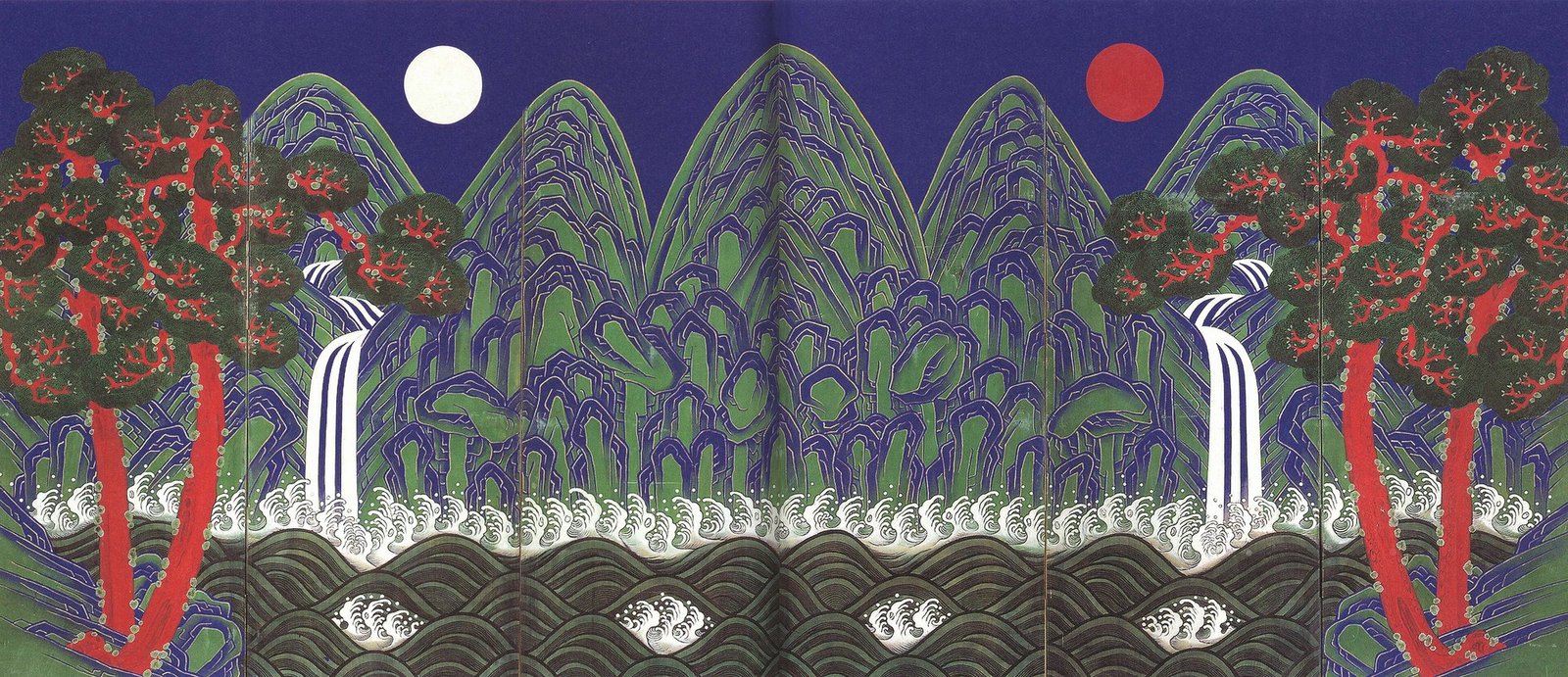
Irworobongdo (Sun, Moon and Five Peaks)
This screen only works when someone is sitting in front of it. The sun and moon are not the king and queen, as is often claimed — they are yang and yin, the two forces that hold the cosmos in balance. Confucian cosmology requires a third element between them: a human being. That was the king. With the throne empty, the composition is incomplete, and it was designed to be.
Quick Facts
- Korean name: 일월오봉도 (Irworobongdo), also Irwoloakdo
- Artists: unknown — court painters of the Dohwaseo
- Date: form fixed during the Joseon period; surviving examples mostly 18th–19th century
- Medium: mineral pigments on silk, multi-panel folding screen
- Format: usually five or six folding panels; the largest exceed four metres in width
- Period: Joseon dynasty (1392–1897)
- Where to see it: National Palace Museum of Korea and Gyeongbokgung Palace, Seoul
The painting that needs a person
This is the essential thing to understand about the work.
Irworobongdo was never a picture to be looked at. It stood permanently behind the throne, as its fixed backdrop. It was not hung on a wall, not shown to visitors, not admired for itself.
The sun and moon represent yang and yin — the opposing forces that keep the world in equilibrium. In Confucian cosmology a human being must stand between them for the system to be complete. That person was the king.
In other words, the screen did not depict the ruler or praise him. It made him part of the cosmos. When the throne was empty, the painting remained unresolved.
The principle was applied so consistently that the screen travelled with the king. It was set up in the throne hall, in provincial residences, at outdoor ceremonies. Wherever the monarch sat, Irworobongdo was placed behind him.
What makes it unforgettable?
There is no other example of court painting that served one function so consistently, for so long, with so little change in form.
That consistency was the point. Dohwaseo painters were not looking for individual expression — they reproduced the canon as faithfully as possible. Deviation would have been an error, not originality. As a result, surviving examples from different centuries look strikingly alike.
It is also worth noticing how stylised the image is. The mountains are solid masses, the waves are ornament, the pines are almost heraldic. This is not a landscape. It is a diagram of the world.
Historical context
The Joseon dynasty ruled Korea for over five hundred years and was Confucian to a radical degree. Hierarchy, ritual, and the precisely fixed meaning of symbols organised court life.
In such a system, the painting behind the throne could not be a matter of taste. It was an element of state ritual, as regulated as court dress or ceremonial protocol.
Court painting was produced by the Dohwaseo, the state bureau of painting. Painters were civil servants who sat examinations and worked to commission. Their job was to reproduce the canon, not to break it.
The dynasty ended formally in 1897, when Korea declared itself an empire, and finally in 1910 with Japanese annexation.
What to look for
Sun and moon. A red disc on the left, a white one on the right — both in the sky at once, which is impossible in nature. This is not a landscape at a particular hour. It is an image of time entire.
Five peaks. The number five recurs throughout Confucian cosmology: five directions, five elements, five virtues. The mountains are also read as the five sacred peaks of Korea, guarding the state from four sides and the centre.
Two waterfalls. Symmetrical, one on each side. Easy to overlook, and a constant feature of the canon.
Four pines. Two on each side, red-trunked. They signify longevity and endurance — the tree that does not shed its needles in winter.
The waves. At the foot of the mountains, rhythmic and geometricised. They represent the eternal cycle rather than any particular sea.
Absolute symmetry. The composition mirrors along a vertical axis. That axis passed exactly through the throne.
Who painted them
The painters are anonymous, and not by accident.
Dohwaseo artists were mid-ranking officials, not artists in the Western sense. They trained for years, mastered mineral pigment technique, and learned the canon by heart.
Their names were rarely recorded alongside individual works. Correctness of execution mattered; authorship did not.
It is worth adding that the same painters produced royal portraits (eojin), documentary records of court ceremonies, and maps. They were the visual apparatus of the state.
How many versions exist
Several dozen survive, in a range of formats.
The largest and best known stands in the Geunjeongjeon throne hall at Gyeongbokgung Palace in Seoul — in the place where it performed its function. Others are held by the National Palace Museum and at Changdeokgung Palace.
Smaller versions also existed: portable travelling screens, and even small panels placed beside the royal bed. The format adapted to circumstance; the canon did not.
A detail worth knowing if you visit Korea: the same motif appears on the reverse of the 10,000-won banknote, behind the portrait of King Sejong. You have probably held it without knowing what you were looking at.
Legacy and influence
Irworobongdo outlived the dynasty and became one of the clearest emblems of Korean identity.
The motif appears in Korean design, fashion, graphics and the set dressing of historical dramas. Contemporary artists cite it, usually as a comment on power and tradition.
It is worth adding that screens of this type are sometimes reconstructions. The example in the Gyeongbokgung throne hall was recreated after the damage the palace suffered during the Japanese occupation and the Korean War.
Where to see it today
The best place is Gyeongbokgung Palace in Seoul. In the Geunjeongjeon throne hall the screen stands in its proper position, behind the throne — exactly as it functioned for centuries.
- You cannot enter the throne hall. It is viewed from the front, through the open doors. Worth knowing in advance.
- The National Palace Museum is on the same site and displays further examples alongside court objects.
- Check opening hours and closed days before you go — the palace and the museum close on different days.
- The complex is large. Allow at least half a day for the palace and museum together.
- A few metro stops away is the National Museum of Korea, which holds one of the largest collections of Asian art in the world.
Frequently asked questions
What does the name mean?
Literally, “painting of sun, moon and five peaks.” Il is sun, wol moon, obong five peaks, do painting.
Do the sun and moon represent the king and queen?
No. This is a common but mistaken reading. They represent yang and yin, the forces of the cosmos. The king was neither of them — he was the third element that completed the arrangement by sitting in front of the screen.
Why did it always stand behind the throne?
Because that is the only place it worked. The screen incorporated the ruler into the cosmic order; without a person seated in front of it, the composition remained incomplete.
Is there a single original?
No. Several dozen examples survive in various formats and from various periods. All reproduce the same canon closely — repeatability was the objective, not a constraint.
Who made them?
Painters of the Dohwaseo, the Joseon state painting bureau. They were officials rather than artists in the modern sense, and their names were not usually attached to individual works.
Where else can I see the motif?
On the reverse of the Korean 10,000-won banknote, behind the portrait of King Sejong.
If Irworobongdo has caught your interest, look next at the moon jar — white porcelain from the same dynasty and its exact opposite: entirely asymmetrical, undecorated, and carrying no message at all.
Image: Irworobongdo – Joseon court painter, 18th–19th century. License: Public Domain. Source: Wikimedia Commons.