Girl with a Pearl Earring
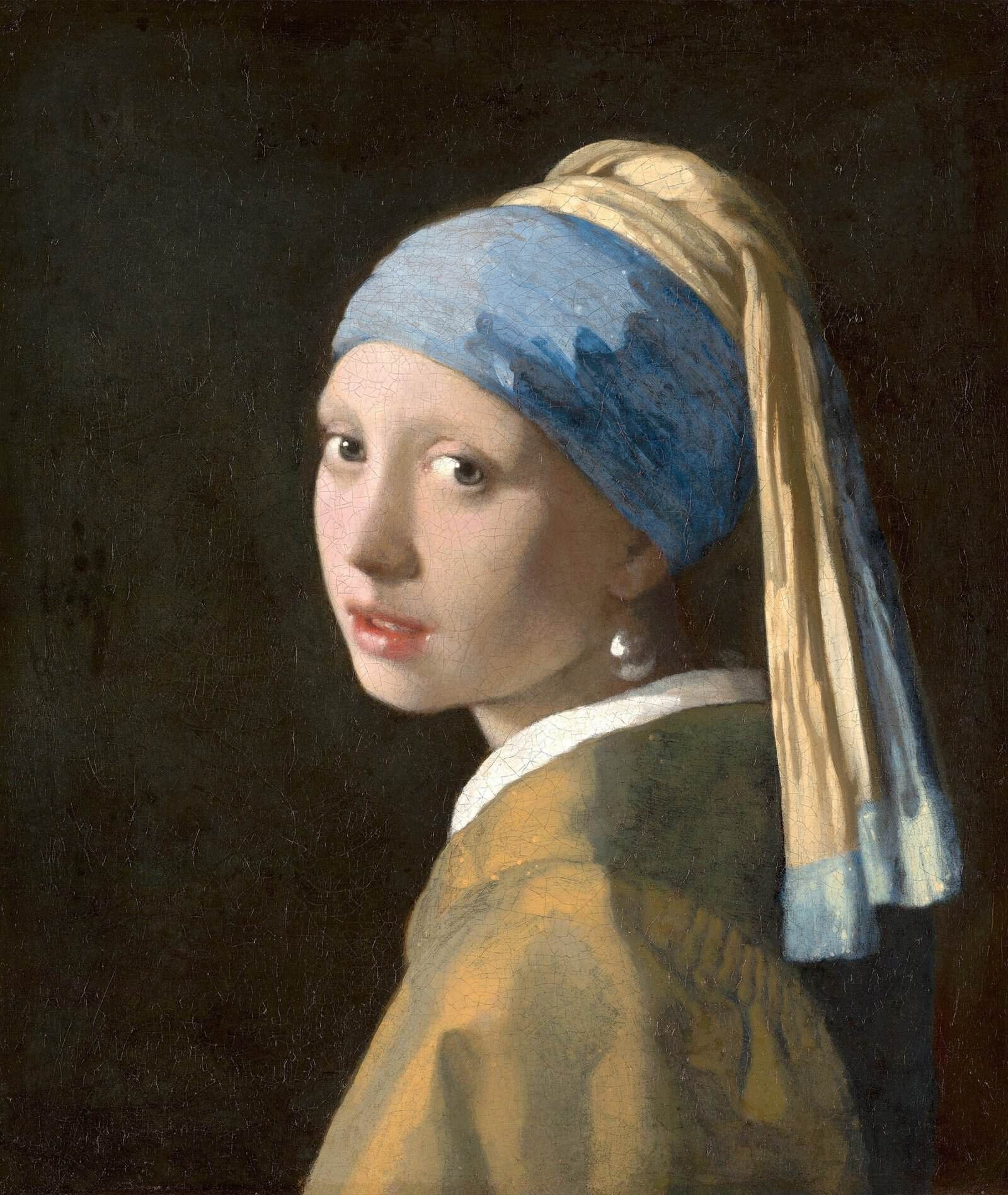
She’s turning toward you — but she never quite arrives. The Girl with a Pearl Earring has captivated viewers for over three and a half centuries, yet Vermeer never signed it with a title, never told us her name, and may never have intended her to be a portrait at all.
Quick Facts
- Artist: Johannes Vermeer
- Year: c. 1665
- Medium: Oil on canvas
- Dimensions: 44.5 cm × 39 cm (17.5 in × 15.4 in)
- Movement: Dutch Golden Age
- Current location: Mauritshuis, The Hague, Netherlands
What Makes Girl with a Pearl Earring So Unforgettable?
Most famous paintings demand your attention through scale, drama, or sheer visual complexity. The Girl with a Pearl Earring does the opposite. She is small. The background is nearly black. There is almost nothing here — and yet you cannot look away.
What Vermeer achieved was something closer to a feeling than a painting. Art historians often describe this work as a tronie — a Dutch term for a character study rather than a formal commissioned portrait. That distinction matters enormously. Vermeer wasn’t trying to document a real person for posterity. He was chasing an emotional effect: the electricity of a moment caught just before it passes.
That half-open mouth. The over-the-shoulder glance. The single luminous earring catching light against shadow. Every element in the composition is engineered to create intimacy — the sense that she has just noticed you, and you her, and something is about to be said that never will be.
Historical Context
By 1665, the Dutch Republic was riding an extraordinary wave. Amsterdam had become one of the wealthiest cities on earth, fueled by global trade through the Dutch East India Company. Prosperity trickled down into the arts — wealthy merchants became passionate art collectors, and painters competed fiercely for their patronage.
This was the Dutch Golden Age in full bloom: Rembrandt van Rijn was in his late career, Frans Hals had already reshaped portraiture, and a younger generation of artists was pushing genre painting — scenes of everyday domestic life — to breathtaking levels of refinement. Vermeer was working in Delft, a smaller city overshadowed by Amsterdam and Haarlem, yet producing work of remarkable quiet power.
The 1660s also brought political tension. The First and Second Anglo-Dutch Wars had strained the republic’s resources. But cultural production didn’t slow — if anything, uncertainty sharpened the appetite for beauty. Vermeer’s patrons wanted images that were intimate, technically stunning, and emotionally resonant. The Girl with a Pearl Earring delivered all three.
The exotic pearl itself — or what many now believe may be a glass or tin earring imitating pearl — carried real cultural weight. Pearls were status symbols tied to maritime trade routes that defined the Dutch economy. Wearing one, or painting one, was a quiet nod to the world the Dutch had built.
Symbolism and What to Look For
Stand in front of this painting — or study a high-resolution reproduction — and resist the urge to go straight to the earring. Start with the background. It is not simply dark; it is a layered, almost velvety black that Vermeer achieved through careful glazing. That darkness is a compositional choice that forces every ounce of your attention onto her face.
That blackness, however, is not what Vermeer painted. A 2018 technical study at the Mauritshuis found a green curtain beneath the surface, with visible folds — its pigments degraded to near-black over three centuries. It is one of several recent findings that changed what we thought we knew about familiar paintings. See the full list.
Now look at the light. It falls from the upper left, washing across her forehead, the bridge of her nose, her lips — and then catching that single earring like a small star. This is Vermeer’s signature: light that feels less like sunlight and more like revelation.
Notice the headwrap. It’s two-toned — a vivid blue on top, an ochre-yellow tail falling behind — and it is not Dutch in origin. Scholars have debated whether it represents an exotic, imaginary costume or a deliberate signal that this is a fictional character rather than a real woman. The ambiguity is intentional. Vermeer is constructing a mood, not a biography.
Then, finally, the earring. It sits below and slightly behind her jaw, catching the light in a teardrop shape. Technical analysis has suggested it may not be a real pearl at all, but a glass drop. Whether precious or imitation, its gleam is the painting’s visual anchor — the detail your eye returns to again and again.
About Johannes Vermeer
Johannes Vermeer was born in Delft in 1632 and spent virtually his entire life there, dying in 1675 at just 43 years old. He left behind fewer than 40 confirmed paintings — a tiny output that reflects both his painstaking technique and, possibly, the demands of a large family and a side career as an art dealer.
He was a master of light — specifically, the way natural light enters a room and falls across fabric, skin, and objects with quiet, transformative power. Many researchers believe he used a camera obscura, an optical device that projects an image onto a surface, to achieve his extraordinary precision. Whether that diminishes his genius is debated hotly; what’s beyond debate is that no one else of his era achieved quite what he did.
Vermeer died in debt, leaving his wife and eleven children in financial difficulty. Within decades, his work was largely forgotten. It wasn’t until the mid-19th century that French art critic Théophile Thoré-Bürger began systematically attributing works to Vermeer and restoring his reputation. Today, he is considered one of the greatest painters in Western history.
Legacy and Influence
The Girl with a Pearl Earring spent centuries in relative obscurity. It entered the Mauritshuis collection in 1902 after being acquired at auction for just two guilders and thirty cents — a price that now reads as one of the great bargains in art history.
Public fascination accelerated dramatically in 1999 when Tracy Chevalier published her bestselling novel of the same name, imagining the girl as a fictional servant named Griet. Peter Webber’s 2003 film adaptation, starring Scarlett Johansson and Colin Firth, brought the painting to a global audience of millions who had never set foot in a Dutch museum.
The painting has since become a touchstone of popular culture — referenced in fashion, advertising, music videos, and endless parody. Its influence on photography is equally profound: the over-the-shoulder glance against a dark background has become one of the most imitated compositions in portrait photography worldwide.
Where to See Girl with a Pearl Earring Today
The painting lives permanently at the Mauritshuis in The Hague, Netherlands — a compact, beautifully curated museum housed in a 17th-century former royal residence. The Mauritshuis is small enough to visit comfortably in two to three hours, which makes it one of the most rewarding museum experiences in Europe.
Book tickets online in advance, particularly in summer months, to avoid queues. The painting is displayed on the upper floor, and the room is rarely empty — arrive early in the morning for the best chance of a quieter moment with her.
While you’re there, don’t miss Rembrandt’s The Anatomy Lesson of Dr. Nicolaes Tulp (1632) and Jan Steen’s wonderfully chaotic domestic scenes. The Mauritshuis also holds several other Vermeers, including View of Delft — widely considered one of the finest landscape paintings of the 17th century.
The Hague itself is easily reached by train from Amsterdam (about 50 minutes) or Rotterdam (about 25 minutes), making a day trip entirely feasible.
Frequently Asked Questions
Where is Girl with a Pearl Earring located?
The painting is housed at the Mauritshuis museum in The Hague, Netherlands, where it has been part of the permanent collection since 1902.
When was Girl with a Pearl Earring created?
Vermeer painted it around 1665, during the height of the Dutch Golden Age, when he was approximately 33 years old and at the peak of his artistic powers.
What does Girl with a Pearl Earring represent?
Rather than representing a specific person or allegorical concept, the painting is believed to be a tronie — a Dutch character study exploring mood, light, and emotional atmosphere. It represents the beauty of a fleeting, intimate human moment.
Why is Girl with a Pearl Earring so famous?
Its fame comes from a combination of extraordinary technical mastery, emotional immediacy, and enduring mystery. The unknown identity of the subject, the perfect simplicity of the composition, and its popularization through novels and film have made it one of the most recognized paintings on earth.
Is the earring actually a real pearl?
Probably not. Technical analysis of the painting suggests the earring may represent glass or another material imitating the look of a pearl, rather than an actual pearl. The precise rendering of its luminous gleam is part of what makes it so visually compelling regardless of the material it depicts.
Fascinated by the mysteries of Dutch Golden Age painting? Explore our related posts on Vermeer’s View of Delft, Rembrandt’s self-portraits, and the remarkable world of 17th-century Dutch art — there’s always another masterpiece waiting to surprise you.
Image: Girl with a Pearl Earring – Johannes Vermeer (1665). License: Public Domain. Source: Wikimedia Commons.