The Hay Wain
England did not want this painting. Shown at the Royal Academy in 1821, it failed to find a buyer and sat in the studio for three years. It took the Paris Salon of 1824 to change that — a gold medal from Charles X, and a generation of French painters who took what they saw and built on it. Constable never went to France. Recognition at home came after his death.
Quick Facts
- Artist: John Constable (1776–1837)
- Year: 1821
- Original title: Landscape: Noon
- Medium: Oil on canvas
- Dimensions: 130.2 × 185.4 cm
- Movement: Romanticism
- Location: National Gallery, London (bequeathed by Henry Vaughan, 1886)
What makes it unforgettable?
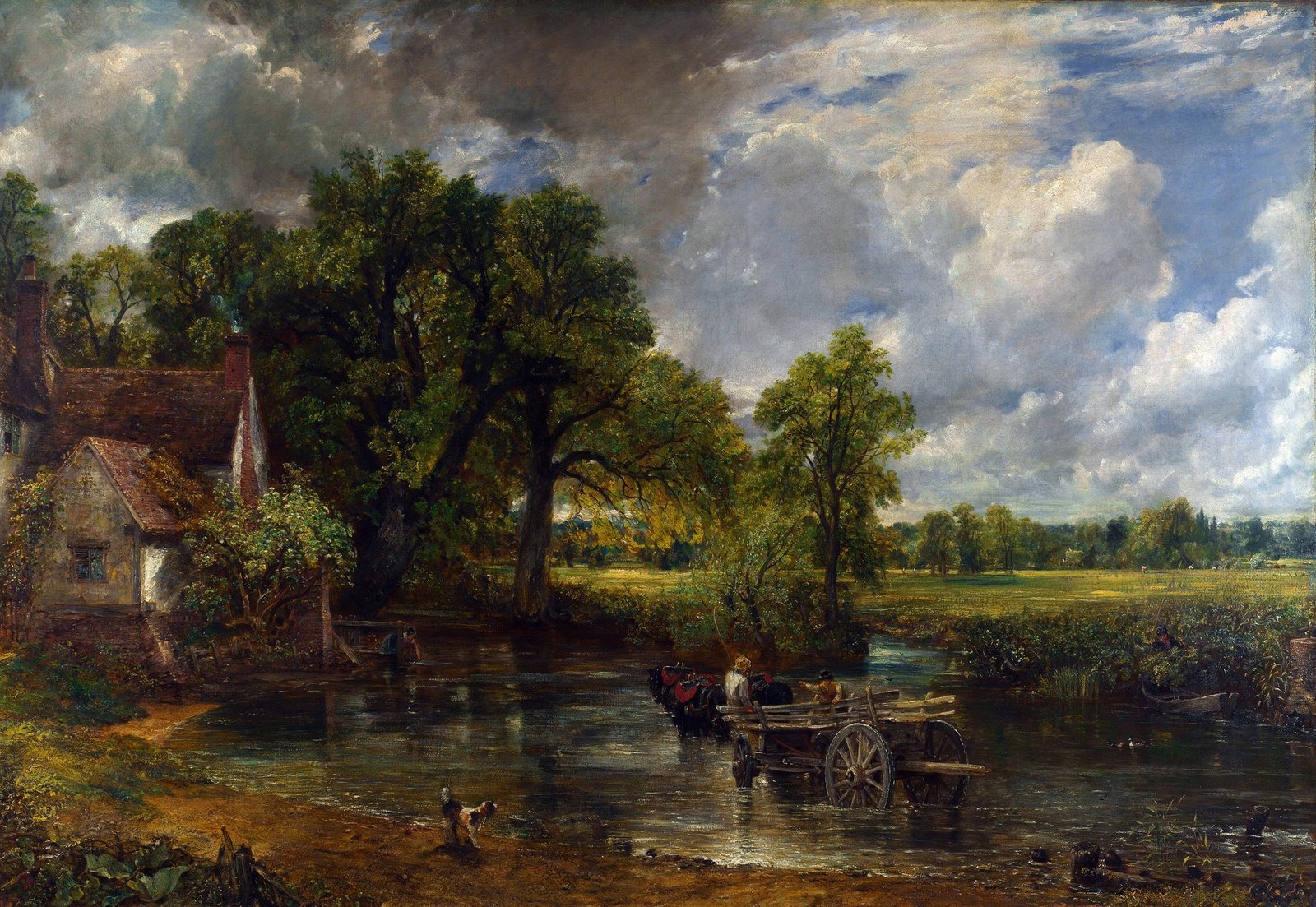
A cart stands in a shallow ford. A dog watches from the bank. Nothing happens.
That was the provocation. A canvas nearly two metres wide was, in the hierarchy of genres, reserved for history and religious painting. Constable used one to paint two horses standing in water.
He was painting a place he had known since childhood. The River Stour, Flatford, Suffolk — his father owned the mill a few hundred metres upstream. He wrote that the sound of water escaping mill dams, willows, old rotten planks and brickwork had made him a painter, and that he was grateful for it.
The six-footers
This is worth knowing, because it explains his method better than the finished painting does.
Constable called his large canvases six-footers, after their width. For each one he made a series of small outdoor studies and then a full-size oil sketch, the same dimensions as the final work.
That was unusual. Sketches are normally small. Constable needed the whole surface to work out composition and light before committing to the exhibition version.
The full-size sketch for this painting survives, at the Victoria and Albert Museum in London. It is looser, more violent, painted fast and wide. Many viewers now find it the more interesting of the two — an observation that says something about where painting was heading over the next century.
Historical context
By 1821 Britain was deep in industrialisation. Cities were growing, rural populations were falling, and agricultural poverty was building towards the Swing Riots of 1830.
Constable was not painting a protest, though, and he was not painting a fantasy. He documented with something close to scientific precision. He studied clouds obsessively, dating his sky studies and noting the time of day, wind direction and weather on the back. He knew the work of Luke Howard, who had devised the cloud classification still in use.
At the Royal Academy in 1821 the painting found no buyer. Constable kept it.
In 1824 the dealer John Arrowsmith bought it and sent it to the Paris Salon. There it caused a sensation and won a gold medal from Charles X. Delacroix saw it and, according to accounts, reworked the background of his Massacre at Chios in response.
Constable was sour about it. He wrote that the French admired him more than his own countrymen did.
What to look for
The sky. More than half the canvas. Constable called it the chief organ of sentiment in a landscape and held that a picture without a convincing sky does not work.
The white highlights. Flecks of pure white applied with a palette knife on the water, the leaves and the harness. Contemporaries called it, dismissively, “Constable’s snow.” It is his signature and the main reason English critics thought these paintings unfinished.
The dog. On the bank, left. Small, but structurally essential — it leads the eye straight to the cart. Remove it and the composition falls into two halves.
The cottage. Willy Lott’s Cottage, which still stands. Lott was a neighbour of the Constables and is said to have lived there for more than eighty years, barely leaving.
The figure that isn’t there. The full-size sketch has a horse and rider on the towpath at that spot. Constable painted them out. X-ray examination has confirmed it, and the trace is visible beneath the surface.
The people in the distance. In the meadow at right, barely indicated, figures are working at the hay. That is where the cart is going — which is where the English title comes from, even though the wain itself is empty.
About John Constable
Born in 1776 in East Bergholt, Suffolk, the son of a prosperous mill owner. He could have taken over the family business; he chose painting instead.
He married Maria Bicknell in 1816 after seven years of obstruction — her family considered a painter beneath her. She died of tuberculosis in 1828, leaving seven children. Constable wore black for the rest of his life, and his late paintings are visibly darker.
He was not elected a full Royal Academician until 1829, aged fifty-two. He sold around twenty paintings in England during his lifetime. He never visited France, where he was admired.
He died in 1837. Recognition at home arrived posthumously.
Legacy and influence
The Paris success had consequences. The Barbizon School — Théodore Rousseau, Jean-François Millet, Camille Corot — cited Constable directly. From Barbizon the line runs straight to Impressionism.
The painting stayed in private hands for sixty-five years. It entered the National Gallery in 1886 as a bequest from Henry Vaughan, a collector who also gave works by Turner and Blake to British institutions.
In Britain it has become something close to a national self-portrait. It appears on biscuit tins, tea towels and school textbooks, and regularly places near the top of polls of favourite paintings.
In July 2022 that popularity was put to use. Two Just Stop Oil activists glued their own reworked version of the scene — complete with an asphalt road, aircraft and farm machinery — over the painting in the National Gallery, then glued their hands to the frame. The paint surface was undamaged; minor damage was limited to the frame and varnish. The choice was not random: they targeted the painting the English treat as an image of their own country.
Three months later the same group threw soup at Van Gogh’s Sunflowers in the same museum.
Where to see it today
The Hay Wain hangs in the National Gallery on Trafalgar Square. Entry to the permanent collection is free.
- Room numbering changed following the rehang completed in 2025 — use the gallery plan on site or the museum app.
- Weekday mornings are quietest.
- Get close, then step back. From half a metre the white highlights look like random specks. From five metres they become light on water.
- Turner hangs in the same gallery. Setting Constable against Turner — two painters of the same generation heading in opposite directions — is one of the better things this museum offers.
- The full-size sketch is at the Victoria and Albert Museum, twenty minutes away by tube. Worth seeing both on the same day.
Flatford in Suffolk is about 120 km northeast of London. Willy Lott’s Cottage and the meadows along the Stour belong to the National Trust, and the view from the ford is close to identical. Flatford Mill, the Constable family business, stands a few hundred metres away.
Frequently asked questions
Why is it called a hay wain if the cart is empty?
A wain is an archaic word for a hay cart — the name describes the type of vehicle, not its load. The cart is empty because it is on its way to collect hay; figures are working in the meadow behind. Constable exhibited the painting as Landscape: Noon; the popular title came later.
Does Willy Lott’s Cottage still exist?
Yes, at Flatford in Suffolk, owned by the National Trust. Lott was a neighbour of the Constable family.
Why did it succeed in France rather than England?
English critics thought the technique unfinished, particularly the white palette-knife highlights. The French saw the same thing as freedom. The 1824 Salon brought a gold medal and influenced Delacroix and, later, the Barbizon painters.
Is there a study for this painting?
Yes — a full-size oil sketch at the Victoria and Albert Museum. Constable made one for every large canvas. It was his standard working method.
How did it enter the National Gallery?
As a gift. The painting remained in private ownership for decades; the collector Henry Vaughan bequeathed it to the nation in 1886.
Has the painting been damaged?
In July 2022 Just Stop Oil activists glued a reworked version of the image over it and attached their hands to the frame. The paint layer was unharmed; damage was confined to the frame and varnish.
If The Hay Wain has caught your interest, look next at The Fighting Temeraire and Rain, Steam and Speed by Turner — same period, same museum, and an entirely different way of looking at the same English sky.
Image: The Hay Wain – John Constable (1821). License: Public Domain. Source: Wikimedia Commons.