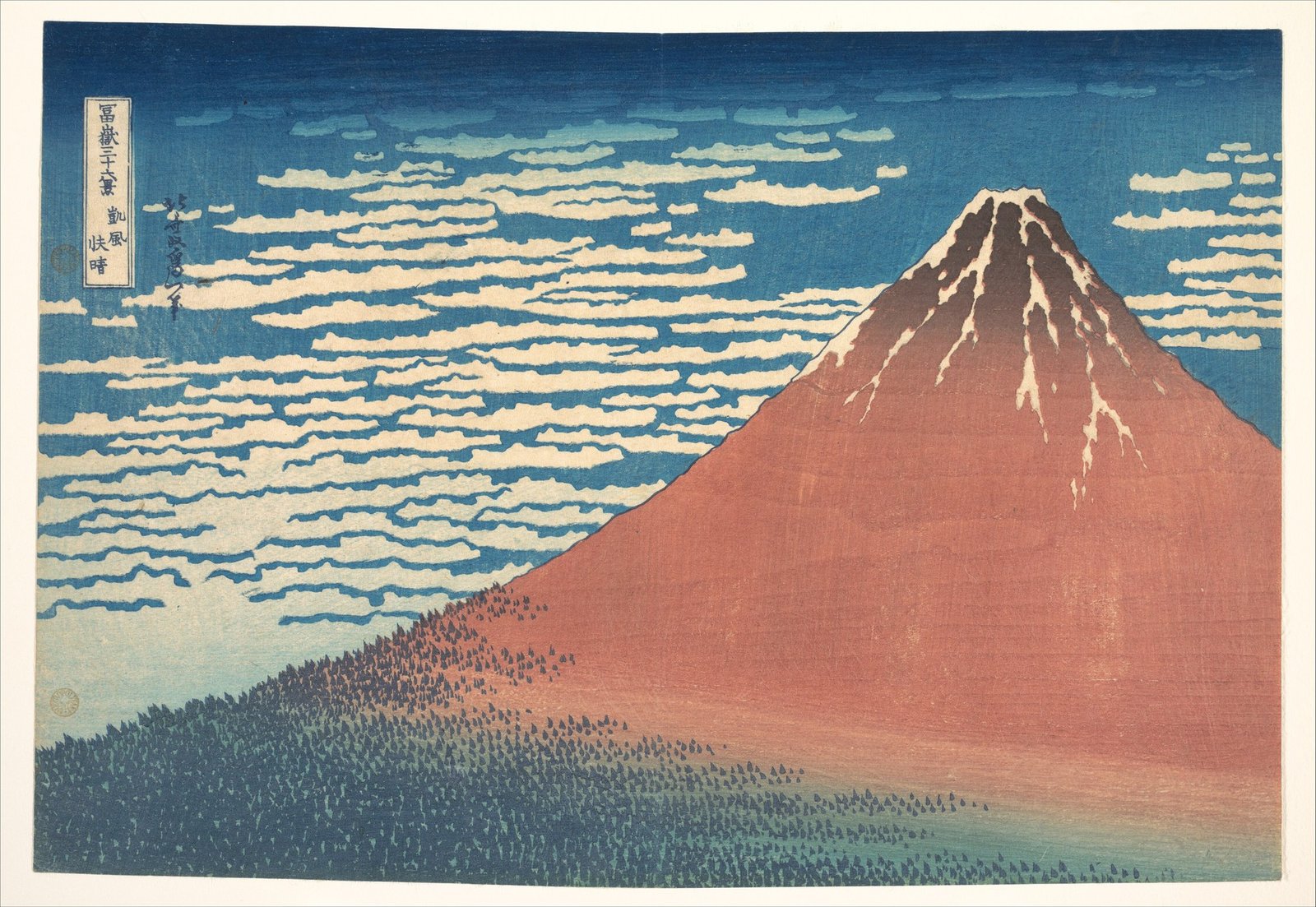
Fine Wind, Clear Morning (Red Fuji)
This is not a painting. It is a print — one of hundreds pulled from the same set of carved cherry-wood blocks and sold in Edo for about the price of a bowl of noodles. Impressions survive in New York, London, Chicago, Tokyo. None of them is the original in the sense we mean with a painting, and no two of them look quite the same.
Quick Facts
- Artist: Katsushika Hokusai (1760–1849)
- Japanese title: Gaifū kaisei (凱風快晴)
- Date: c. 1830–1832
- Medium: Nishiki-e polychrome woodblock print
- Dimensions: c. 25.7 × 38 cm (ōban format, horizontal)
- Series: Thirty-Six Views of Mount Fuji
- Movement: Ukiyo-e
- Where to find it: impressions at the Metropolitan Museum, the British Museum, the Art Institute of Chicago, and elsewhere
Why this is not a “painting”
It is worth starting here, because it changes everything.
A ukiyo-e print was made by four people. The publisher commissioned the series and carried the cost. The artist drew the design in ink on thin paper. The block cutter pasted that drawing onto a cherry-wood block and carved through it — destroying the original drawing in the process. The printer prepared a separate block for each colour and pulled them in sequence, by hand, onto damp paper.
Hokusai drew the design. He did not touch the rest.
First editions ran into the hundreds, and popular designs were reprinted for years until the blocks wore down. Later impressions are noticeably weaker: lines thicken, gradations flatten, colours lose precision.
So the question with this work is never “where is the original.” It is “which impression.”
Two versions of the same mountain
This is the most interesting fact about the print, and most accounts skip it.
Early impressions have a darker, more brick-coloured slope and a distinct gradation in the sky. In the earliest examples the forest at the base is finely drawn and the clouds are crisp.
Later printings came out lighter and more uniformly red. It is those that shaped the popular idea of “Red Fuji.”
There is also a companion piece in the same series — Sanka hakuu, “Storm Below the Summit,” often called Black Fuji. Same mountain, same angle, but in dark storm colours with lightning at the base. Hokusai printed the same shape in two kinds of weather.
What makes it unforgettable?
Most landscapes tell you something. This one says nothing. No people, no incident, no narrative. Mountain, sky, forest.
The composition rests on a single idea: the diagonal of the slope cuts the frame from bottom left to top right, and everything else exists to support that line. There is no vanishing point, no modelling shadow. Depth is built entirely from graded colour.
That reduction — flat fields of colour, a strong diagonal, no contour in the coloured areas — was a revelation to European painters at the end of the nineteenth century.
Historical context
Edo-period Japan was closed to the outside world, but its cities had a lively commercial culture. Prints were cheap and widely circulated — the nearest equivalent to a poster.
The series was published by Nishimura Yohachi around 1830–1832. It sold well enough that ten extra designs were added, which is why “Thirty-Six Views” actually contains forty-six.
Mount Fuji was not an arbitrary subject. Fuji-kō confraternities organised pilgrimages to the summit, and the mountain was believed to hold the secret of immortality. The series met an existing market.
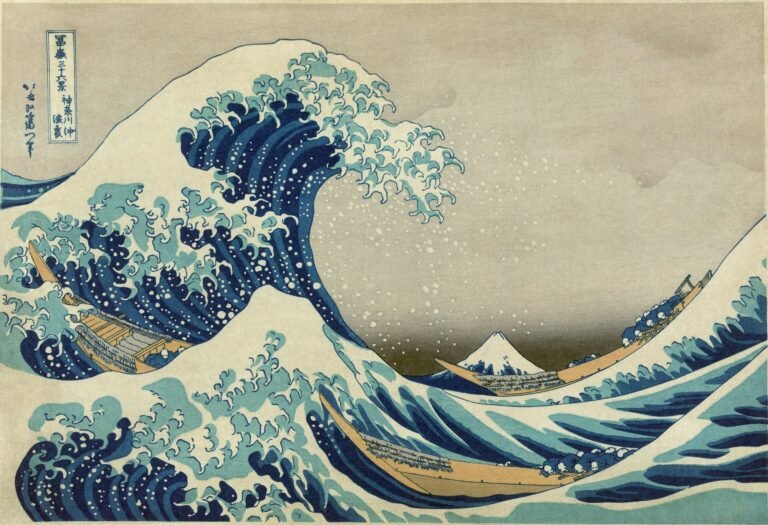
Technology mattered just as much. Around 1829 cheap imported Prussian blue reached Japan — the first modern synthetic pigment. It was more stable and more intense than the plant-based blues Japanese printers had been using, which faded. Hokusai built the entire series on it. Without that import there is no sky like this, and no Great Wave either.
What to look for
The colour of the mountain. The phenomenon is real. In late summer and early autumn, when the snow has gone and the sky is clear, the rising sun turns Fuji’s bare volcanic slope red. The Japanese call it aka-Fuji and consider it auspicious. It lasts a matter of minutes.
The snow at the summit. The remaining snow runs down in branching streaks. That is not ornament — it is how a melting snowpack behaves in the gullies.
The sky. It moves from saturated blue at the top to a pale band at the horizon. The effect, called bokashi, was produced by hand: the printer wiped pigment off the block with a damp cloth before each pull. Every impression is therefore different in this respect.
The clouds. A row of small scalloped forms across the upper area. The only movement in the image, and the only indication of scale.
The forest. A dark green band built from thousands of tiny dots. This is where the difference between an early and a late impression shows most clearly — in later printings the detail merges into a mass.
What is missing. No people at all. In a series where someone is almost always fishing, working or walking, that is the exception.
About Katsushika Hokusai
Hokusai was born in Edo in 1760. He changed his art name more than thirty times and reportedly moved house ninety-three times — according to one anecdote, because he preferred moving to cleaning.
He began the Fuji series in his seventies. By then he had been through bankruptcy, a stroke, and a grandson who gambled away his money.
In the postscript to one of his books he wrote that nothing he produced before the age of fifty was of any value; that at seventy-three he had begun to grasp the structure of animals and plants; and that if he lived to a hundred and ten, every dot and line would be alive.
He died in 1849, aged eighty-eight. His reported last words were that with another five years he might have become a real painter.
He left around thirty thousand works.
Legacy and influence
Japanese prints reached Europe after Japan opened in the 1850s and set off the craze known as Japonisme.
Van Gogh collected them and copied them in oil. Monet owned more than two hundred Japanese prints at Giverny, where they still hang. Degas took the cropped, off-centre framing; Toulouse-Lautrec took the flat colour into poster design.
One thing is worth keeping in proportion. Europeans saw these prints as exotic minimalism. To an Edo buyer they were a commercial product, bought roughly the way one buys a postcard. That gap is part of the history of Japonisme.
Today Red Fuji turns up on tote bags, tattoos and phone cases — less often than the Great Wave, but often enough.
Where to see it
Because these are impressions, they are scattered. Major holdings are at the Metropolitan Museum in New York, the British Museum, the Art Institute of Chicago and the Museum of Fine Arts in Boston. In Japan, the Sumida Hokusai Museum in Tokyo.
- Check whether it is actually on display. Works on paper are shown in rotation, usually for a few weeks every few years. This is the commonest cause of disappointment.
- The Met and the British Museum both offer free high-resolution scans online. For a print this is a reasonable substitute — you can see detail that is invisible through glass.
- At the Met, pay-what-you-wish admission applies to New York State residents and to students from New Jersey and Connecticut; everyone else pays a fixed rate.
- If you ever see two impressions side by side, compare the skies. The bokashi differences are immediately visible.
Frequently asked questions
What does Gaifū kaisei mean?
Gaifū is a gentle south wind, the kind that blows in summer; kaisei means clear, cloudless weather. English titles vary — “Fine Wind, Clear Morning” and “South Wind, Clear Sky” are both in use — but the phrase refers to wind direction rather than good fortune.
Why is the mountain red?
Because it genuinely can be. The aka-Fuji effect occurs in late summer and early autumn, when the snow has melted and early sunlight strikes the bare volcanic slope. It lasts only minutes and is regarded in Japan as a good omen.
Where is the original?
There isn’t one. This is a woodblock print, pulled in hundreds of impressions from the same blocks. Impressions are held in museums worldwide and differ from one another — earlier ones are darker and sharper, later ones lighter.
Did Hokusai make the print himself?
He made the design. A block cutter carved the blocks, a printer pulled the impressions, and a publisher financed and directed the whole thing. Ukiyo-e was collaborative work in which the artist’s name stood for the result.
How does it relate to the Great Wave?
Both come from the same series. The Wave is motion, drama and threat; Red Fuji is stillness. On one the mountain is tiny in the distance; on the other it fills the frame.
What did a print like this cost?
About the same as a bowl of soba noodles — a handful of coins. It was a mass-market product, not a collector’s item. Early impressions now sell at auction for hundreds of thousands of dollars.
If Red Fuji has caught your interest, look next at The Great Wave off Kanagawa from the same series — the other side of the same mountain, and the same experiment with Prussian blue.
Image: Gaifū kaisei (Red Fuji) – Katsushika Hokusai, c. 1830–1832, from the series Thirty-Six Views of Mount Fuji. License: Public Domain. Source: Wikimedia Commons.