The Great Wave off Kanagawa: History, Interpretation and the Artist
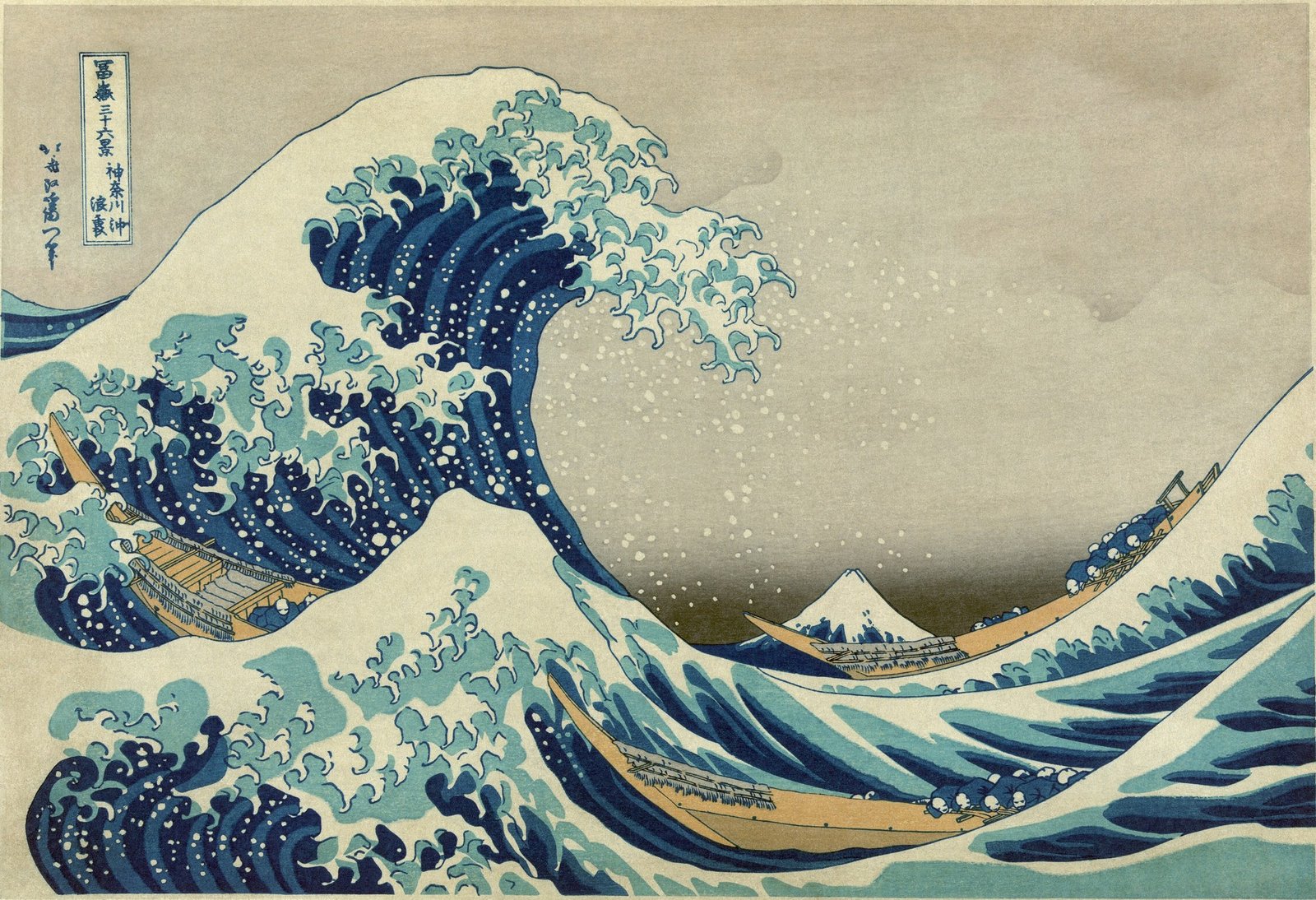
Start with the correction, because almost every article gets it wrong: the wave is not a tsunami. It is a wind-driven wave, the kind that builds in open water during a storm. A 2009 study in the Royal Society’s Notes and Records worked through the fluid dynamics and concluded that Hokusai drew a plunging breaker – a storm wave of perhaps ten metres, roughly three kilometres offshore, large enough for the authors to file it under rogue waves. The internet keeps forgetting. Once you know it, the whole image reads differently – this is not a freak catastrophe, it is a Tuesday on the Edo shipping route.
Quick Facts
- Artist: Katsushika Hokusai (1760–1849)
- Japanese title: Kanagawa oki nami ura – “Under the Wave off Kanagawa”
- Published: around 1831, by Nishimuraya Yohachi (the Eijudō house)
- Medium: Woodblock print (nishiki-e), ink and colour on paper
- Sheet size: approx. 25.7 × 37.9 cm – standard ōban format, though surviving impressions vary by a centimetre or two because sheets were trimmed
- Series: Thirty-Six Views of Mount Fuji – which grew to forty-six prints once ten more were added
- Movement: Ukiyo-e, Edo period
- Where to see it: impressions are held by the Metropolitan Museum, the British Museum, the Art Institute of Chicago, LACMA, the Tokyo National Museum and others
The History: How It Was Actually Made
The first thing to understand is that Hokusai did not make this object with his own hands, and it was never unique.
The process, called nishiki-e, was industrial in the best sense. Hokusai supplied the design. Specialist carvers cut the woodblocks – one block per colour. Printers inked the blocks and pressed the paper. The publisher Nishimuraya Yohachi financed the venture and sold the result. Four trades, one image, and only one of the four names is remembered.
Estimates run as high as 8,000 impressions pulled from the original blocks before they wore out. That wear is visible: later impressions show softer outlines and shifted colours as the keyblock cracked. Capucine Korenberg at the British Museum assembled digital images of 111 surviving impressions – two more surfaced afterwards – and used the breaks in the lines to sequence them into a chronology. Of the thousands printed, only around a hundred are thought to have survived into this century.
What it cost
An ōban sheet in the early 1830s went for roughly 20 mon. That was a little more than a double helping of soba noodles at a restaurant. A letter written by the author Bakin in 1838 suggests the price had climbed to somewhere between 32 and 48 mon, probably reflecting the economic troubles of that decade.
Put plainly: this was a cheap, mass-produced print sold to ordinary townspeople. In March 2023 an exceptional early impression set the artist’s auction record at Christie’s in New York, at $2.76 million. Solid but less pristine impressions now trade in a narrower band – one sold at Bonhams in September 2024 for $889,500.
The blue
The colour is the technical story. Hokusai used Prussian blue – bero-ai in Japanese – a synthetic pigment that reached Japan through Nagasaki, the single port where the shogunate still admitted foreign merchants, and only Dutch and Chinese ones. It was new to Japanese printmaking, it did not fade the way traditional blues did, and it is one of the most stable pigments ever manufactured.
Scientific analysis has shown he combined it with traditional indigo to get the gradations in the water. A seventy-year-old artist betting his most ambitious series on an imported chemical is not a footnote – it is why the impressions in museum collections still look close to how they looked coming off the block.
The Interpretation: What the Image Is Doing
Mount Fuji is the subject, not the wave
The series is called Thirty-Six Views of Mount Fuji, and Fuji is what every print in it is about. Here the mountain sits small and still at the centre of the composition, low in the frame, framed inside the trough of the wave.
It is genuinely easy to miss. The British Museum’s own research on the print notes that Fuji can be mistaken for another crest of water. That confusion is the point: Hokusai made the eternal, sacred mountain visually indistinguishable at first glance from a momentary heap of seawater. Permanence and impermanence, drawn with the same line. It is also a good reason to give the print more than the few seconds most people spend in front of a painting – what the research on art and the brain shows is that the images that stay with us are the ones we return to rather than scan.
The boats
There are three of them, low in the frame, each carrying eight crouching rowers – about thirty people in the picture altogether, once you count the passengers hunched between them. They are generally identified as oshiokuri-bune – fast, narrow craft used to run fresh fish into Edo.
This matters for reading the picture. These are not fishermen surprised by a storm. They are professional crews on a routine delivery, doing a dangerous job they do every week. Nobody in the image is panicking. Nobody is looking up.
The claw
The wave does not break in a clean arc. Its crest fractures into dozens of white foam fingers that curl downward toward the boats, each one splitting again into smaller fingers. Hokusai got this right before photography existed: the fluid dynamicists who examined the print noted that a real plunging breaker throws exactly these claw-like fingers, which pinch off into droplets at their tips. The repetition at descending scales is what makes the water feel alive rather than illustrated – and it is the detail most reproductions on tote bags flatten out.
What it is not about
Because the print became a global shorthand for overwhelming force, it gets read as a doom image: nature crushing humanity. That reading survives contact with the poster but not with the print.
Look at what is actually depicted. A regular wave, on a regular route, with working men getting on with it, and a mountain that has watched this happen for as long as anyone can remember. It is less apocalypse than routine.
The Artist: Who Made It
Katsushika Hokusai was born in Edo in 1760 and worked until his death in 1849. He was about seventy when this design was published.
He changed his professional name more than thirty times across his career, each shift marking a new phase – the signature on this print reads Hokusai aratame Iitsu hitsu, roughly “from the brush of Iitsu, formerly Hokusai.” He trained under the ukiyo-e master Katsukawa Shunshō, studied European prints and adopted elements of Dutch linear perspective, which shows here in the unusually low horizon.
He is credited with something like thirty thousand designs across his life. His own verdict on all of it, written in the postscript to One Hundred Views of Mount Fuji, was blunt: nothing he produced before the age of seventy was worth counting.
Where to See It
There is no single original. Because the print is an edition, fine impressions live in several institutions – the Metropolitan Museum of Art in New York, the British Museum in London, the Art Institute of Chicago, LACMA, and the Tokyo National Museum among them.
One practical warning. Woodblock prints on paper are highly light-sensitive, so museums display them in rotation and keep them in storage most of the time. Assuming you can walk in and see it is the most common mistake visitors make. Check the museum’s online collection page for current display status before you plan a trip around it.
Legacy
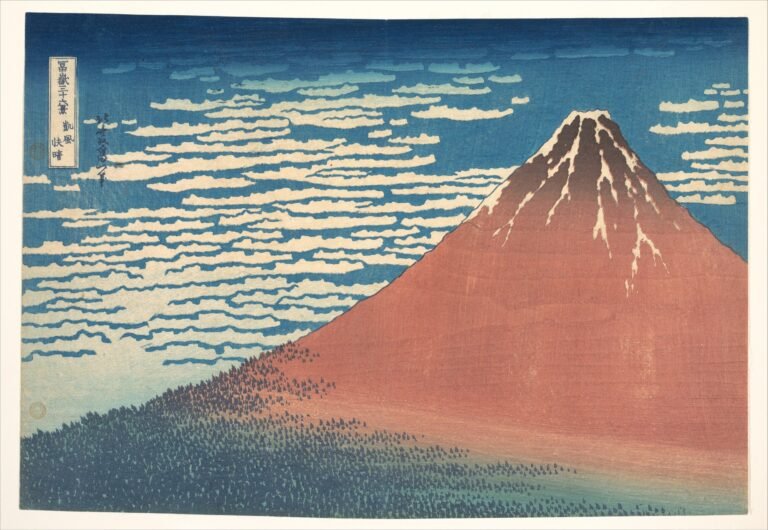
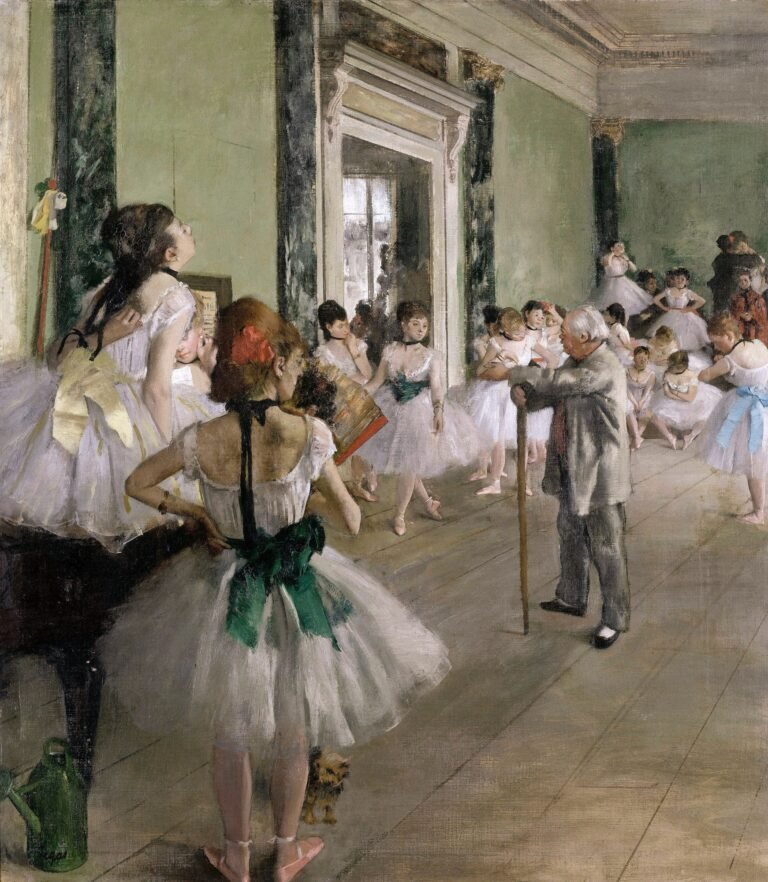
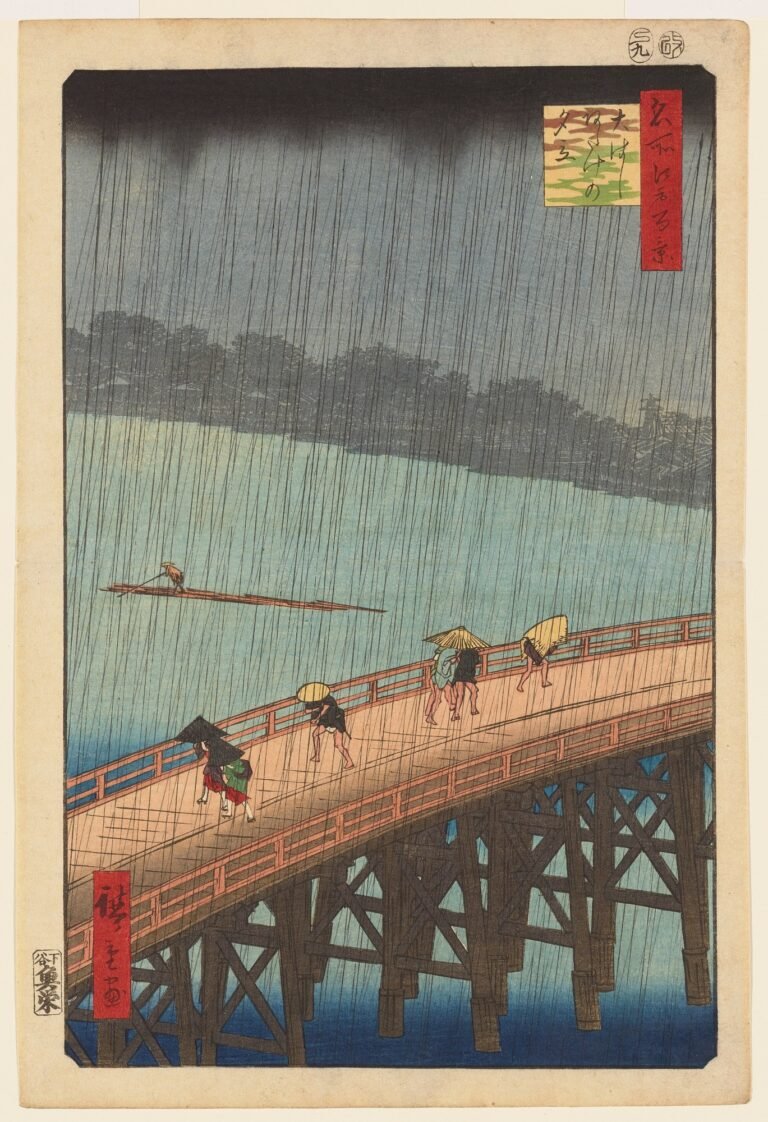
Japan’s closure ended in stages: Perry’s squadron arrived in 1853, the first treaty followed in 1854, and the trading ports opened properly in 1859. Prints like this one then reached Europe in quantity and set off Japonisme. Monet collected Japanese woodblocks and hung them throughout his house at Giverny. Degas, Whistler and Van Gogh all absorbed the flat colour, hard outline and off-centre cropping. Debussy’s La Mer was published in 1905 with a cover adapted from this print.
Which produces a nice historical irony. A disposable sheet, sold for the price of a double bowl of noodles to Edo townspeople who could not have named the carver, ended up reshaping how European painters saw composition – and then came back around as one of the most reproduced images on earth.
Image: The Great Wave off Kanagawa – Katsushika Hokusai (1831). License: Public Domain. Source: Wikimedia Commons.