Impression Sunrise
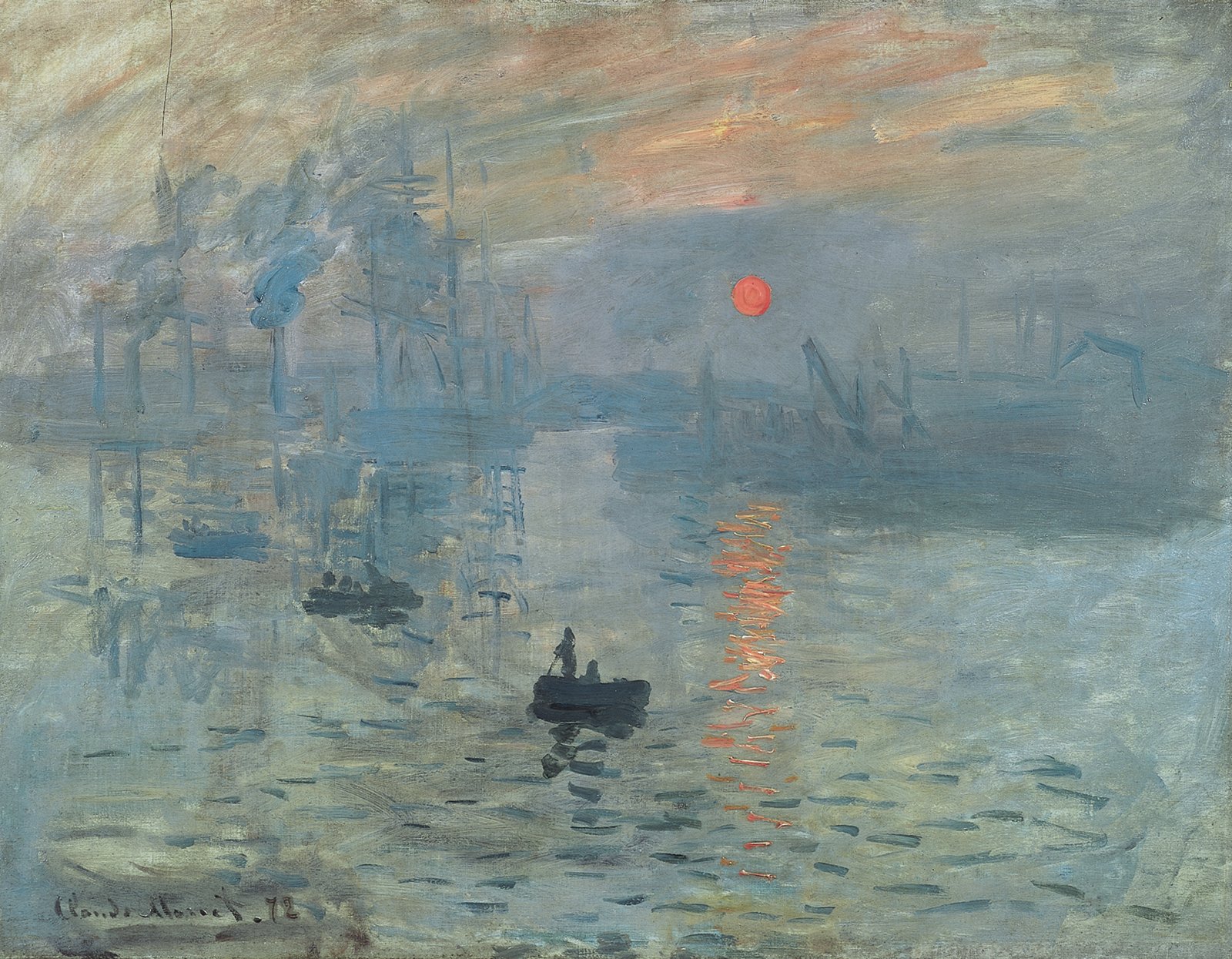
A single painting accidentally named an entire art movement — and its creator didn’t even mean to title it anything grand. Impression Sunrise, dashed off by Claude Monet in 1872, was described by a dismissive critic as mere “impression” work, and Monet essentially shrugged and agreed. That offhand insult became the badge of honor for one of the most revolutionary movements in the history of Western art.
Quick Facts
- Artist: Claude Monet
- Year: 1872
- Medium: Oil on canvas
- Dimensions: 48 cm × 63 cm (18.9 in × 24.8 in)
- Movement: Impressionism
- Current location: Musée Marmottan Monet, Paris
What Makes Impression Sunrise So Unforgettable?
Most famous paintings earn their reputation through grand gestures — enormous canvases, religious drama, perfect academic technique. Impression Sunrise does the opposite. It is small, loose, and almost aggressively unfinished by the standards of its day. And yet it stops you cold.
What sets it apart is its radical honesty. Monet wasn’t painting the port of Le Havre as it objectively existed. He was painting the exact feeling of standing there at dawn — the cold blue mist, the burning smear of orange sun, the ghostly silhouettes of industrial cranes dissolving into haze. For the first time, a painter’s subjective experience became the entire point of the work.
That shift sounds simple. In practice, it changed everything. Impression Sunrise didn’t just break rules — it proved that the rules were the wrong rules to begin with.
Historical Context
France in 1872 was a nation still catching its breath. The Franco-Prussian War had ended just the year before, and Paris itself bore the scars of the Paris Commune uprising. The country was rebuilding — physically, economically, and psychologically. Monet captured that industrial port scene at Le Havre during this tense, transitional moment.
At the same time, the official Paris Salon remained the gatekeeper of artistic prestige. Its jury favored polished, highly finished historical and mythological scenes. Artists like Monet, Renoir, Pissarro, and Degas were repeatedly rejected or patronized. Therefore, in April 1874, they organized their own independent exhibition on the Boulevard des Capucines.
Impression Sunrise was among the works on display. A critic named Louis Leroy, writing for the satirical journal Le Charivari, mocked the show by borrowing Monet’s title. He intended the word “Impressionist” as a jab. However, the artists embraced it, and history took care of the rest.
In addition, the painting captures a world on the cusp of industrial modernity. Those dark factory smokestacks and steamboats in the background weren’t incidental details — they were the new reality of France, rendered in shimmering, uncertain light.
The Exact Morning Monet Painted
For more than a century, nobody knew precisely when this painting was made — or even, with certainty, whether it showed sunrise or sunset. Monet gave no date beyond the year, and the two readings each had serious defenders.
In 2014 the Musée Marmottan Monet asked Donald Olson, an astrophysicist at Texas State University, to settle it. He treated the canvas as a dataset.
The sun’s height above the horizon places the moment roughly twenty to thirty minutes after it cleared the horizon. The harbour gates in the background are open, which only happened at high tide — large sailing ships could not otherwise pass. Cross-referencing tide tables for Le Havre with the November-to-January window Monet’s known movements allowed left nineteen candidate mornings. Weather records eliminated the stormy and clear ones, since the painting shows heavy mist. Finally, the direction of smoke drifting from the chimneys gave the wind bearing, narrowing the field to two dates.
The answer: 13 November 1872, at around 7.35 a.m., painted from a window of the Hôtel de l’Amirauté overlooking the outer harbour.
And it is a sunrise. The position of the sun relative to the harbour, given the geography of Le Havre, admits no other reading. This is one of several long-standing questions about famous paintings that have been settled in the last two decades. See the others.
Symbolism and What to Look For
Stand in front of Impression Sunrise and resist the urge to look immediately at the orange sun. That instinct is exactly what Monet is playing with.
First, notice the overall palette. The canvas is dominated by cool blue-grey tones — the water, the sky, the fog-blurred horizon. These cold hues create a sense of early morning stillness and quiet industry. The whole scene feels suspended between night and day.
Then your eye finds the sun. That fierce orange-red disc and its shimmering reflection on the water are painted with startling economy — just a few bold strokes of warm paint against the cool background. Researchers have noted that the reflected light on the water is actually brighter than the sky around the sun itself, a phenomenon that matches the physics of how dawn light scatters across rippling water.
There is a further quirk worth knowing. Measured for luminance rather than hue, the sun is almost exactly as bright as the sky behind it. Your eye reads it as blazing because of the colour contrast, not the brightness — which is why the disc appears to pulse or flicker when you look at reproductions in black and white, where it nearly vanishes.
Look next at the two small rowboats in the foreground. The figures inside them are barely suggested — dark, featureless shapes. They anchor the composition and give you a sense of human scale, but Monet refuses to let you focus on them as individuals. They are part of the atmosphere, not characters in a story.
Finally, look at the background. Industrial cranes, masts, and smokestacks dissolve into the mist. Monet didn’t paint them with precise outlines. Instead, he let them blur and merge with the grey air. That deliberate softness is the technique — and the message. Reality is fluid, not fixed.
About Claude Monet
Claude Monet was born in Paris in 1840 and grew up in Normandy, on the coast — which explains his lifelong obsession with water, light, and weather. He showed artistic talent early and eventually trained in Paris, where he met the painters who would become his closest collaborators and fellow rebels.
Monet spent his career chasing light in all its forms. He painted the same haystacks at different hours. He painted Rouen Cathedral in fog, sunlight, and shadow. He built his famous water garden at Giverny specifically so he could paint it. His late series of Water Lilies, painted while his eyesight was failing, are among the most celebrated works of the 20th century.
He died in 1926, having lived long enough to see the movement he helped ignite become the foundation of modern art itself.
Legacy and Influence
Impression Sunrise didn’t just name a movement — it modeled a new way of thinking about what a painting could be. By prioritizing sensation over accuracy, Monet opened a door that couldn’t be closed. Post-Impressionists like Cézanne, Van Gogh, and Gauguin all walked through it. So, eventually, did the Fauves, the Expressionists, and the Abstract painters of the 20th century.
The painting also has a dramatic modern history. In 1985, it was stolen from the Musée Marmottan Monet in an audacious armed robbery. For five years it disappeared entirely. It was recovered in 1990 in Corsica and returned to the museum, where it has remained ever since.
Today, Impression Sunrise is considered one of the most culturally significant paintings in French history — not simply for its beauty, but for the argument it made about art and perception that still resonates.
Where to See Impression Sunrise Today
Impression Sunrise is permanently housed at the Musée Marmottan Monet in the 16th arrondissement of Paris. The museum itself is a beautiful former hunting lodge and holds the largest collection of Monet’s works in the world — well over 100 paintings.
The nearest Metro station is La Muette on Line 9, which puts you about a ten-minute walk from the museum entrance. Booking tickets online in advance is strongly recommended, especially during peak tourist season in summer. The museum is closed on Mondays.
While you’re there, don’t miss Monet’s series of Water Lily paintings and his large-scale decorative panels. The museum also holds important works by Berthe Morisot and other Impressionist contemporaries, making it a deeply satisfying half-day visit. For context, consider pairing your visit with a trip to the Musée d’Orsay, which houses a superb broader collection of Impressionist masterworks just across the city.
Frequently Asked Questions
Where is Impression Sunrise located?
The painting is permanently held at the Musée Marmottan Monet in Paris, France. It entered the collection through the bequest of Dr Georges de Bellio’s daughter, Victorine Donop de Monchy, in 1940, and returned there after its recovery following the 1985 theft.
When was Impression Sunrise created?
Monet painted it in 1872 — specifically, astronomical and tidal analysis published in 2014 dates it to the morning of 13 November 1872, at around 7.35 a.m., from a hotel window overlooking the harbour of Le Havre. It was first publicly exhibited in April 1874 at the independent group show that would later be called the first Impressionist Exhibition.
Is it a sunrise or a sunset?
A sunrise. The question was genuinely contested for decades, but the 2014 study settled it: given the geography of Le Havre and the sun’s position relative to the harbour, the scene can only be facing east at dawn.
What does Impression Sunrise represent?
On one level, it depicts a foggy morning at the industrial port of Le Havre. On a deeper level, it represents a radical new philosophy — that a painting should capture a fleeting sensory experience rather than a fixed, objective reality. It stands for the freedom of perception over photographic precision.
Why is Impression Sunrise so famous?
It is famous primarily because it gave Impressionism its name and its manifesto in a single image. It also happens to be a genuinely beautiful and technically innovative painting — but its historical significance as the accidental spark that named a movement makes it truly iconic.
Was Impression Sunrise really stolen?
Yes. In October 1985, a group of armed thieves broke into the Musée Marmottan Monet and stole nine paintings, including Impression Sunrise. The works vanished for five years before being discovered in a villa in Corsica in 1990. All nine paintings were recovered and returned to the museum.
If Impression Sunrise has sparked your curiosity about the Impressionist world, there is so much more to explore. Browse our related posts on Monet’s Water Lilies, the painters of the 1874 exhibition, and the remarkable story of how a handful of rejected artists changed art history forever — all right here on the site.
Image: Impression Sunrise – Claude Monet (1872). License: Public Domain. Source: Wikimedia Commons.