A Sunday on La Grande Jatte
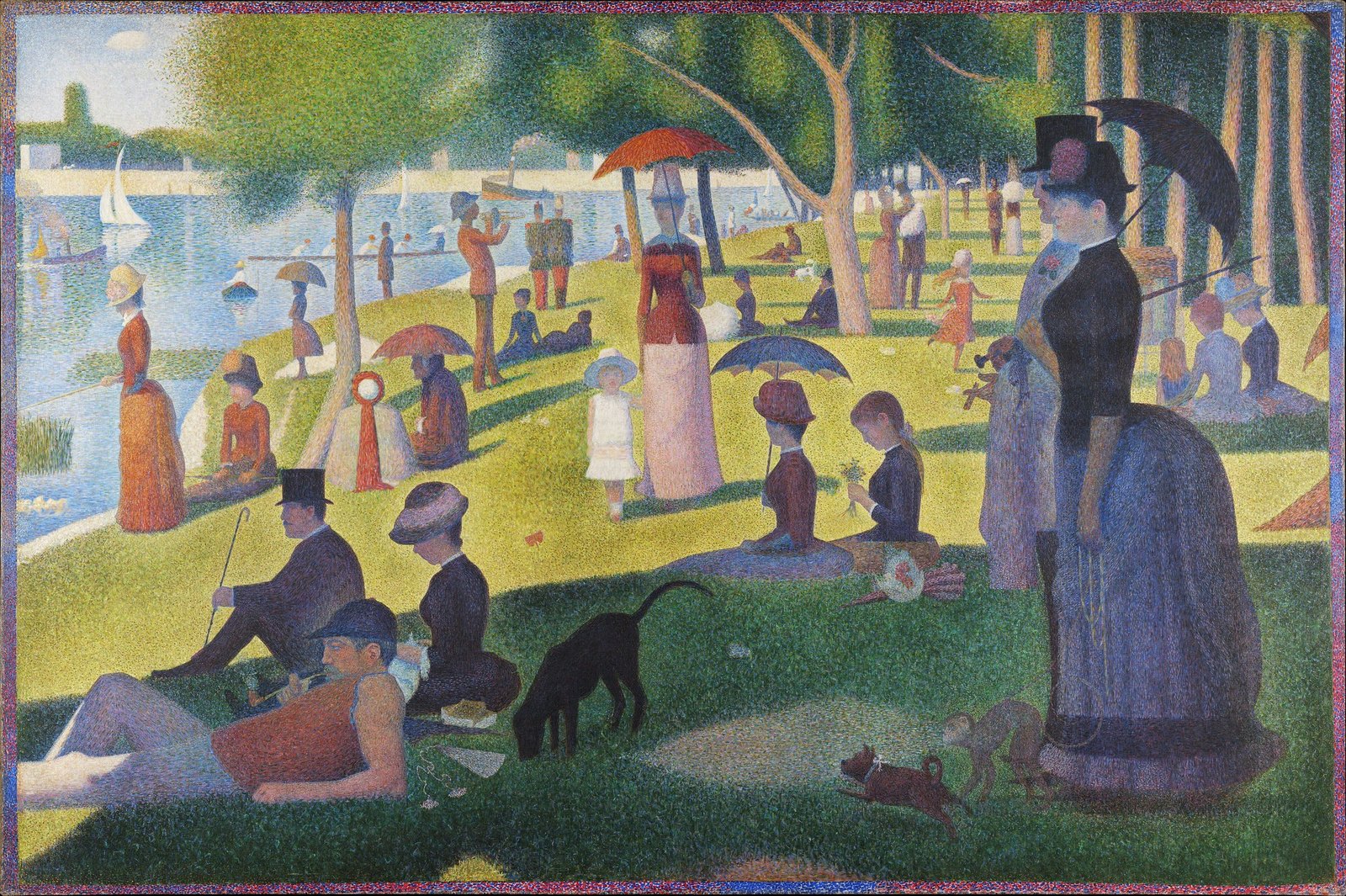
Here is a fact that stops most people cold: Georges Seurat painted A Sunday on La Grande Jatte using millions of tiny, individual dots of pure color – and he spent roughly two years placing every single one of them with deliberate, almost scientific precision. No sweeping brushstrokes. No blending on the canvas. Just dots, working together like pixels on the world’s first great screen.
Quick Facts
- Artist: Georges Seurat
- Year: 1884–1886, with a painted border added in 1889
- Medium: Oil on canvas
- Dimensions: 207.5 × 308 cm (81.7 × 121.25 in)
- Movement: Post-Impressionism
- Current location: Art Institute of Chicago – Gallery 240
What Makes A Sunday on La Grande Jatte So Unforgettable?
Most monumental paintings overwhelm you with drama – battles, saints, gods in the clouds. A Sunday on La Grande Jatte does something far stranger. It shows ordinary people doing almost nothing. They stand, sit, fish, and stroll on a grassy riverbank outside Paris. And yet the painting stops you cold.
The reason is tension. Seurat fills this sunny leisure scene with an eerie stillness. Nobody interacts. Nobody really looks at anyone else. The figures feel like mannequins arranged by a meticulous hand. For a painting about relaxation, it is surprisingly unsettling – and that contrast is precisely what burns it into memory.
Then there is the technique itself. Seurat rejected intuitive brushwork and replaced it with a rigorous system he called Chromoluminarism – what most of us now call Pointillism, a name coined by hostile critics rather than by him. He studied color theory obsessively, particularly the work of chemist Michel Eugène Chevreul. The result is a surface that seems to vibrate with light rather than simply depict it.
Historical Context
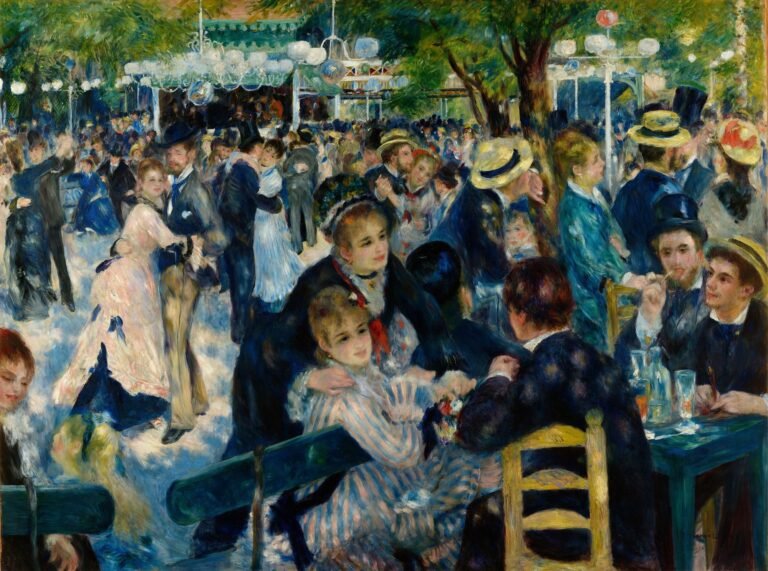
By the mid-1880s, Impressionism had already shaken the Paris art world to its foundations. Monet, Renoir, and their circle had traded the academy’s polished formulas for loose, spontaneous marks that captured fleeting moments of light. The public was still catching up.
Seurat, however, felt that Impressionism was too casual – too dependent on instinct. He wanted something more systematic. He began A Sunday on La Grande Jatte in 1884, making dozens of preparatory sketches and studies before touching the large canvas. He exhibited the finished painting at the final Impressionist exhibition in 1886, alongside Signac and others who shared his scientific outlook.
That 1886 exhibition was a pivotal moment. It marked the birth of what critics soon called Neo-Impressionism – a movement built on optical science rather than feeling. France itself was changing rapidly too. Industrialization was reshaping the cities, and Parisians were flooding into suburban parks on their new days off. La Grande Jatte island, in the Seine northwest of Paris, was exactly that kind of popular escape. Seurat captured a society in transition, dressed in its Sunday best but emotionally guarded.
Symbolism and What to Look For
Stand in front of A Sunday on La Grande Jatte and resist the urge to step back. Move close first. Up close, the painting dissolves into a mosaic of colored dots – orange, violet, blue, green – that seem almost random. Step back several feet and, like magic, those dots fuse into solid forms, shimmering sunlight, and deep shadow. That transformation is the whole point, and it rewards standing there longer than feels natural: research on how people actually look at art finds that the average museum visitor gives a painting a matter of seconds, which is not enough for this one to do its trick twice.
Look at the edges. Running around the whole composition is a border of red, orange and blue dots, painted directly onto the canvas. Seurat added it in 1889, three years after finishing the picture, taking the canvas off its stretcher and folding out the tacking margins to make room. Almost every reproduction crops it off, so most people meeting the painting in Chicago are seeing something they have never seen before.
Now look at the social details. Seurat populates his riverbank with a cross-section of Parisian society. Notice the fashionable woman at the right, holding a monkey on a leash – a knowing symbol of affected bourgeois taste at the time. Her rigid posture echoes the parasol she carries, both perfectly upright and socially performative.
Look, in addition, at how Seurat handles shadow. Rather than painting shadows as simply darker versions of the surrounding color, he shifts the hue entirely – cool blues and purples push against warm greens. This reflects his reading of color theory directly onto the canvas.
Notice also the geometry. The composition is almost architectural. Figures are arranged in a careful lateral procession, and vertical elements – trees, parasols, fishing rods – divide the canvas into measured intervals. Nothing here is accidental. Every element reinforces a sense of order just barely containing something uneasy underneath.
One caveat worth carrying with you: the painting is duller than Seurat made it. For the sunlit grass he used a then-new zinc yellow, which began browning within his own lifetime. The greens you are looking at were once far more luminous, and no amount of conservation can bring them back.
About Georges Seurat
Georges Seurat was born in Paris on December 2, 1859, into a comfortable middle-class family. He trained at the prestigious École des Beaux-Arts but quickly grew restless with its conservative curriculum. He turned instead to scientific texts on optics and color perception, treating painting almost as a branch of applied physics.
He was methodical, private, and intensely focused. He completed relatively few large canvases in his short life – he died in 1891 at just 31 years old, likely from diphtheria. However, the work he left behind was revolutionary. A Sunday on La Grande Jatte remains his masterpiece. It was preceded by Bathers at Asnières of 1883–84, which shows the opposite bank of the same stretch of the Seine, and followed by late works such as The Circus, left unfinished at his death.
Seurat’s influence spread quickly through Paul Signac, who became his close collaborator and later the movement’s leading advocate.
Legacy and Influence
A Sunday on La Grande Jatte launched Neo-Impressionism as a recognized movement and gave future generations a new way to think about how color and light work together. It influenced Van Gogh, who adopted broken brushwork after seeing Seurat’s ideas in action. It fascinated Pissarro, who worked in the new manner for several years. It even echoes forward into the digital world – the idea of building an image from discrete colored units anticipates pixel-based screens by nearly a century.
In popular culture, the painting became famous to a new generation through Stephen Sondheim’s 1984 musical Sunday in the Park with George, which dramatizes the creation of the work itself. The painting also inspired countless parody and tribute images, cementing its status as one of the most recognized works in Western art.
Why the Painting Never Leaves Chicago
After Seurat’s death the canvas passed to his mother and then his brother, and in 1900 it sold for 800 francs. The Chicago collector Frederic Clay Bartlett bought it in 1924 and lent it to the Art Institute immediately; he and his wife gave it to the museum outright in 1926.
It has left the building exactly once. In 1958 it travelled to the Museum of Modern Art in New York for a Seurat exhibition, and while it was hanging there a fire broke out in the building – destroying a Monet water lily panel and damaging other works. Seurat’s canvas came through unharmed, but the Art Institute drew its conclusion: the painting has not been lent since, and the museum does not intend to lend it again. Chicago is the only place on earth you can see it.
Where to See A Sunday on La Grande Jatte Today
A Sunday on La Grande Jatte hangs in the Art Institute of Chicago, in Grant Park on Michigan Avenue, in Gallery 240 – part of the second-floor European painting galleries in the Allerton Building, not the Modern Wing. The painting is enormous in person, over three metres wide, and seeing it up close for the first time is genuinely breathtaking.
The museum is closed on Tuesdays and open the rest of the week, with late hours until 8 p.m. on Thursdays. Those Thursday evenings are the quietest slot of the week; weekend afternoons are the busiest. Admission is always free for children under 14 and for Chicago teens under 18, and Illinois residents get free evening entry on certain Thursdays through the year – Chicago and Illinois residents otherwise receive a discount rather than free entry, so check the museum’s site before you plan around it.
While you are there, seek out Seurat’s smaller oil studies for the same composition, also in the collection, to see how he worked the idea through. Monet’s Water Lilies hangs in the same second-floor galleries. Bathers at Asnières, the companion picture from the opposite bank, is in London’s National Gallery – seeing both makes an extraordinary comparison, but it will take two trips.
Frequently Asked Questions
Where is A Sunday on La Grande Jatte located?
At the Art Institute of Chicago, in Gallery 240. Frederic Clay Bartlett bought the painting in 1924 and gave it to the museum in 1926. It has not left Chicago since 1958 and the museum does not lend it.
When was A Sunday on La Grande Jatte created?
Seurat began working on it in 1884 and finished it in 1886, after dozens of preparatory drawings and oil sketches. He returned to it in 1889 to add the painted dotted border that still frames the composition.
What does A Sunday on La Grande Jatte represent?
On the surface, it depicts Parisians relaxing on La Grande Jatte island in the Seine on a Sunday afternoon. On a deeper level, it is a carefully coded portrait of class, social performance, and the emotional distance that can exist even in moments of shared leisure.
Why is A Sunday on La Grande Jatte so famous?
It is famous both for its revolutionary Pointillist technique – which fundamentally changed how artists thought about color – and for its extraordinary scale, ambition, and the haunting quality of its composition. It effectively launched an entire art movement.
How big is A Sunday on La Grande Jatte?
The canvas measures approximately 207.5 by 308 centimeters, or roughly 6.8 by 10 feet. Its large scale was deliberate – Seurat wanted it to carry the monumental weight of a traditional history painting, applied to an everyday modern subject.
Do the colors look the way Seurat intended?
Not quite. The zinc yellow he used for the sunlit grass was a new pigment at the time, and it started to darken to brown while he was still alive. The painting is therefore duller and greener than the version he finished in 1886, and the change is chemical and irreversible.
If A Sunday on La Grande Jatte has sparked your curiosity, you will find plenty more to explore right here. Browse our guides to other landmark Post-Impressionist works, dive deeper into the life of Georges Seurat, or discover the full collection at the Art Institute of Chicago – each one a new conversation waiting to begin.
Image: A Sunday on La Grande Jatte – Georges Seurat (1884–86). License: Public Domain. Source: Wikimedia Commons.