Water Lilies (1906)
Here is a number that might stop you mid-scroll: Claude Monet painted roughly 250 versions of Water Lilies – and the 1906 canvas now hanging in the Art Institute of Chicago sits at the exact midpoint of that obsession, created at a moment when Monet was pushing paint further from reality than almost any Western artist had dared before.
Quick Facts
- Artist: Claude Monet
- Year: 1906
- Medium: Oil on canvas
- Dimensions: 89.9 × 94.1 cm (35⅜ × 37 1/16 in)
- Movement: Impressionism
- Current location: Art Institute of Chicago
What Makes Water Lilies So Unforgettable?
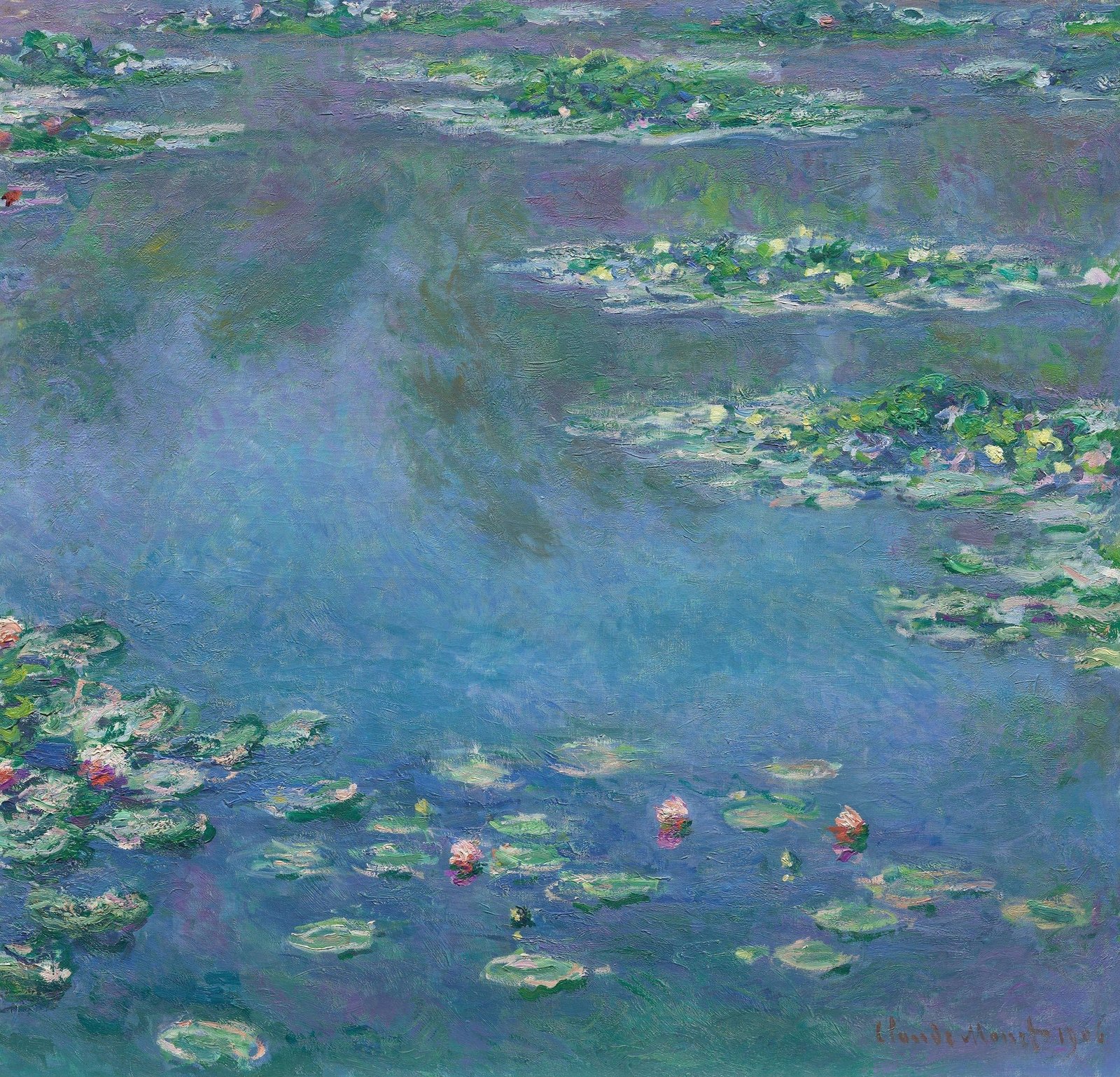
Most landscape paintings give you something to hold on to – a horizon line, a sky, a sense of where the earth ends and the air begins. Monet’s Water Lilies refuses all of that. There is no shore, no bank, no frame of reference. You are dropped directly onto the surface of the pond, surrounded on all sides by shimmering reflections and floating blooms, with no clear up or down.
That radical decision – to eliminate the horizon entirely – was not accidental. It was a deliberate dismantling of the rules of pictorial space that had governed Western painting for centuries. In doing so, Monet created something that feels less like a window and more like an immersive environment. And that reading is not hindsight: as early as August 1897 he described to the writer Maurice Guillemot a plan for a circular room lined entirely with water lilies, an idea he would only realise three decades later in Paris.
What also sets this particular canvas apart is its intimacy. At roughly 90 by 94 centimetres, it is almost square – a format that feels balanced, meditative, complete. It does not demand that you walk along it. It invites you to stand still and simply be present.
Historical Context
By 1906, the art world was in the middle of a seismic shift. The Impressionists had already fought their battles and largely won them. The artists who had taken their ideas somewhere rawer and more subjective were by now gone or going: Van Gogh had died in 1890, Gauguin in 1903, and Cézanne – a year older than Monet, not younger – would die that October. The Fauvists had exploded onto the Parisian scene the previous autumn, at the 1905 Salon d’Automne, where the critic Louis Vauxcelles looked at Matisse, Derain and their circle wielding colour like a blunt instrument and gave them their name.
Into this charged atmosphere, Monet, now in his mid-sixties, retreated – not in defeat, but in focus. He had moved to Giverny in 1883 and bought the house in 1890. In 1893 he acquired the marshy plot beyond it, secured permission to divert the Ru – a small branch of the River Epte – and dug the pond that became his water garden. The Japanese-style bridge followed in the mid-1890s. From 1899 onwards the pond was his central subject, interrupted only by painting campaigns in London and Venice.
France itself was modernizing rapidly. The Dreyfus Affair had convulsed the nation since 1894 and only reached its formal end in 1906, the year of this canvas. Automobiles were appearing on Parisian streets. The age of industry was reshaping daily life in ways that felt both thrilling and unsettling. Monet’s pond, in contrast, was timeless – a place of silence and slow change, where the only drama was light moving across water.
It is worth noting that Monet would later develop cataracts that severely compromised his vision. He began complaining about his eyesight in 1908, was diagnosed in 1912, and put off surgery until 1923. The 1906 paintings predate all of it, and they show his eyesight – and his hand – still at full power.
Symbolism and What to Look For
Stand in front of this painting and resist the urge to name everything you see. That impulse – to identify the lilies, the reflections, the sky – is exactly what Monet is asking you to let go of.
Instead, notice the color temperature. Cool lavenders and blue-greens dominate the water’s surface, carrying the sky and the trees that stand above the pond, neither of which appears directly. Then look for the warmer ochres and pinks scattered among the lily pads – those are the blooms themselves, almost casual in their placement, as if they simply drifted there.
Pay attention to the brushwork. Up close, it is surprisingly loose – broad, confident strokes that seem almost careless. Step back a few feet, and everything snaps into focus. This is the fundamental Impressionist trick, and Monet executes it better than almost anyone. It is also a good argument for slowing down: what research on art and the brain actually shows is that the works people find moving are the ones they return to, not the ones they walk past.
Look also at the edges of the canvas. The lily pads and blossoms are cropped at the margins, as if the pond simply continues beyond the frame in every direction. This was a deliberate compositional choice, influenced in part by Japanese woodblock prints – an art form Monet collected throughout his life and hung throughout his house at Giverny. It creates a feeling of endlessness that a neatly bounded composition could never achieve.
Finally, consider the absence of depth. There is no foreground or background in any traditional sense. The entire painting is organised on a single plane, like a tapestry or a Japanese screen. This flattening of pictorial space would prove enormously influential on what came next in art history.
About Claude Monet
Claude Monet was born in Paris in 1840 and grew up in Le Havre, on the Normandy coast, where his early love of outdoor painting took root. He was one of the founding voices of Impressionism – a movement that took its name from a hostile review. When Impression, Sunrise, painted in 1872, was shown at the group’s first independent exhibition in April 1874, the critic Louis Leroy headed his mocking piece in Le Charivari “The Exhibition of the Impressionists”. The insult stuck, and the painters adopted it.
Throughout the 1870s and 1880s he refined his technique of capturing fleeting light and atmospheric conditions, and in the 1890s he turned that method into sustained series – the grain stacks of 1890–91, usually known in English as the Haystacks, and the Rouen Cathedral façades of 1892–94. He had settled in Giverny in 1883, bought the property in 1890, and lived and worked there until his death in 1926.
The final three decades of his life were devoted largely to his water garden – a living artwork that he tended as carefully as any canvas. His monumental Grandes Décorations, eight compositions he formally offered to the French state in 1922, were installed in two purpose-built oval rooms at the Orangerie in Paris and opened to the public in May 1927, a few months after his death.
Legacy and Influence
The impact of the Water Lilies series on subsequent art is almost impossible to overstate – though the story is usually told the wrong way round. The Abstract Expressionists themselves left little record of any debt to Monet. The connection was made for them, in the 1950s, by critics and curators: Alfred Barr bought a large water lily panel for the Museum of Modern Art in 1955, and that same year Clement Greenberg’s essay “American-Type Painting” placed Monet’s all-over surfaces in the ancestry of Jackson Pollock’s. Painters including Barnett Newman, Clyfford Still and Ellsworth Kelly did openly acknowledge what they owed the late Monet. The result was a wholesale reassessment: canvases dismissed as dull decoration in the 1920s were treated, thirty years later, as a peak of revolutionary painting.
Today, the water lily paintings are among the most recognized images in Western art, reproduced on everything from tote bags to wallpaper. But familiarity has not dimmed their power. In person, they remain genuinely surprising – more abstract, more physical, more emotionally complex than any reproduction suggests.
The 1906 Chicago canvas comes from the group of pond pictures Monet worked on between 1903 and 1908, the midpoint of his spatial experiments, and it hangs in what is widely regarded as the finest collection of French painting outside Paris.
Where to See Water Lilies Today
The 1906 Water Lilies is on display at the Art Institute of Chicago, located at 111 South Michigan Avenue in Chicago’s Grant Park. It is normally shown in the second-floor European painting galleries – the 240s, where the museum’s Impressionist and Post-Impressionist holdings hang – though gallery placements shift during special exhibitions and individual works occasionally travel, so it is worth checking the museum’s website before your visit.
The Art Institute is open Wednesday through Monday and closed on Tuesdays, with extended hours until 8:00 p.m. on Thursdays. Those Thursday evenings, along with Monday and Wednesday afternoons, are the quietest times to stand in front of the canvas; weekend afternoons are the most crowded. Holiday schedules vary, so confirm current hours before you travel.
While you are there, seek out Georges Seurat’s A Sunday on La Grande Jatte in Gallery 240, a few steps away – his pointillist, systematically constructed surface makes a fascinating contrast with Monet’s loose, layered one. The museum’s collection of Japanese woodblock prints – the art form that shaped Monet’s sense of cropping and flatness – is also exceptional, though the sheets are light-sensitive and are shown in rotation rather than permanently on view.
Frequently Asked Questions
Where is Water Lilies located?
The 1906 version of Water Lilies is part of the permanent collection at the Art Institute of Chicago, 111 South Michigan Avenue, Chicago, Illinois.
When was Water Lilies created?
This particular canvas was painted in 1906, one of a group of pond pictures Monet produced between 1903 and 1908, during his decades-long engagement with his Giverny water garden.
What does Water Lilies represent?
On one level, it is a straightforward depiction of Monet’s garden pond. On a deeper level, it represents his lifelong pursuit of transient light and atmosphere – and his radical reimagining of what a painting could be.
Why is Water Lilies so famous?
Because it broke the rules so quietly and so completely. By eliminating the horizon and flattening pictorial space, Monet produced work that critics half a century later would read as a direct forerunner of abstract painting.
How many Water Lilies paintings did Monet make?
Monet produced approximately 250 paintings in the Water Lilies series, from around 1897 until his death in 1926 – an extraordinary sustained focus that has few parallels in the history of art.
If Water Lilies has stirred your curiosity, you will find plenty more to explore right here – from other masterworks of Impressionism to deep dives into the artists and movements that changed how we see the world. Browse our related posts and discover your next favorite painting.
Image: Water Lilies – Claude Monet (1906). License: Public Domain. Source: Wikimedia Commons.