Composition with Red, Blue and Yellow
Here is a number that might stop you in your tracks: this canvas measures just 46 × 46 centimetres — roughly the size of a laptop screen — yet Composition with Red, Blue and Yellow has influenced everything from Yves Saint Laurent fashion to IKEA shelving designs. Something that small has no business reshaping the visual culture of an entire century. And yet, here we are.
Quick Facts
- Artist: Piet Mondrian
- Year: 1930
- Medium: Oil on canvas
- Dimensions: 46 × 46 cm (18 × 18 in)
- Movement: De Stijl
- Current location: Kunsthaus Zürich
What Makes Composition with Red, Blue and Yellow So Unforgettable?
Most paintings seduce you with a story. A battle, a goddess, a bowl of fruit. Composition with Red, Blue and Yellow refuses to do that. It gives you almost nothing — black lines, white space, three colour blocks — and somehow that austerity feels thrilling rather than empty.
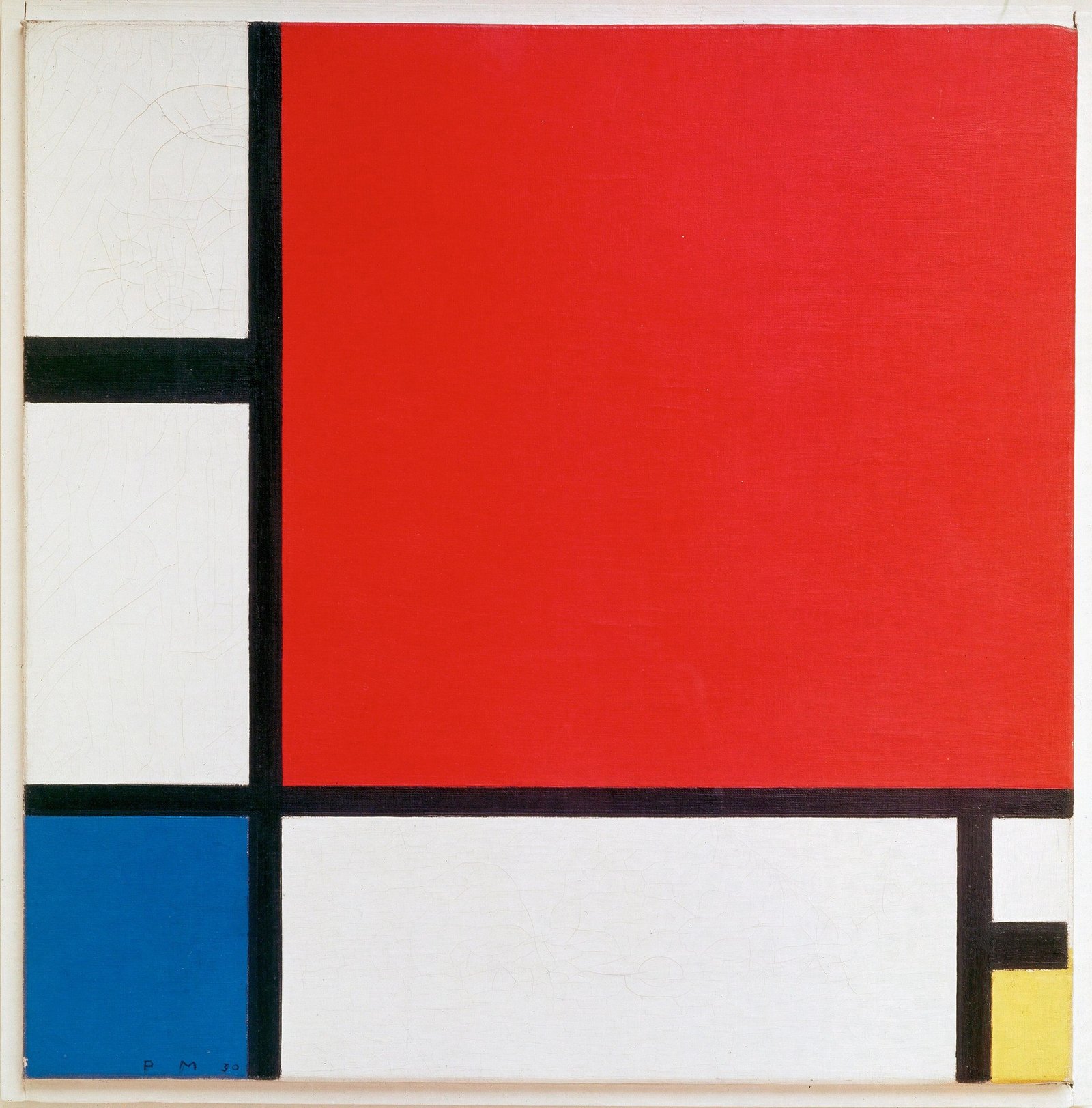
The secret lies in Mondrian’s asymmetry. The large red square dominates the upper right. A small blue rectangle anchors the lower left. A sliver of yellow hides in the lower right corner. These three elements are not balanced in the way a see-saw is balanced. Instead, they create a dynamic tension, a visual conversation that keeps your eye moving endlessly around the canvas.
That restlessness is the point. Mondrian believed pure abstraction could express something deeper than any landscape or portrait ever could. He called it “universal harmony.” Whether you buy that philosophy or not, the painting genuinely holds your attention. It does not let you look away and feel finished. That is a rare achievement for any work of art.
Historical Context
By 1930, Europe was an anxious place. The Great Depression was tightening its grip. Fascism was rising in Italy and gaining momentum in Germany. Against this backdrop of chaos and uncertainty, Mondrian’s pursuit of pure order feels almost defiant.
He had co-founded the De Stijl movement back in 1917, alongside Theo van Doesburg and others. The movement argued that art should strip away all representation and personal emotion. What remained — primary colours, straight lines, right angles — would express something universal and eternal. In a world spinning out of control, that idea had real emotional weight.
By 1930, Mondrian had been refining this visual language for over a decade. He was living in Paris, working in a studio he decorated to mirror his paintings. The walls were painted in his signature rectangles. This was not a hobby for him. It was a complete worldview.
Therefore, Composition with Red, Blue and Yellow is not just a painting from 1930. It is a philosophical statement made at a moment when the world desperately needed coherent frameworks to hold onto.
Symbolism and What to Look For
Stand in front of Composition with Red, Blue and Yellow and resist the urge to move on quickly. Give it two full minutes. Here is what to notice.
First, look at the black lines. They vary in thickness. The thicker lines carry more visual weight, almost like load-bearing walls in architecture. They do not create a simple grid — they create an irregular rhythm.
Next, pay attention to the white and grey sections. Mondrian used off-white rather than a stark, brilliant white. This gives the painting warmth. The canvas breathes rather than glares.
Now focus on the red square. It is the dominant force, occupying more space than the blue and yellow combined. However, the red does not overwhelm. The surrounding white areas hold it in check. Notice how your eye moves from red, seeks the blue for relief, then catches the yellow as a quiet surprise in the corner.
Finally, look at the edges. The lines run to the very border of the canvas — some even seem to continue beyond it. This gives the painting a sense that it is a fragment of a much larger, infinite grid. The universe, Mondrian implied, follows these rules whether we paint it or not.
About Piet Mondrian
Piet Mondrian was born in Amersfoort, Netherlands, in 1872. He trained as a conventional painter and produced accomplished landscapes and portraits in his early career. Then, in the 1910s, Cubism hit him like a revelation.
He studied Cubist work in Paris and began reducing his paintings step by step. Trees became grids. Seascapes became horizontal and vertical lines. By around 1920, he had arrived at the style he called Neoplasticism — the pure abstraction that defines his legacy.
He moved to London in 1938 as war threatened Europe, then emigrated to New York in 1940. New York electrified him. The grid of Manhattan streets, the energy of jazz clubs — it all fed directly into his late paintings, particularly the vibrant Broadway Boogie Woogie of 1942–43.
Mondrian died in New York in 1944, just months before the end of the war he had fled. He was 71. His influence, however, was only just beginning to be fully felt.
Legacy and Influence
Composition with Red, Blue and Yellow sits at the heart of one of the most pervasive aesthetic influences in modern history. Mondrian’s visual language became the grammar of modernist design.
In 1965, Yves Saint Laurent debuted his famous Mondrian Collection — shift dresses divided by black lines into blocks of primary colour. It caused a sensation. Suddenly, a painting from 1930 was on the cover of every fashion magazine.
In addition, architects, graphic designers, and typographers have borrowed from his system for decades. The Bauhaus school shared his passion for functional geometry. Many argue that the clean, grid-based layouts of modern websites owe a quiet debt to Mondrian’s thinking.
More broadly, Composition with Red, Blue and Yellow demonstrated that abstraction could be popular, emotionally resonant, and commercially powerful. It proved that “difficult” art could speak to ordinary people — if it was executed with enough conviction and precision.
Where to See Composition with Red, Blue and Yellow Today
Composition with Red, Blue and Yellow lives in the permanent collection of the Kunsthaus Zürich in Switzerland. The museum is one of the finest art institutions in Europe and houses an extraordinary range of work spanning several centuries.
The Kunsthaus is located in the centre of Zürich, a short walk from the main train station (Zürich Hauptbahnhof). It expanded significantly with a new wing, designed by architect David Chipperfield, which opened in 2021. The new wing connects to the original building via an underground passage.
When you visit, allow plenty of time to explore the museum’s wider collection. You will find significant works by Alberto Giacometti, Edvard Munch, and a strong selection of Impressionist paintings. The museum café offers a comfortable pause between galleries.
For practical planning: the Kunsthaus is closed on Mondays. It opens Tuesday through Sunday, with extended evening hours on Wednesdays. Zürich’s public transport system is excellent, so there is no need to drive.
Frequently Asked Questions
Where is Composition with Red, Blue and Yellow located?
The painting is part of the permanent collection at the Kunsthaus Zürich in Zürich, Switzerland. It is one of the museum’s most celebrated holdings.
When was Composition with Red, Blue and Yellow created?
Mondrian completed the painting in 1930, during his Paris years, when his Neoplasticist style had reached full maturity.
What does Composition with Red, Blue and Yellow represent?
Mondrian intended it to express universal harmony through pure form. The primary colours and black grid represent, in his philosophy, the fundamental forces underlying all of visible reality — not any specific object or scene.
Why is Composition with Red, Blue and Yellow so famous?
It is famous because it perfectly distills Mondrian’s radical vision: maximum impact from minimum means. It also became a cornerstone reference for modernist design, fashion, and architecture throughout the twentieth century.
How big is the actual painting?
Many visitors are surprised by its intimate scale. The canvas measures approximately 46 × 46 centimetres — significantly smaller than most people expect given its enormous cultural footprint.
Mondrian’s work rewards deeper exploration, and Composition with Red, Blue and Yellow is just one remarkable stop on a fascinating journey through abstract art. Browse our related posts on De Stijl, Neoplasticism, and the artists who transformed twentieth-century visual culture — there is always another masterpiece waiting to surprise you.
Image: Composition with Red, Blue and Yellow – Piet Mondrian (1930). License: Public Domain. Source: Wikimedia Commons.