Composition with Red, Blue and Yellow
Mondrian could not stand the colour green. When he dined with friends he asked to sit with his back to the window so he would not have to look at trees. In the courtyard of his studio he had the trunks painted white. Green was the colour of nature, and nature was what he believed art should break with. This painting is that aversion carried to its conclusion.
Quick Facts
- Artist: Piet Mondrian (1872–1944)
- Full title: Composition II in Red, Blue, and Yellow
- Year: 1930
- Medium: Oil on canvas
- Dimensions: 46 × 46 cm
- Movement: De Stijl, Neoplasticism
- Location: Kunsthaus Zürich
What makes it unforgettable?
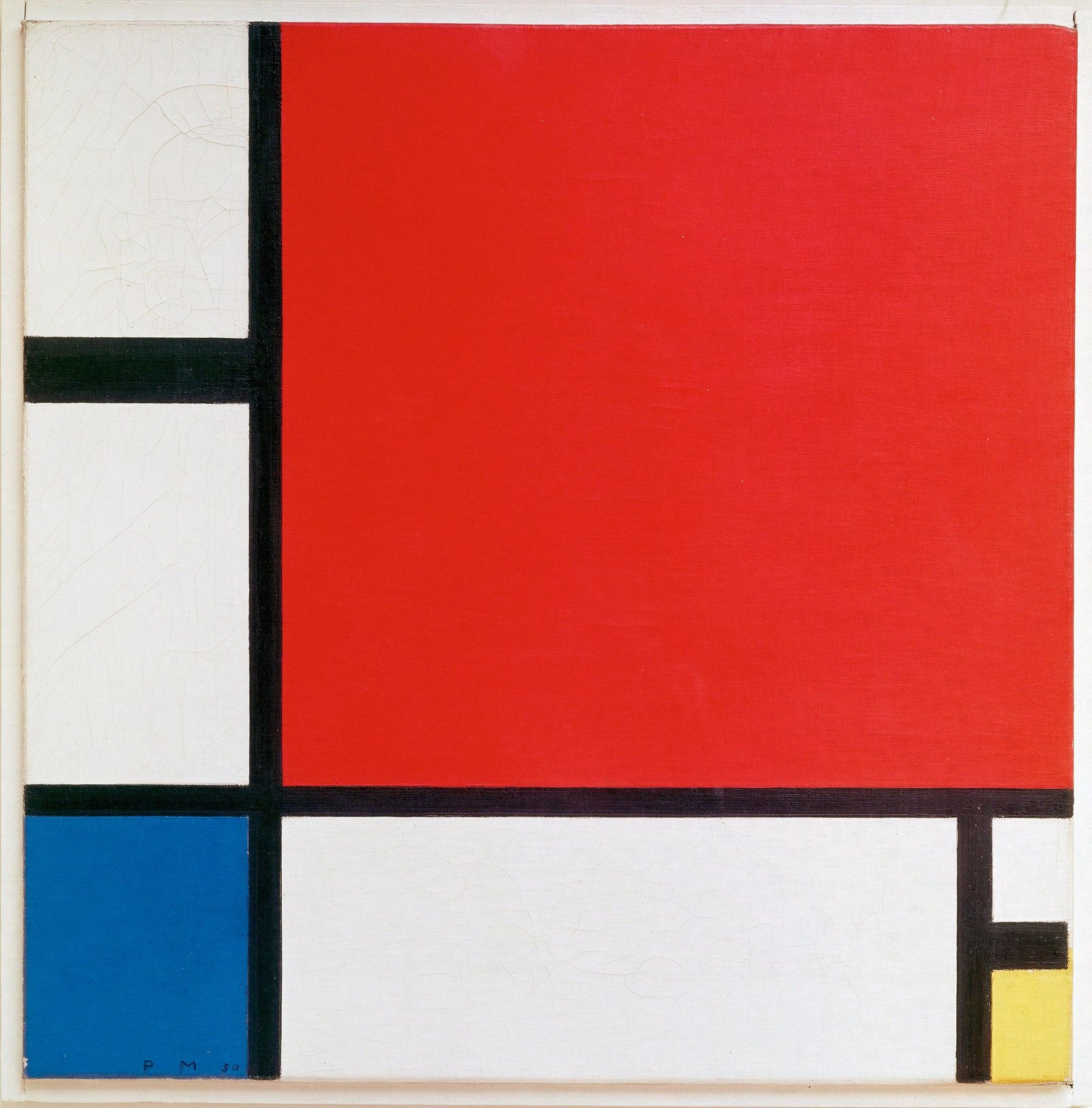
At first glance it is a few rectangles. Black lines on white, a large red field in the upper right, small blocks of blue and yellow below.
The simplicity is deceptive. The black lines are not of uniform thickness — Mondrian varied them deliberately so the grid would not go dead. If they were all equal, this would be graph paper. It is not.
Second thing worth noticing: the lines run to the edge of the canvas and stop. They do not close the composition into a frame. They imply that the arrangement continues beyond the picture — that we are seeing a fragment of something without limit.
The format is square, which is also a decision. No axis dominates, so the eye never settles and keeps circulating.
Breaking with De Stijl
This episode shows how seriously Mondrian took his own rules.
De Stijl was founded in 1917 around a journal edited by Theo van Doesburg. Mondrian was its most important painter and theorist.
In the mid-1920s van Doesburg began introducing diagonal lines into his compositions, calling the new direction Elementarism.
For Mondrian this was not acceptable. He held that the vertical and the horizontal corresponded to the fundamental forces of reality — rising and repose — and that the diagonal introduced arbitrariness and dynamism he wanted to exclude.
He left the movement in 1924. The friendship ended with it. They resumed contact only shortly before van Doesburg’s death in 1931.
This painting, made in 1930, therefore belongs to a period when Mondrian was defending his orthodoxy alone.
Historical context
By 1930 Europe was uneasy: the Depression was deepening, fascism was consolidating in Italy and gaining ground in Germany.
Art responded in different registers. The Surrealists went into the unconscious; the Expressionists shouted. Mondrian went the other way and looked for absolute order.
He was living in Paris, on the rue du Départ. His studio was a work in its own right: white walls hung with rectangles of coloured card that he rearranged like elements of a composition. The furniture was painted white; there was one red stool. Visitors described it as walking into a painting.
The name was a decision too. He was born Mondriaan, with two a’s. He changed the spelling around 1911, after moving to Paris.
What to look for
Line thickness. Compare the horizontal at the top with the vertical on the left. They differ, and that difference is the starting point of the whole composition.
The white. It is not one colour. Mondrian used several whites of slightly different tone across the fields, which is visible only in front of the canvas. Reproductions flatten it.
The surface. It is not smooth. Brushmarks are visible, and in places layers laid over corrections — Mondrian repainted his canvases repeatedly.
The edges of the colour fields. They are not perfectly straight. Close up you can see small irregularities. This is painted by hand, not printed.
The placement. The red is large and high, which ought to tip the composition over. It does not, because the white beneath acts as a counterweight. Mentally cover the lower half and watch it collapse.
Why these colours
Red, blue and yellow are the primaries — they cannot be produced by mixing other colours.
Mondrian called his system Neoplasticism. He reduced painting to the straight line, the right angle and the three primaries, with white, black and grey.
The thinking behind it came from theosophy, a spiritual movement concerned with laws hidden beneath appearances. Mondrian joined the Theosophical Society in 1909 and regarded his paintings as records of universal equilibrium rather than as decoration.
Hence the objection to green. Green is a mixed colour and the colour of plants — it belonged to the world art was supposed to transcend.
About Piet Mondrian
Born in Amersfoort in the Netherlands in 1872. He began with realist landscapes, windmills and flowers; his early paintings give no indication of what followed.
The turn came in Paris, around 1912, through Cubism. Over the next decade his trees and seascapes progressively dissolved into grids, until by about 1920 the last trace of the object had gone.
He moved to New York in October 1940, after the London Blitz — not in 1938, when he had first left Paris for England. He was sixty-eight.
America changed him. He discovered jazz and the pace of the city. The result was Broadway Boogie Woogie and the unfinished Victory Boogie Woogie, in which the black lines disappear altogether and are replaced by pulsing blocks of colour.
He died of pneumonia on 1 February 1944, three and a half years after arriving, aged seventy-one.
One further detail: he was an enthusiastic dancer. He went to dance halls regularly and reportedly took it badly when new steps did not fit his sense of rhythm.
Legacy and influence
Mondrian’s grid became a foundation of modern graphic design and architecture. Its traces run through the Bauhaus, through minimalism, and through Swiss typography.
In 1965 Yves Saint Laurent presented a collection of shift dresses based directly on these compositions. Six models, autumn 1965. The effect was immediate: the motif went onto the cover of Vogue and from there onto everything from advertising to shampoo packaging.
Mondrian did not live to see it, and would probably have objected — he insisted consistently that his paintings were philosophy rather than pattern.
One more thing worth knowing, and it is currently a subject of research: Mondrian’s whites have yellowed. He used several different whites with different stabilities, so the contrasts he calculated have shifted over time. The paintings are warmer now than they were.
Where to see it today
The painting hangs at the Kunsthaus Zürich, Heimplatz 1, in the centre of Zürich. Trams 3, 5, 8 and 9 stop nearby.
- Check opening hours and prices before you travel; the museum has extended evening hours on certain days.
- Weekday mornings are quietest.
- Get close, then step back. From two metres it looks like a graphic. From half a metre you see the brush, the corrections, and the fact that the whites are not the same.
- The Kunsthaus also holds work by Giacometti, Munch, Chagall and Léger, and one of the largest Munch collections outside Norway.
- The Chipperfield extension opened in 2021 and connects to the original building by an underground passage.
The largest holding of Mondrian’s work is elsewhere: Kunstmuseum Den Haag in The Hague has over three hundred pieces — the biggest collection anywhere, and the place to trace the path from windmills to the grid.
Frequently asked questions
Why only three colours?
Because red, blue and yellow are primary — they cannot be mixed from anything else. Mondrian built his paintings only from elements that could not be reduced further, together with white, black and grey.
Did Mondrian really dislike green?
Yes. Contemporary accounts record that he avoided looking at trees and had the trunks in his studio courtyard painted white. Green was the colour of nature, which his art was intended to leave behind.
Why are there no diagonals?
Because Mondrian held that only the vertical and the horizontal corresponded to fundamental forces. When Theo van Doesburg introduced diagonals into De Stijl, Mondrian left the movement in 1924 and broke off the friendship.
Did he paint anything other than grids?
Yes. For the first twenty years of his career he painted Dutch landscapes, windmills, trees and flowers. The abstraction crystallised only around 1920.
What changed after he moved to America?
Everything. He arrived in New York in 1940 and was taken with jazz and the tempo of the city. In the final paintings the black lines vanish and are replaced by pulsing fields of colour.
Where is the largest collection of his work?
Kunstmuseum Den Haag in The Hague — more than three hundred works, from the early landscapes to the mature compositions.
If this painting has caught your interest, look next at The Kiss by Klimt — made in the same era and heading in precisely the opposite direction: opulence instead of reduction, gold instead of three colours.
Image: Composition II in Red, Blue, and Yellow – Piet Mondrian (1930). License: Public Domain. Source: Wikimedia Commons.