The Calling of Saint Matthew
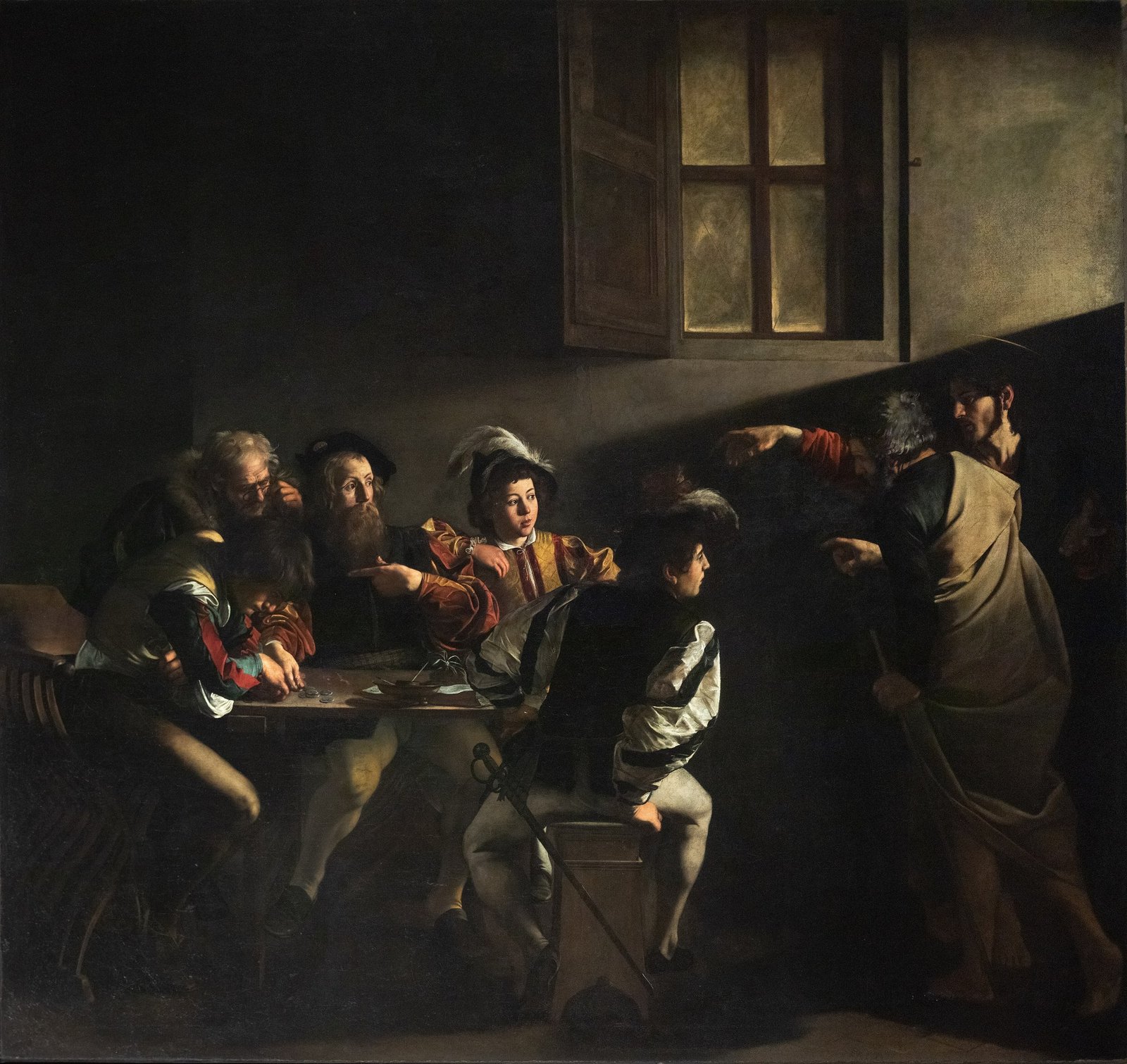
Christ is barely visible in this painting. Peter blocks him, and his face is in shadow — what you actually see is an outstretched hand. That hand is a quotation. Caravaggio took Adam’s hand from the Sistine ceiling and reversed its meaning. In Michelangelo, God gives life. Here he takes away the life you had.
Quick Facts
- Artist: Michelangelo Merisi da Caravaggio (1571–1610)
- Italian title: Vocazione di san Matteo
- Years: 1599–1600
- Medium: Oil on canvas
- Dimensions: 322 × 340 cm
- Movement: Baroque
- Location: San Luigi dei Francesi, Rome — Contarelli Chapel
What makes it unforgettable?
Religious painting before Caravaggio worked by convention: haloes, clouds, idealised bodies, antique drapery.
Here there is a dark room, a scarred table, scattered coins and five men dressed in the fashions of Rome around 1600 — plumed hats, velvet caps, slashed sleeves.
Only two figures wear biblical dress — Christ and Peter. The rest look like a party from the tavern down the street.
This was not a stylistic flourish. It was an argument: the call happens now, here, in the middle of counting money.
Which one is Matthew?
This is the most interesting dispute attached to the painting, and it deserves setting out properly.
The traditional reading: Matthew is the bearded man in the middle, pointing a finger at himself as if to say “me?” This has dominated for centuries.
The alternative: his finger points not at himself but sideways, at the young man bent over the coins at the end of the table. The gesture would then mean “him?”
Several things support the second reading. The young man is the only person who has not looked up — he is still counting. The light falls on his bent neck. And in The Martyrdom of Saint Matthew across the chapel the apostle is bearded, which would give continuity to the first reading, though years have passed and it settles nothing.
The argument has run for decades without resolution. Some scholars hold that Caravaggio left it open on purpose — the viewer decides who is being called.
Historical context
The commission had a long and unsuccessful history. Cardinal Matthieu Cointrel — Contarelli in Italian — left funds in his will of 1565 for the decoration of his chapel. He died in 1585 and nothing happened.
The work went first to a sculptor, then to the painter Cavaliere d’Arpino, in whose workshop Caravaggio had been an assistant. D’Arpino painted the vault and abandoned the rest.
In July 1599 the contract for the two side paintings went to Caravaggio. He was twenty-eight and had essentially no experience of large-scale work — until then he had produced small genre pieces.
Cardinal Francesco Maria Del Monte, his patron, in whose house he was living, helped secure it.
The paintings were unveiled in 1600. The effect was immediate — painters came from across Rome to see them, and Caravaggio became the most talked-about artist in the city overnight.
The wider setting was the Counter-Reformation. The Council of Trent had required religious art to be intelligible and affecting. Caravaggio took that literally, and repeatedly overshot what the Church found acceptable.
What to look for
Christ’s hand. Limp, falling, extended without tension. It is the reversed hand of Adam from The Creation of Adam. Caravaggio certainly knew the fresco.
The light. It enters from the upper right, from outside the frame. It runs exactly along Christ’s arm, as if the gesture were carrying it. It is not sunlight: the window in the wall is covered with oiled parchment and shows nothing.
The cross in the window. The window frame forms a distinct cross. Few people notice it.
Christ’s feet. Turned away, pointing towards the door. He is already leaving. The call lasts a second.
The two young men on the left. Well dressed, wearing rapiers. One looks at Christ with curiosity; the other has not registered anything.
The old man in spectacles. Bent over the coins, wearing eyeglasses — an expensive rarity. He cannot see what is happening.
The coins. Scattered on the table, painted with precision. They are the only part of the canvas given that degree of finish.
The division of the canvas. The upper half is almost empty and almost black. Caravaggio gave half his surface to darkness.
About Caravaggio
Michelangelo Merisi was born in Milan in 1571; the name comes from the town his family came from. Orphaned young, he trained with a local painter and arrived in Rome around 1592 with nothing.
He painted for dealers, then came under Del Monte’s protection. The Contarelli Chapel changed everything.
He was habitually violent. Court records survive from more than a dozen cases: brawls, insults, throwing a plate of artichokes at a waiter, abusing watchmen.
In May 1606 he killed Ranuccio Tomassoni in a fight — possibly during a ball game, though the circumstances are unclear. He was sentenced to death by beheading in absentia and fled Rome.
He spent his last four years in Naples, Malta and Sicily, painting continuously and staying ahead of the sentence. He died in 1610 at Porto Ercole, travelling back towards Rome and a pardon. He was thirty-eight.
Legacy and influence
The movement of followers is called Caravaggism, and it reached across Europe: Artemisia and Orazio Gentileschi in Italy, José de Ribera in Spain, Georges de La Tour in France, Hendrick ter Brugghen and the Utrecht school in the Netherlands.
Rembrandt never went to Italy, but he absorbed the manner through the Utrecht painters and made it his own.
One correction is worth making: Caravaggio did not invent tenebrism. Strong contrasts of light and dark have precedents in Northern painting and in Venice. What he did was push the device to its extreme and make it structural rather than decorative.
It is also worth knowing that his reputation collapsed for roughly three centuries. He was restored to the canon in the twentieth century, largely through the work of Roberto Longhi, whose 1951 exhibition in Milan put him back in the histories.
Where to see it today
The painting hangs where it was made — in the Contarelli Chapel, the last chapel on the left of the nave in San Luigi dei Francesi, a few minutes from the Pantheon.
- Entry is free, but the chapel lighting runs on a coin box. Bring coins or the paintings stay in gloom.
- The church closes over the middle of the day. Check hours before visiting; they change.
- Come in the morning. By the afternoon there are tour groups in front of the chapel and little room to stand.
- Look at all three. The Calling on the left, The Martyrdom of Saint Matthew on the right, Saint Matthew and the Angel on the altar. They tell the story from beginning to end.
- Note the direction of the painted light. Caravaggio matched it to the real window of the chapel.
- Nearby: the Pantheon, five minutes on foot, and Piazza Navona, three.
Two other Roman churches hold Caravaggios in situ: Santa Maria del Popolo and Sant’Agostino. Both are free to enter.
Frequently asked questions
Which figure is Matthew?
Unresolved. The traditional reading identifies the bearded man in the centre, apparently pointing at himself. Others argue his finger points sideways at the young man still counting coins — the only person who has not looked up. Caravaggio left no explanation.
Where does Christ’s gesture come from?
It is the reversed hand of Adam from Michelangelo’s Creation of Adam. Caravaggio quoted the most famous gesture in painting and inverted its sense.
Can you see Christ at all?
Barely. Peter blocks him and his face is in shadow. Only the hand is clearly visible. The painting is built around the gesture, not the person.
What is chiaroscuro?
A violent contrast of light and shadow. Caravaggio took it to an extreme, lighting figures as if by a spotlight in a dark interior. The extreme version is sometimes called tenebrism — a technique he intensified rather than invented.
How much does it cost to see?
Nothing. The church is free, though the chapel lights are coin-operated — a couple of euros is worth having.
What happened to Caravaggio?
He killed a man in a brawl in 1606, was sentenced to death in absentia, and fled Rome. He painted for four more years in Naples, Malta and Sicily, and died in 1610 while travelling back in hope of a pardon.
If this painting has caught your interest, look next at The Creation of Adam — the fresco Caravaggio took the gesture from, painted ninety years earlier a few hundred metres away.
Image: Vocazione di san Matteo – Caravaggio (1599–1600). License: Public Domain. Source: Wikimedia Commons.