The Colosseum
The Colosseum stands where a lake used to be. Nero had an artificial pond dug in the gardens of his palace; Vespasian drained it and built an amphitheatre for the public on the site. The gesture was legible to every Roman: a tyrant’s private pleasure ground returned to the city. The name is Nero’s too — it comes from the thirty-metre bronze colossus that stood beside it.
Quick Facts
- Original name: Amphitheatrum Flavium
- Construction: 72–80 AD
- Patrons: Vespasian and Titus; extended under Domitian
- Materials: travertine, tuff, brick, Roman concrete (opus caementicium)
- Dimensions: 188 × 156 m, height 48 m, circumference 527 m
- Capacity: estimated 50,000–80,000
- Movement: ancient Roman architecture
- Location: Rome, Italy
What makes the Colosseum unforgettable?
It is the largest amphitheatre ever built, and nothing has surpassed it in its category.
The most interesting part, though, is what you cannot see. Eighty numbered entrances ran around the perimeter, each leading into a system of corridors and stairs called vomitoria. Spectators were issued clay or bone tokens marked with entrance, section and row — a ticket, in all but name. Estimates suggest tens of thousands of people could clear the building in a quarter of an hour. Modern stadium design still works on the same principle.
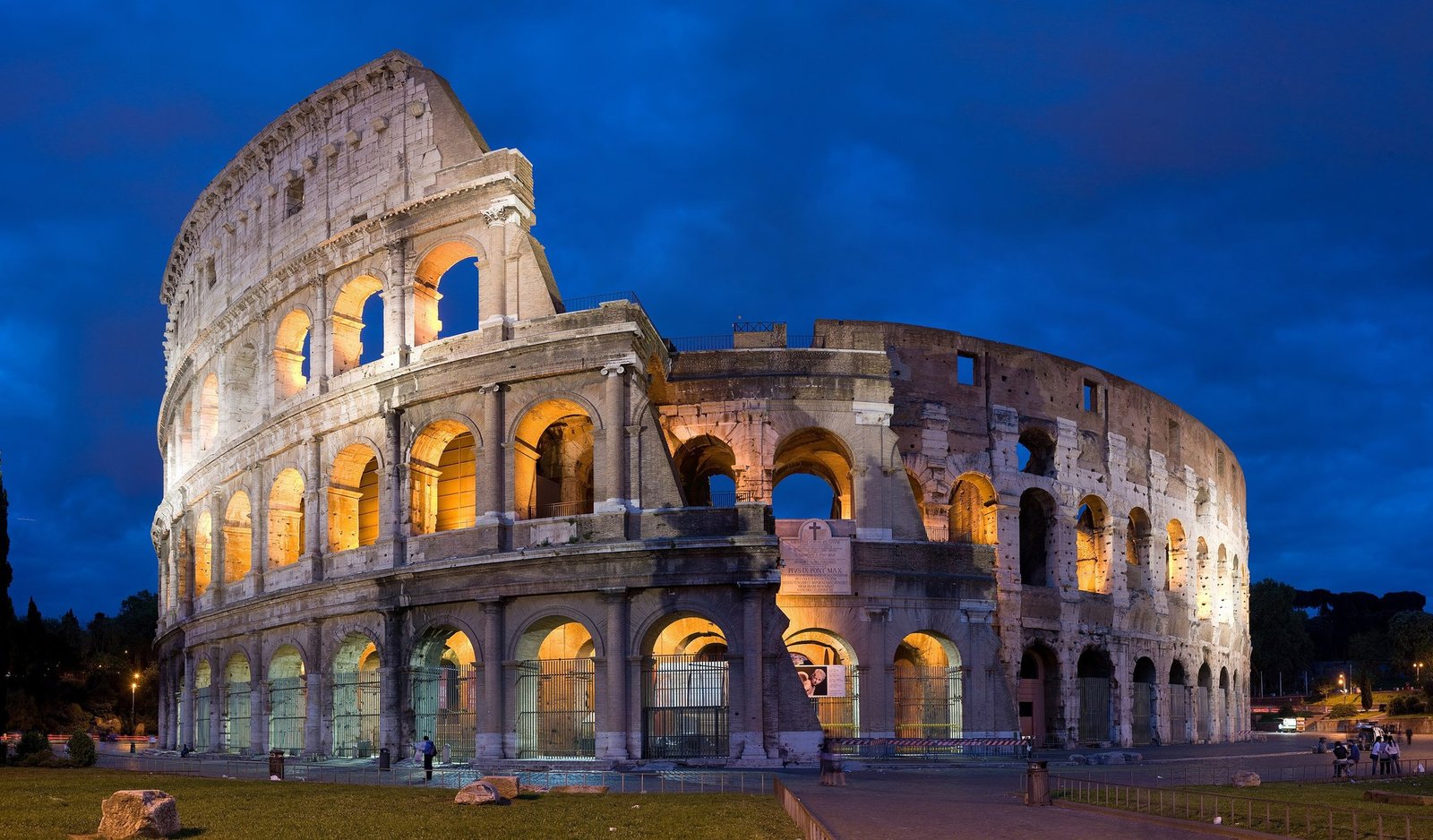
The façade carries three classical orders: Doric below, Ionic in the middle, Corinthian above. This was not decoration but argument — Rome demonstrating that it had absorbed the entire Greek tradition and stacked it in one building.
There is a fourth storey, and it is different: a solid wall articulated with Corinthian pilasters and small windows, added under Domitian. It holds the brackets for the awning masts.
It is also worth remembering that the structure was faced in marble and filled with hundreds of statues in the arcades. What looks today like a raw skeleton was once dazzlingly finished.
The velarium: the roof that isn’t there
This is the most under-appreciated element of the building.
A vast canvas awning, the velarium, could be drawn over the seating to shade it. It was held by a system of masts seated in stone corbels at the top of the wall — still visible today — and ropes running to bollards anchored outside the building.
It was operated by a detachment of sailors from the imperial fleet at Misenum. Nobody else had the rigging skills. Sources suggest around a thousand men.
The anchor stones survive in the pavement around the amphitheatre. Next time you walk the perimeter, look down.
Historical context
After Nero’s death in 68 AD, Rome went through a year of civil war. Vespasian emerged victorious and needed a gesture that would legitimise a new dynasty.
He chose the site of the Domus Aurea — Nero’s palace, which after the fire of 64 AD had swallowed a vast tract of central Rome. The ornamental lake was drained and an amphitheatre for the people built in its place.
The construction was funded from the spoils of Jerusalem, taken in 70 AD. An inscription survives recording that the building was paid for from war booty. Jewish prisoners were among the workforce.
Titus opened it in 80 AD with a hundred days of games. Cassius Dio records nine thousand animals killed.
The name “Colosseum” took hold in the Middle Ages and derives from the Colossus Neronis, a thirty-metre bronze statue standing beside it. Vespasian had Nero’s head recut into that of the sun god. The statue survived into the early medieval period; only its foundation remains.
What to look for
The holes in the stonework. Regular pits across the entire surface are where iron clamps bound the travertine blocks together. They were dug out in the Middle Ages for the metal. Those holes are a record of several centuries of dismantling.
The hypogeum. The underground network beneath the arena, uncovered in the nineteenth century. It held animal cages, gladiators’ quarters and around thirty lifts worked by hand-operated winches. An animal appeared on the sand suddenly, through a trapdoor. The hypogeum has been open to visitors since 2021.
The seating hierarchy. Society was reproduced exactly. Senators at the bottom, then equestrians, then citizens, and at the very top, in a standing wooden gallery, women, slaves and the poor — furthest from the arena and closest to the sun.
The cross on the arena floor. Placed in the twentieth century, commemorating supposed Christian martyrs. It marks a tradition rather than a documented fact.
Colour by time of day. Travertine is cream in the morning and honey-red at sunset. It is worth coming back in the evening.
Who built it
The architect is unknown. The design almost certainly came from imperial engineers — the same people who built aqueducts and siege machines.
Tens of thousands worked on it: free craftsmen, slaves, and prisoners brought back from the Jewish war. Completing a structure of this size in eight years required organisation on the scale of a military campaign.
The anonymity matters. This is not the work of a genius. It is the work of a state that knew how to organise tens of thousands of people around a single objective.
The slow dismantling
The last gladiatorial games were probably held in the fifth century; animal hunts continued into the sixth.
Then the building began its second life. It housed workshops, dwellings, a cemetery, and at one point a fortress belonging to the Frangipane family. By the thirteenth century the interior was effectively a neighbourhood.
The earthquake of 1349 brought down the southern section of the outer wall. That is when the Colosseum lost the shape it has in reconstructions and acquired the lopsided silhouette we know.
The rubble became a quarry. Travertine from the Colosseum went into the Palazzo Venezia, the Palazzo della Cancelleria and, by tradition, St Peter’s. Limestone was burned for quicklime.
The quarrying was stopped by Pope Benedict XIV in 1749, who declared the amphitheatre sanctified by the blood of martyrs and forbade the removal of material. A historically doubtful tradition saved the building.
Legacy and influence
The elliptical plan, arcaded façade and circulation system recur in almost every large stadium since.
In culture the Colosseum is shorthand for Rome and simultaneously a symbol of cruelty. It is worth remembering that the games were a political instrument — free entertainment through which an emperor bought the loyalty of the crowd.
Since 2000 the building has had another function: whenever a death sentence is carried out anywhere in the world, or a state abolishes capital punishment, the Colosseum is lit in gold. The city of Rome runs the initiative with the Sant’Egidio community.
It appears on the five-cent euro coin and on the list of the New Seven Wonders of the World chosen in 2007. More than twelve million people visit annually.
Visiting
The Colosseum is at the Colosseo station on metro line B.
- Book online and in advance. Timed tickets sell out days ahead in season; without one the queue can run to two hours.
- The standard ticket also covers the Roman Forum and the Palatine and is valid for twenty-four hours. Allow half a day.
- The hypogeum and arena floor need a separate, more expensive ticket and can only be seen with a guide. It is worth it — an entirely different experience from looking down from the tiers.
- There is no shade. In summer, come at opening or late afternoon.
- Evening visits are available seasonally.
- Check current prices and opening hours on the archaeological park’s official site.
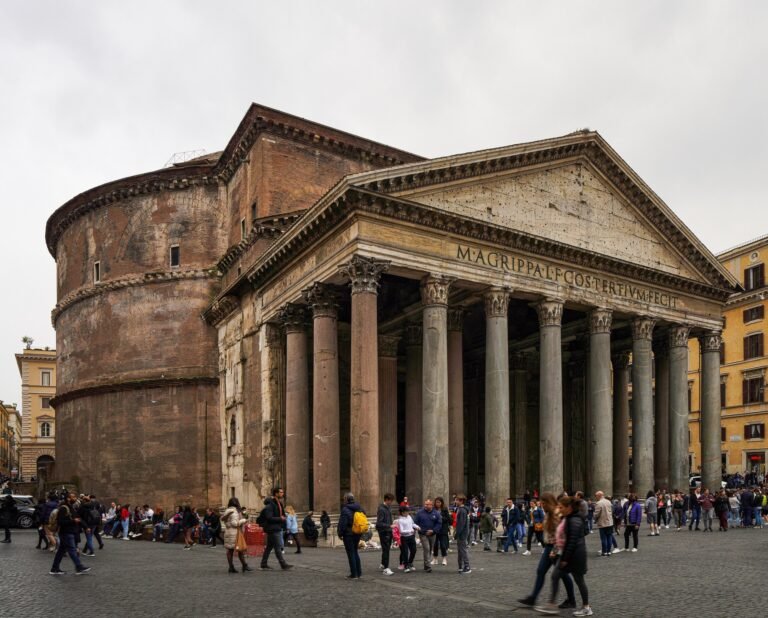
Nearby: the Arch of Constantine immediately outside, the Forum and Palatine on the same ticket, and twenty minutes’ walk away the Pantheon — the same concrete, the opposite purpose.
Frequently asked questions
Why is it called the Colosseum?
Officially it was the Flavian Amphitheatre. The name derives from the Colossus Neronis, a thirty-metre bronze statue that stood beside it, and became standard in the Middle Ages.
How many people did it hold?
Estimates range from 50,000 to 80,000. Seating was allocated strictly by social rank: senators nearest the arena, women and the poor at the top.
Why is it incomplete?
Partly the 1349 earthquake, which brought down the southern outer wall, and partly centuries of quarrying — stone and metal were carted off for Roman palaces and churches. Pope Benedict XIV stopped the practice in 1749.
Did Christians die here?
There is no firm evidence. The tradition is late and contemporary sources are silent. The Church has nonetheless treated the site as a place of martyrdom for centuries, and that tradition is what saved the building from complete demolition.
Was the arena really flooded?
Probably, but only in the earliest years. Cassius Dio describes naval battles during the inaugural games. Once Domitian built the hypogeum it became impossible.
What was the velarium?
A canvas awning drawn over the seating for shade, worked by sailors from the imperial fleet at Misenum. The corbels that held its masts are still visible at the top of the wall, and the anchor stones survive in the pavement outside.
If the Colosseum has caught your interest, look next at the Pantheon — built in the same era from the same concrete, but surviving whole, and with a dome that has still not been surpassed.
Image: The Colosseum, Rome (72–80 AD). License: Public Domain. Source: Wikimedia Commons.