Parthenon
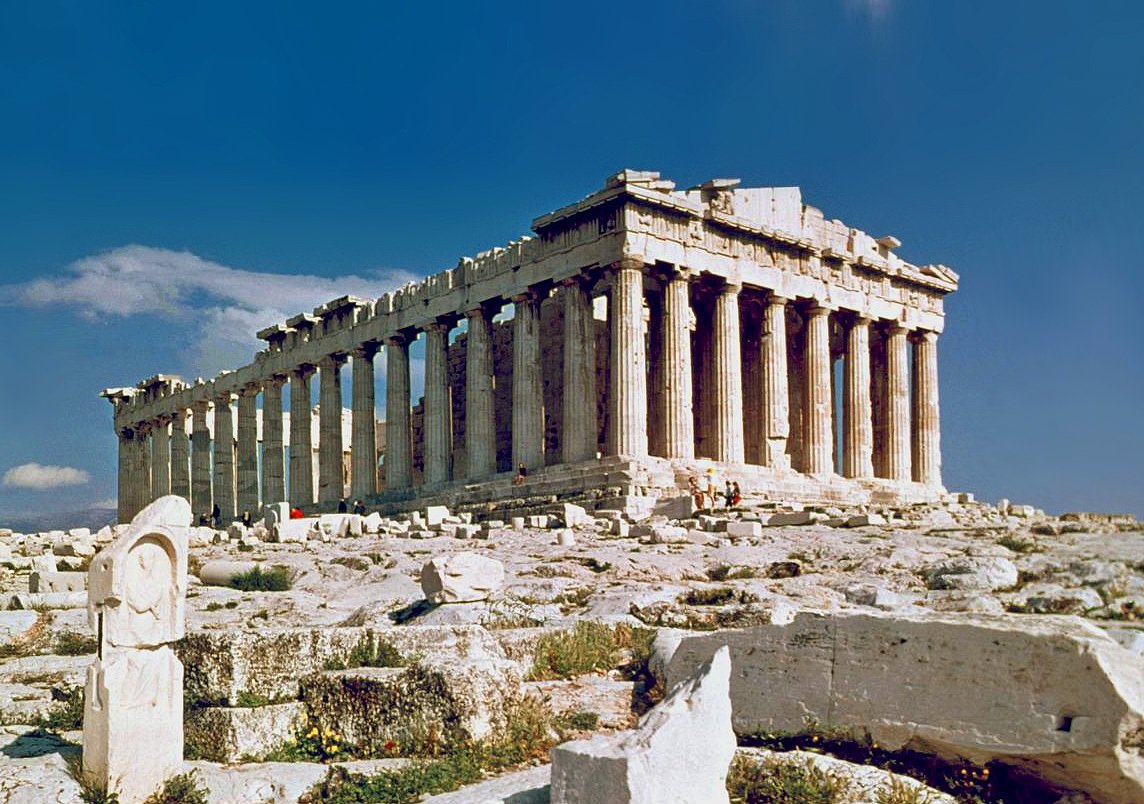
In 1687 the Parthenon was still largely intact, after twenty-one centuries. Then a Venetian mortar shell hit the Ottoman gunpowder store inside it. The explosion blew out the roof, collapsed the cella and destroyed a large part of both colonnades, killing around three hundred people. Everything we call the ruins of the Parthenon dates from one night.
Quick Facts
- Architects: Ictinus and Callicrates, with Pheidias directing the sculpture
- Construction: 447–438 BC; sculptural programme completed c. 432 BC
- Medium: Pentelic marble; Doric order with Ionic elements
- Dimensions: 69.5 × 30.9 m; columns 10.4 m tall
- Columns: 8 across the ends, 17 along the sides
- Movement: ancient Greek architecture
- Location: the Acropolis, Athens
What makes the Parthenon unforgettable?
There are almost no straight lines in this building, and that is the point.
The architects introduced dozens of deliberate deviations from regularity, known as refinements:
- The columns lean inward. If you extended their axes upward, they would meet roughly a mile and a half above the building.
- The stylobate curves. The platform rises towards the centre — about 11 centimetres along the long sides.
- The columns have entasis — a slight swelling at mid-height that corrects the eye’s tendency to read a straight shaft as concave.
- The corner columns are thicker than the rest and set closer to their neighbours, because seen against bright sky they would otherwise appear thinner.
The result is a building that looks perfectly straight while containing almost no straight line. It also meant every block had to be cut individually — there are no two identical elements in the structure.
It is worth adding that the Parthenon combines two orders. Externally it is Doric, but a continuous frieze runs around the cella, which is an Ionic feature. In 447 BC that was daring.
Historical context
Construction began in 447 BC, at the height of Athenian power, under Pericles.
The building replaced a temple destroyed by the Persians in 480 BC. The Athenians built the unfinished column drums of that earlier temple into the north wall of the Acropolis, deliberately visible from the city below — a permanent reminder of the invasion.
The funding was a scandal. The money came from the treasury of the Delian League, contributed by allied states for defence against Persia. Pericles moved the treasury from Delos to Athens and spent it on buildings. Plutarch records that opponents accused him of dressing up the city like a vain woman, with other people’s money.
Inside stood the Athena Parthenos — twelve metres of gold and ivory by Pheidias. The gold alone weighed over a tonne and was designed to be removable, so it could be melted down in an emergency. The statue disappeared in antiquity; we know it from descriptions and small copies.
Pheidias came to a bad end. He was accused of embezzling some of the gold, then of impiety — for including portraits of himself and Pericles on the goddess’s shield. According to Plutarch, he died in prison.
Eighteen hundred years of conversion
This is the most under-told part of the building’s history.
Temple of Athena — from 438 BC.
Christian church — from around the sixth century, dedicated to the Virgin Mary. An apse was cut through the eastern wall, the colonnades were walled in, and a bell tower was added. Some metopes were defaced because they showed pagan deities.
Mosque — after the Ottoman capture of Athens in 1458. The bell tower became a minaret.
Gunpowder store — and that ended it. On 26 September 1687, during the Venetian siege, a mortar round from Francesco Morosini’s artillery hit the magazine inside. The building was torn open.
Immediately afterwards Morosini tried to remove the sculptures of Poseidon and Athena’s horses from the western pediment. The lifting tackle failed, and the sculptures fell and shattered.
What to look for
Entasis. Look along a column shaft from the side. The swelling is a matter of millimetres but visible once you know it is there.
The metopes. The panels between the triglyphs show four battles: Lapiths against centaurs, gods against giants, Greeks against Amazons, and the Trojan War. Each is the same metaphor — order against chaos.
The frieze. A continuous band of relief 160 metres long, with over three hundred human figures and two hundred animals, usually read as the Panathenaic procession. What is remarkable is the subject: a temple decorated not with gods or heroes but with Athenians themselves.
Colour. The Parthenon was not white. Metopes, frieze and architectural details carried red, blue and gold. Imaging studies have confirmed traces of pigment, including Egyptian blue. The white we admire is weathered stone.
The marble changes colour. Pentelic marble contains iron, which oxidises. In afternoon light the building takes on a warm honey tone.
The Parthenon Marbles
Between 1801 and 1812, Lord Elgin, British ambassador to the Ottoman Porte, had roughly half the surviving sculpture removed — most of the frieze, fifteen metopes and figures from both pediments. They went to London, and in 1816 the British government bought them for the British Museum.
Elgin claimed Ottoman authorisation. The original document does not survive; only an Italian translation of disputed scope.
The removal was controversial from the start. Byron called Elgin a plunderer in Childe Harold’s Pilgrimage.
Greece has been requesting the return since the 1970s. In 2009 the Acropolis Museum opened with a gallery built for them: the top floor has the exact dimensions of the Parthenon cella and faces the hill. The missing sections are filled with white plaster casts, so the gaps are impossible to overlook.
Talks between Greece and the British Museum continue. Several institutions — including the Vatican and a museum in Sicily — have returned fragments in recent years.
Legacy and influence
Neoclassicism took the Parthenon as its standard. Its influence runs through the British Museum, the Brandenburg Gate, the Walhalla near Regensburg, and much of official Washington.
There is a full-scale replica in Nashville, Tennessee, completed in 1897, including a reconstruction of the Athena Parthenos. It is the only place on earth where you can see what the interior looked like.
It is also worth knowing that the building you visit is partly a reconstruction. Restoration work has been running since 1975, much of it undoing damage from repairs made around 1900, when iron clamps were used. The iron rusted, expanded, and cracked the marble from inside. Ancient clamps had been sealed in lead, which insulated them. The Greeks knew something the engineers of 1900 did not.
Visiting
The Parthenon stands on the Acropolis in Athens. Nearest metro station: Akropoli, on the red line.
- You cannot go inside. The route runs around the building. Worth knowing in advance — it is the commonest disappointment.
- Arrive at opening or in the last two hours. In July and August the site is sometimes closed during the hottest part of the day.
- There is no shade. Bring water and a hat.
- The marble underfoot has been polished by millions of visitors and is slippery. Footwear matters.
- A combined ticket covers several sites in Athens. Check current prices and hours before you travel.
- The Acropolis Museum is not optional. At the foot of the hill: the original Erechtheion caryatids, surviving frieze sections, and a gallery that shows you exactly what is missing.
Also on the hill: the Erechtheion with its caryatid porch, the Temple of Athena Nike, and the Propylaea. The whole site takes two to three hours.
Frequently asked questions
Why is the Parthenon a ruin?
Because of an explosion on 26 September 1687. A Venetian shell struck an Ottoman gunpowder store inside the building during a siege. Until that night the Parthenon, despite conversions into a church and a mosque, was largely intact.
When was it built?
Between 447 and 438 BC, with sculptural decoration finished around 432 BC. The structure itself went up in nine years.
Was it white?
No. The sculptures and architectural details were painted in red, blue and gold; traces of pigment survive. The white marble is the result of centuries of weathering.
What are the Parthenon Marbles?
Roughly half the surviving sculptural decoration, removed between 1801 and 1812 by Lord Elgin and held in the British Museum since 1816. Greece is seeking their return.
Can you go inside?
No. Visitors walk around the exterior. The interior is closed because of structural condition and ongoing restoration.
Why do the columns lean?
Because vertical columns look as though they splay outward when seen from below. All of them tilt slightly inward; their axes would converge about a mile and a half overhead. It is one of several optical corrections built into the structure.
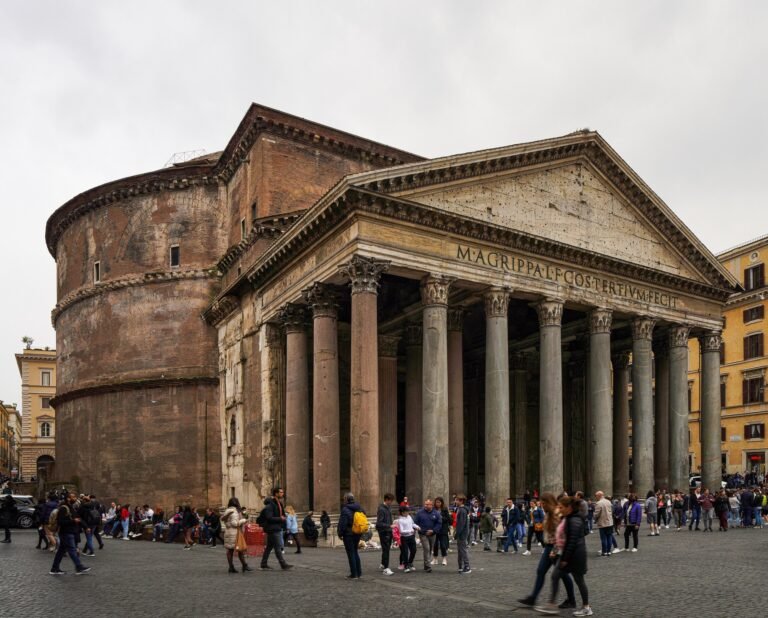
If the Parthenon has caught your interest, look next at the Pantheon in Rome — a temple built five centuries later from an entirely different material and on an opposite principle: not to impress from outside, but to overwhelm from within.
Image: The Parthenon, Athens (447–432 BC). License: Public Domain. Source: Wikimedia Commons.