Winged Victory of Samothrace
A few metres from this sculpture, in a glass case on the landing, sits her right hand. It was found on Samothrace in 1950, eighty-seven years after the statue itself. The fingers are open. That single detail settled an argument that had run for a century: Nike was not holding a wreath, or a trumpet, or a stylus. She was holding nothing at all.
Quick Facts
- Artist: Unknown — probably a Rhodian workshop
- Date: c. 200–185 BC
- Medium: Parian marble (figure); grey Lartos marble from Rhodes (base)
- Height: 244 cm for the figure; c. 550 cm for the whole monument with base and plinth
- Movement: Hellenistic art
- Location: Louvre, Paris — top of the Daru staircase
What makes it unforgettable?
Most ancient statues stand. This one has just landed.
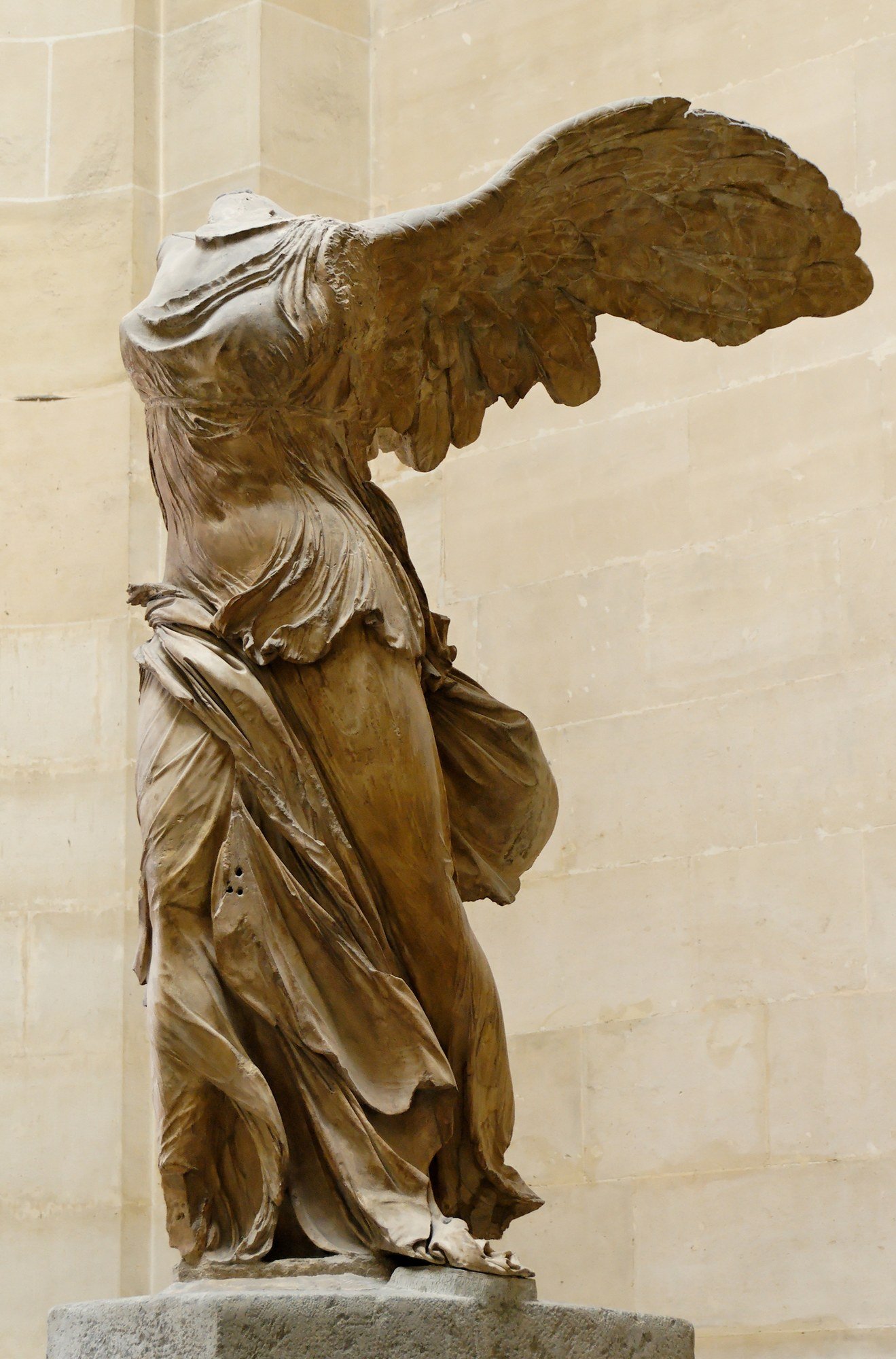
The sculptor caught the instant when the goddess’s foot touches the deck of a ship. The body has not stopped moving, the drapery is still streaming backwards, the wings are still spread.
The fabric is the astonishing part. It clings to the torso as though soaked, and simultaneously tears away from the body in violent folds. One block of marble, two entirely different behaviours of cloth.
It is also worth knowing that this was never meant to stand alone in a gallery. It was set into a niche cut into a hillside on Samothrace, above a pool of water, so that the reflection reinforced the impression of a ship surging towards the viewer. The whole arrangement was staged.
The hand that was found
This is the most interesting chapter in the sculpture’s history, and most accounts skip it.
In 1950 an American excavation led by Karl Lehmann was working in the sanctuary on Samothrace. They found the goddess’s right hand — missing the thumb and ring finger, which turned out to be in a Viennese collection.
Greece transferred the hand to the Louvre. It sits today in a case on the staircase landing, a few metres from the statue. Most visitors walk past while photographing the sculpture.
It resolved an old question. For decades scholars had assumed Nike held something — a wreath, a trumpet, a stylus — because that is how she appears on coins. An open hand with spread fingers rules all of that out.
The accepted reading now is that she was raising her hand in a gesture of greeting or proclamation. Arm up, palm open, nothing in it.
Historical context
Around 200–185 BC the Hellenistic world was in permanent competition. Rome was expanding eastwards and the successor kingdoms were fighting for control of the Aegean.
The material of the base points to who paid for it. The grey marble comes from the Lartos quarries on Rhodes. The monument is usually connected to naval victories of the Rhodian fleet over Antiochus III, at Side and Myonnesus in 190 BC — though the dating is not settled and some scholars argue for an earlier date.
Samothrace was one of the most important cult sites in the Greek world. The Sanctuary of the Great Gods hosted mystery rites; among the initiates were Philip II of Macedon and Olympias — Alexander’s parents. A dedication on this scale would have been seen by thousands of pilgrims a year.
What to look for
The base. It is a warship’s prow, carved in grey marble with remarkable precision — you can still see where bronze fittings were attached. The base is part of the scene, not a pedestal.
The wings. Both survive, though the right one is in worse condition and was partly restored in plaster in the nineteenth century. It is not, as sometimes claimed, a complete reconstruction.
The twist. The figure is not frontal. The torso turns, the left leg is forward, the hips are displaced. Walk around it if the crowd allows — the degree of torsion is only visible from the side.
Uneven finish. The left side is worked more carefully than the right. This tells us the monument was designed to be seen from one direction — from the lower left, along the path leading up to the sanctuary.
Two states of cloth. Wet and clinging at the front, loose and flying behind. Compare them.
The discovery, and what followed
In April 1863 the French vice-consul at Adrianople, Charles Champoiseau, was excavating on Samothrace. He found the figure broken into more than a hundred pieces and shipped them to Paris.
He left the base behind. He judged the grey blocks of the ship’s prow to be of no interest. Only after Austrian archaeologists published a reconstruction showing what they were did Champoiseau return, in 1879, to collect them.
The sculpture was reassembled and installed at the top of the Daru staircase in 1884 — a position chosen specifically for it.
Between 2013 and 2014 it underwent a full conservation. It was dismantled, cleaned of yellowed accretions, and the marble was seen in something close to its original colour for the first time in 130 years.
Legacy and influence
The Futurists saw in her an ancestor of their own aesthetic of speed. Marinetti wrote in the 1909 manifesto that a roaring racing car was more beautiful than the Victory of Samothrace — a provocation, obviously, but one that tells you what status she held.
The sportswear company Nike takes its name from the goddess, and the swoosh is often described as a stylisation of her wing. Accounts of the logo’s origin vary, but the connection to the name is not in doubt.
The deeper influence is different. This sculpture taught modern audiences that a fragment can be complete. Headless and armless, it works more powerfully than many intact statues — and that recognition shaped nineteenth-century thinking about the unfinished in art, right through to Rodin.
Where to see it today
She stands at the top of the Daru staircase in the Louvre. She is one of the few objects in the museum you do not need to hunt for — the stairs lead directly to her, and she is visible from the bottom.
- Stop at the foot of the stairs. The sculpture was designed to be seen from below and at an angle. Most people run up and look at it from a metre away, losing the effect entirely.
- Find the case with the hand. It is on the landing, to the right. Easy to miss without knowing it is there.
- The Louvre is closed on Tuesdays. Check hours and prices before you travel — since 2026 there are higher rates for visitors from outside the EU.
- Early morning is quietest. After 11 a.m. the space around her fills up.
- The Venus de Milo is in the Sully wing; continuing past Nike towards Denon brings you to the Mona Lisa and Liberty Leading the People.
Frequently asked questions
Why does she have no head?
The head and arms have never been recovered. When the statue was found in 1863 it was already in more than a hundred fragments, without them. The damage probably occurred in antiquity, when the niche collapsed.
Have any missing parts been found?
Yes. In 1950 American archaeologists found the goddess’s right hand on Samothrace; two fingers had reached Vienna earlier. The hand is now in the Louvre, in a case near the statue — open, with spread fingers, proving that Nike held nothing.
Who discovered it?
Charles Champoiseau, a French vice-consul, in April 1863. He initially left the ship’s-prow base behind as worthless and returned for it sixteen years later.
Why is she standing on a ship?
Because the monument commemorates a naval victory. The base is carved from Rhodian marble, which points to Rhodes as the dedicating party — most often linked to the battles of Side and Myonnesus in 190 BC, though this is not certain.
How old is she?
Roughly 2,200 years. Current dating places her between 200 and 185 BC, in the Hellenistic period.
Was she painted?
Probably, at least in part — ancient marbles were routinely painted. The 2013–2014 conservation restored the colour of the stone itself, which had been obscured by yellow deposits for over a century.
If the Winged Victory has caught your interest, look next at the Venus de Milo — the Louvre’s other great Hellenistic sculpture, also armless, also anonymous, but saying something entirely different: stillness instead of flight.
Image: Winged Victory of Samothrace (c. 200–185 BC). License: Public Domain. Source: Wikimedia Commons.