Notre-Dame de Paris
Notre-Dame has been saved twice by the same thing: attention. In the 1820s it was in such poor condition that demolition was discussed, and a novel rescued it. In April 2019 fire took the spire and the roof, and what saved it was that the whole world was watching. The famous chimeras, which almost everyone assumes are medieval, are a souvenir of the first rescue.
Quick Facts
- Initiated by: Bishop Maurice de Sully
- Construction: 1163–1345
- Style: French Gothic
- Materials: Lutetian limestone, oak, lead, stained glass
- Dimensions: 128 m long, 48 m wide, vault height 33 m
- Towers: 69 m; spire (rebuilt) 96 m
- Location: Île de la Cité, Paris
What makes Notre-Dame unforgettable?
In the Middle Ages a cathedral was the tallest thing human beings knew how to build, and that was the message.
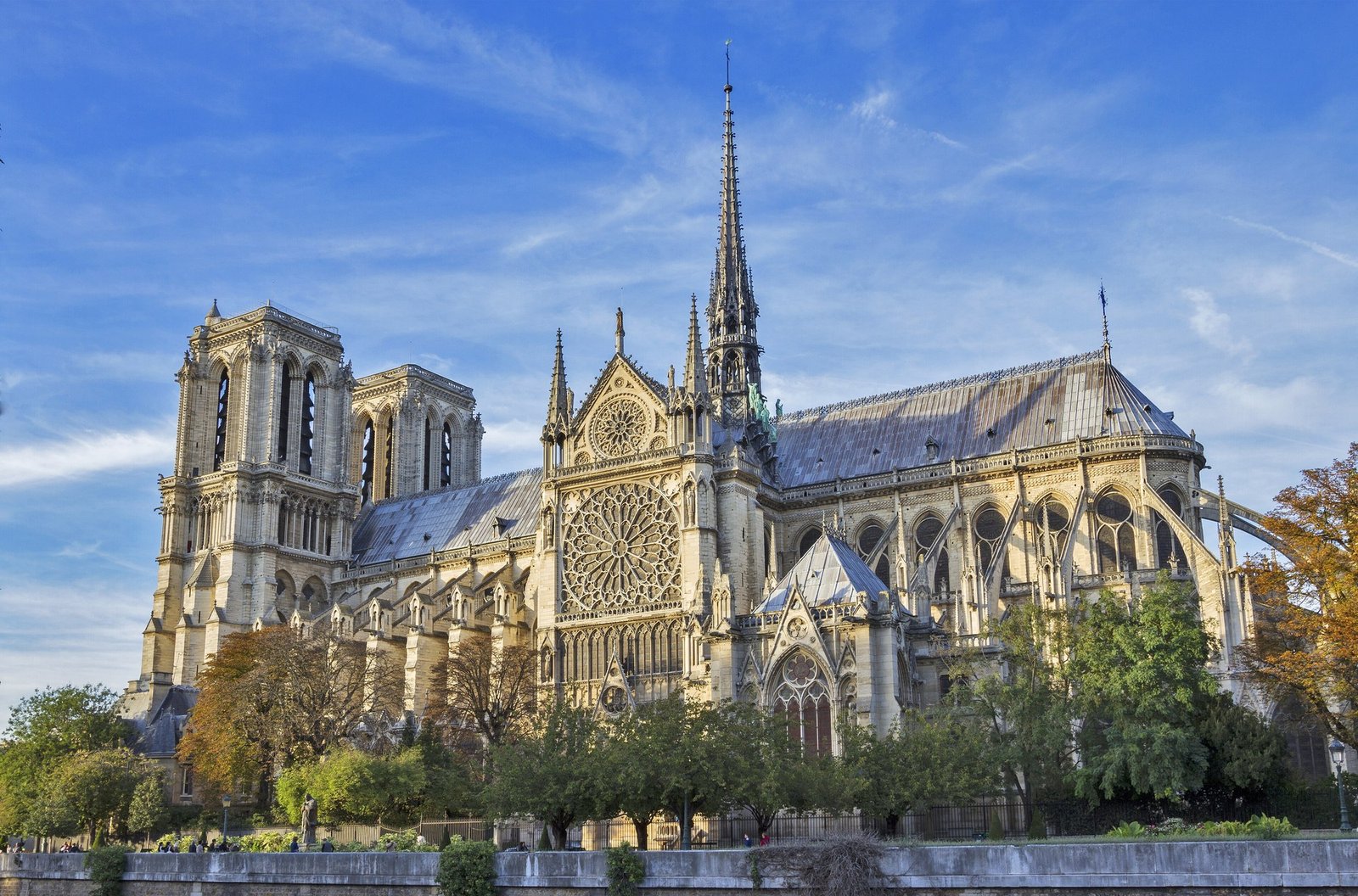
Notre-Dame combines mass with lightness. This is where flying buttresses were first used on this scale. They carry the thrust of the vaults out to external piers, which meant the walls could be thin and the windows enormous. Without that solution, Gothic as we know it does not exist.
It is also worth knowing that the building took nearly two centuries and it shows. The choir, the oldest part, is still heavy and Romanesque in its proportions. The west front is mature Gothic. The transept arms with their great roses belong to the Rayonnant style. Walking through the building means walking through three generations of architecture.
Historical context
Construction began around 1163 under Bishop Maurice de Sully. Paris was expanding — the university was forming, and the Capetian court was gaining weight.
The work ran across generations. Nobody who laid the first stones lived to see it finished. The choir was completed in 1177, the nave in the 1220s, the west front around 1250, and the last chapels only in the mid-fourteenth century.
The cathedral witnessed events worth naming precisely:
- 1431 — Henry VI of England crowned King of France here, at the height of the Hundred Years’ War.
- 1793 — during the Revolution the building was rededicated as a Temple of Reason. Twenty-eight statues were beheaded from the Gallery of Kings, mistaken for French monarchs. They were in fact the kings of Judah.
- 1804 — Napoleon’s coronation. Contrary to popular belief, he did not crown himself in defiance of the Pope. Pius VII presided and anointed him; Napoleon placed the crown on his own head, but this had been agreed in advance. David’s painting shows the moment he crowns Joséphine.
- 1944 — a Te Deum sung for the liberation of Paris.
The 1793 story has a postscript worth knowing. The severed heads were assumed lost. They were found in 1977, by chance, during building work beneath a bank courtyard on the rue de la Chaussée-d’Antin. Somebody had buried them there two centuries earlier. Twenty-one heads are now in the Musée de Cluny.
What to look for
The three portals. Centre: the Last Judgment. Left: the Virgin. Right: Saint Anne. The sculpture was a readable narrative for people who could not read. At the Last Judgment portal, look for the weighing of souls and the devil trying to tip the scales.
The Gallery of Kings. Twenty-eight figures above the portals. The present ones are nineteenth-century replacements; the original heads are in Cluny.
The roses. The west rose is 9.6 metres across and the oldest. But the transept roses are the more extraordinary: the north rose, about thirteen metres wide, retains most of its original thirteenth-century glass. That is rare almost anywhere in Europe. It survived the 2019 fire.
Direction of light. The north rose sits in shadow and burns cold blue; the south catches the afternoon sun and turns red. If you want to see the glass at its best, come in the afternoon and stand in the transept.
The chimeras. Those celebrated creatures on the tower balustrade are not medieval. Viollet-le-Duc designed them in the 1850s. The most famous — the Stryga, chin on hands, staring out over the city — dates from around 1850.
Gargoyles. Different thing entirely. They are functional waterspouts, and some are original.
Who built it
Notre-Dame has no single architect. It was built by generations.
A few names survive. Maurice de Sully began the project. Jean de Chelles and Pierre de Montreuil directed work in the thirteenth century and are responsible for the transept and its roses. On the south transept façade an inscription records Jean de Chelles’s name and the date 1258 — one of the very few medieval architects’ signatures anywhere.
The rest were anonymous masons, carpenters, glaziers and smiths. The knowledge passed from master to apprentice. What they built has stood for eight hundred years.
Two rescues
First: a novel.
By the 1820s the cathedral was in wretched condition. The Revolution had stripped it of sculpture, the roof leaked, and demolition was seriously discussed.
In 1831 Victor Hugo published Notre-Dame de Paris. The book was in effect a campaign for saving medieval architecture — Hugo devoted an entire chapter to describing the building and lamenting its neglect. It became a bestseller, and public opinion forced action.
The restoration went to Eugène Viollet-le-Duc, who worked on it from 1844 to 1864. He recreated the sculpture, designed the chimeras and built a new spire — the previous one had been dismantled in 1786 because it was unsafe.
Viollet-le-Duc put sixteen copper statues of apostles and evangelists around the spire. The face of Saint Thomas, patron of architects, is his own self-portrait. The figure turns to look back at the cathedral while the others face outward.
Second: fire.
On 15 April 2019 fire broke out beneath the roof. The entire timber frame burned — a thirteenth-century structure of more than a thousand oaks, known as “the forest.” Viollet-le-Duc’s spire collapsed. The vault was breached in three places.
The windows, the great organ, the Crown of Thorns and most of the treasury were saved. Firefighters made the decision to defend the towers — had the bells caught and fallen, the building would probably have gone with them.
A piece of luck: the sixteen copper statues had been lifted off the spire four days earlier for scheduled conservation. All of them survived.
Restoration took five years and cost close to a billion euros in donations. It included rebuilding the timber frame from oaks sourced across France, using traditional carpentry. The cathedral reopened on 7 December 2024.
The cleaning produced an unexpected result: the interior is far brighter than anyone alive remembered. Centuries of candle soot and pollution were removed for the first time.
Visiting
The cathedral stands on the Île de la Cité in the 4th arrondissement. Nearest métro: Cité.
- Entry to the cathedral is free, but since reopening a free timed booking is in operation. Without one you queue, and the queue can be long.
- Come at opening or late in the afternoon.
- The towers are a separate, paid visit up a narrow spiral staircase — nearly four hundred steps, no lift. Tickets go quickly.
- In the afternoon, stand in the transept and look at the south rose. It is the best light in the building.
- Hours, booking rules and tower availability have changed repeatedly since reopening. Check the official site before you go.
Nearby, on the same island: Sainte-Chapelle, with fifteen windows running from floor to vault, the Conciergerie, and the archaeological crypt beneath the forecourt. The Gallery of Kings heads are in the Musée de Cluny, twenty minutes’ walk away.
Frequently asked questions
When was Notre-Dame built?
Construction began around 1163 and the main work was finished by about 1345 — nearly two centuries, across several generations of builders.
Is the cathedral open after the fire?
Yes. It reopened on 7 December 2024, after five years of restoration. Entry is free but requires a timed booking.
Are the chimeras medieval?
No. Eugène Viollet-le-Duc designed them in the mid-nineteenth century during the restoration. The gargoyles — carved waterspouts — are a different thing, and some are original.
What was lost in the 2019 fire?
The thirteenth-century oak roof frame, built from over a thousand trees, and the nineteenth-century spire. The vault was breached in three places. The towers, windows, organ and treasury survived.
Did Napoleon crown himself?
Not quite. Pope Pius VII presided over the 1804 ceremony and anointed him. Napoleon placed the crown on his own head, but this was arranged beforehand rather than an act of defiance.
How long does a visit take?
Thirty to sixty minutes for the interior. Add an hour for the towers. With the archaeological crypt, allow two hours.
If Notre-Dame has caught your interest, walk five minutes to Sainte-Chapelle — a chapel built in seven years rather than two centuries, where the walls have effectively been replaced by glass.
Image: Notre-Dame de Paris (1163–1345). License: Public Domain. Source: Wikimedia Commons.