Great Sphinx of Giza
We know who broke the Sphinx’s nose. It was not Napoleon — that story appeared centuries later. The fifteenth-century Egyptian historian al-Maqrizi recorded that in 1378 a Sufi named Muhammad Sa’im al-Dahr defaced the statue, enraged that local peasants were making offerings to it. According to the account, he was executed for it.
Quick Facts
- Arabic name: Abu al-Hol — “Father of Terror”
- Maker: unknown; usually attributed to the reign of Khafre
- Date: c. 2500 BC, Fourth Dynasty, Old Kingdom
- Medium: carved directly from living limestone bedrock
- Dimensions: 73 m long, 20 m tall, face approximately 4 m wide
- Movement: ancient Egyptian art
- Location: Giza Plateau, Egypt
What makes the Sphinx unforgettable?
This is not a statue that was placed somewhere. It is a rock from which everything that was not a sphinx was removed.
Workers cut a horseshoe-shaped trench around the outcrop and left the mass standing in the middle. The blocks quarried in the process went into the Sphinx Temple immediately in front of it — the same limestone, the same operation. Sculpture and building came out of a single cut.
It remains the largest surviving monolithic sculpture from antiquity.
The message was straightforward. A human head on a lion’s body joined the intelligence of a ruler to the strength of a predator. The Sphinx faces due east and sits on the axis of Khafre’s pyramid complex — it is not a free-standing monument but part of a larger funerary arrangement.
The beard is in London
This is a detail that rarely gets mentioned, and it is a surprising one.
The Sphinx wore a ceremonial plaited beard — an item of royal costume, not facial hair. It came away at some unknown point, probably in antiquity.
Fragments were recovered in 1817 by Giovanni Battista Caviglia during clearance work. The largest piece went to the British Museum in London, where it remains. A smaller fragment stayed in Egypt.
Egypt has requested its return more than once. The case remains open, though it attracts nothing like the attention given to the Parthenon Marbles.
Scholars also disagree about whether the beard belonged to the original carving or was added during the New Kingdom, more than a thousand years later.
Buried for millennia
For most of its history the Sphinx was invisible.
Sand buried it to the neck repeatedly. We know of at least three major clearances: under Thutmose IV around 1400 BC, in the Roman period, and again in the twentieth century.
The first of these left a document. Between the paws stands the granite Dream Stele, erected by Thutmose IV. It records that the young prince fell asleep in the statue’s shadow, that the Sphinx appeared to him in a dream asking to be cleared of sand, and promised him the throne in return. Thutmose cleared it and became pharaoh.
Historians treat this as propaganda justifying the accession of a prince who was not first in line. But the stele is real, and it is still there.
Full excavation came only between 1925 and 1936, under Émile Baraize. That was the first time in millennia that anyone saw the entire lion body.
When Napoleon arrived in 1798, he saw the head and the upper back. Everything else was under sand.
What to look for
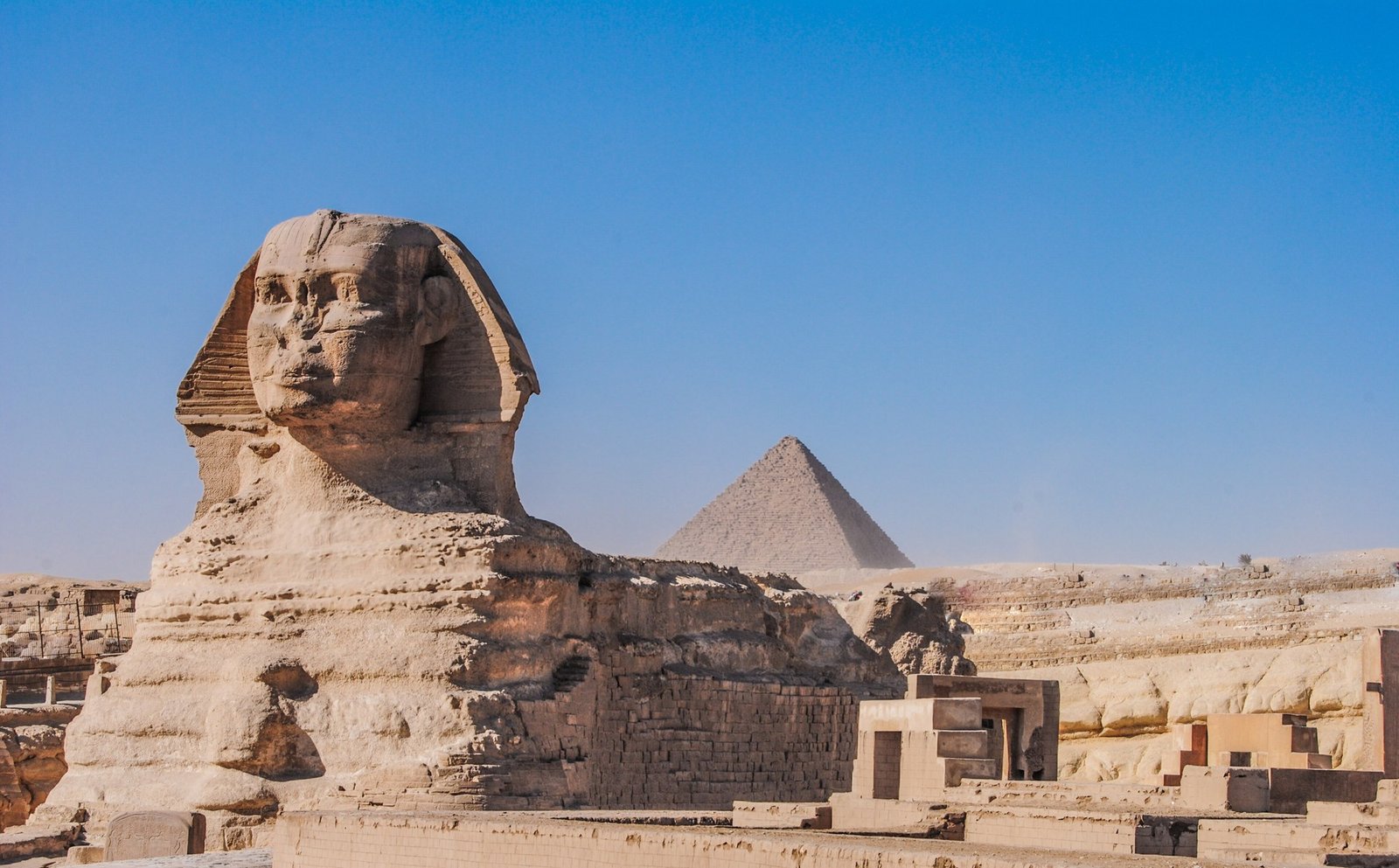
The scars from the beard and the nose. Flat areas on the face mark where elements were struck off. The nose was removed with a chisel — two points of impact are visible on either side.
Colour. Traces of red pigment survive on parts of the face sheltered from wind. The Sphinx was painted: the face red, the headdress probably in blue and yellow stripes.
The rock layers. The body is cut through three bands of limestone of differing hardness. The middle band is the softest and has eroded fastest, which is why the flanks look rippled and deeply grooved.
The Dream Stele. The granite slab between the paws. Visible from the viewing area, though not legible from there.
The tail. Wrapped around the right hind paw. Easy to miss, and complete.
The tunnels. There are three passages cut into the body — one behind the head, one in the tail, one in the north flank. All have been investigated. None leads anywhere. They are almost certainly the work of treasure hunters.
The argument about its age
It is worth knowing that the dating has been challenged.
The standard chronology places the Sphinx in the reign of Khafre, around 2500 BC, on the basis of its position within his complex, the carving technique, and the archaeological context.
In the 1990s the geologist Robert Schoch argued that the vertical channels in the walls of the enclosure were produced by rainfall rather than wind, which would push the date back before 5000 BC, when the region was wetter.
Egyptologists reject this. The erosion pattern is explained by the composition of the rock and by moisture, and moving the date would require an advanced civilisation for which no other evidence exists anywhere.
The argument is worth knowing because it recurs in popular books, usually without the information that the field has settled it.
Conservation that made things worse
The Sphinx is in poorer condition now than it was a century ago, partly because of attempts to save it.
In the 1980s the body was reinforced with new limestone blocks and the losses filled with cement. The cement proved damaging — harder than the original stone, it trapped moisture and salt and accelerated the decay of what it was meant to protect.
In 1988 a section of the shoulder weighing several hundred kilograms fell away. That forced a change of approach.
Work from the 1990s onwards has involved removing the cement and replacing it with lime mortar of properties closer to the original rock.
Legacy and influence
The sphinx motif spread across the Mediterranean. The Greeks reworked it into a winged creature with a woman’s face who asks riddles — the figure from the Oedipus myth. That is the Greek version, not the Egyptian: the Egyptian Sphinx is male and asks nothing.
Romans placed sphinxes in gardens. The Renaissance and Baroque adopted them into hermetic iconography. Nineteenth-century Egyptomania scattered them across European architecture.
The Giza necropolis has been a UNESCO World Heritage Site since 1979.
Visiting
The Sphinx stands on the Giza Plateau, about fifteen kilometres from central Cairo.
- You cannot walk up to it. Viewing is from a terrace and from the approach beside the Valley Temple. This is the commonest disappointment among visitors.
- Come at opening. Crowds and heat build quickly, and there is no shade.
- Buy plateau tickets online, and separate tickets if you want to enter a pyramid. Check current prices and hours before travelling.
- The best view is from the Valley Temple side, where the Sphinx appears in profile against Khafre’s pyramid.
- Touts selling camel rides are persistent. Agree the price before, not after.
- Evening sound and light shows run regularly and are a different experience from a daytime visit.
It is worth combining the visit with the Grand Egyptian Museum near the plateau, which has taken over the collections formerly held at the Tahrir Square museum.
Frequently asked questions
Who broke the Sphinx’s nose?
According to al-Maqrizi’s fifteenth-century chronicle, a Sufi named Muhammad Sa’im al-Dahr did so in 1378, angered by peasants making offerings to the statue. Napoleon had nothing to do with it — drawings made before his expedition already show the nose missing.
Where is the Sphinx’s beard?
The largest surviving fragment is in the British Museum, where it went after Caviglia’s excavation in 1817. A smaller piece remains in Egypt, which has requested the return of the whole.
How old is the Sphinx?
About 4,500 years. The standard dating places it in the reign of Khafre, around 2500 BC. Alternative theories pushing the date back by thousands of years are not accepted by Egyptology.
Are there hidden chambers beneath it?
Seismic and ground-penetrating radar surveys have found no significant voids. Three tunnels cut into the body itself have been investigated; none leads anywhere, and they were probably dug by treasure hunters.
Was the Sphinx painted?
Yes. Traces of red pigment survive on sheltered parts of the face, and remnants of blue and yellow on the headdress. It was originally fully coloured.
Why is the body more damaged than the head?
Because it is cut from softer limestone. The head is in a harder band, and for millennia it was additionally protected by sand — paradoxically, being buried saved the body from worse.
If the Sphinx has caught your interest, look next at the Great Pyramid of Giza a few hundred metres away — the other great structure of the same plateau, built a generation earlier.
Image: The Great Sphinx of Giza (c. 2500 BC). License: Public Domain. Source: Wikimedia Commons.