Venus de Milo
Every year, millions of visitors squeeze into a gallery on the ground floor of the Louvre, craning their necks for a glimpse of a goddess – yet the Venus de Milo has no arms, a contested creator, and no definitive explanation for what she was originally holding. The one piece of stone that could have answered the question of who made her went missing inside the Louvre within a few years of her arrival.
Quick Facts
- Artist: Unknown – attributed to Alexandros of Antioch
- Year: Hellenistic period, c. 150–125 BC
- Medium: Parian marble, carved in two main blocks
- Dimensions: 204 cm (approximately 6 ft 8 in) in height
- Movement: Ancient Art
- Current location: Louvre, Paris – Sully wing, level 0
What Makes Venus de Milo So Unforgettable?
Most famous artworks earn their reputation through a clear narrative – a known artist, a documented commission, a traceable history. The Venus de Milo throws all of that out the window. She arrived in the modern world essentially anonymous, freshly dug from the earth on a small Greek island, and immediately caused a sensation.
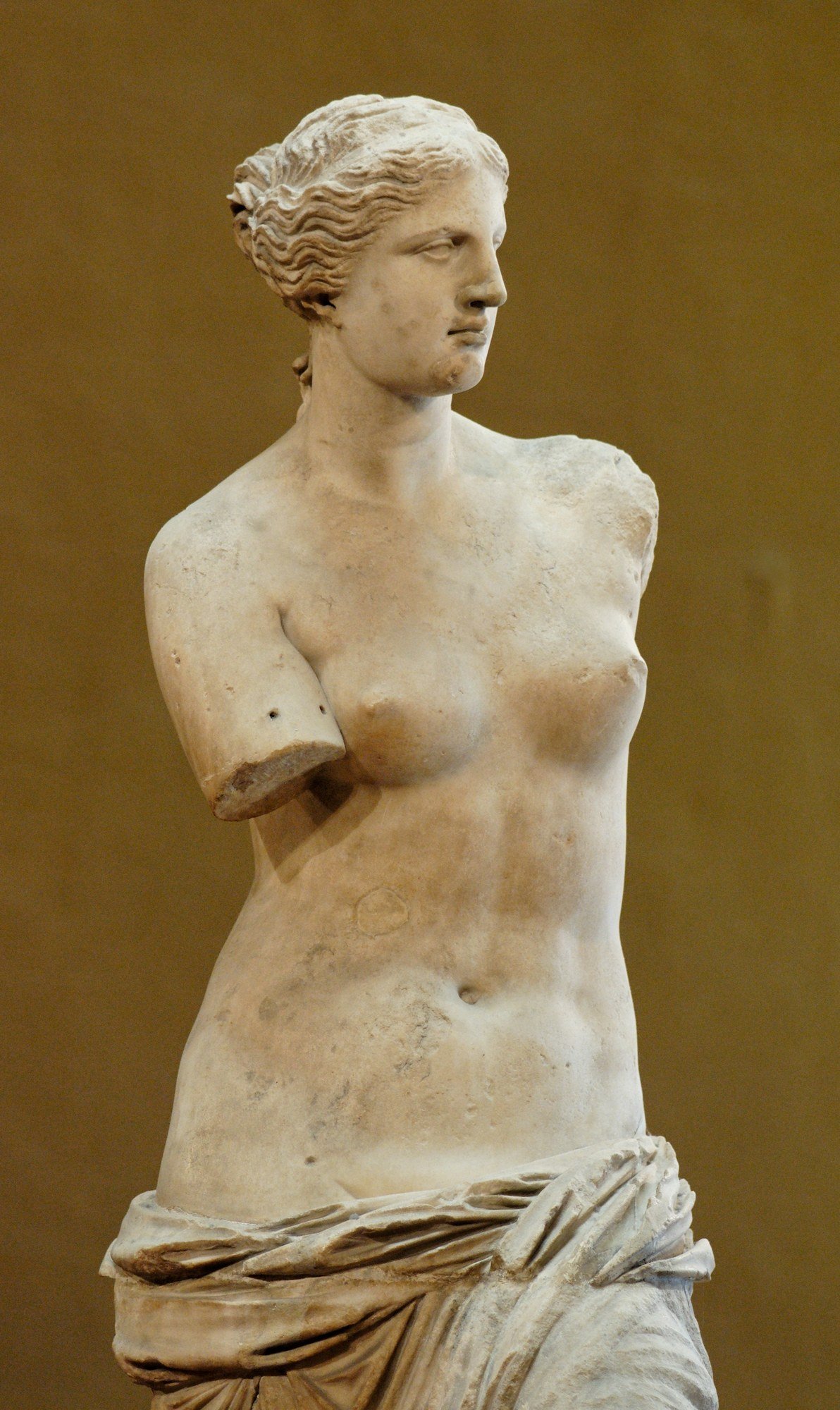
What sets her apart is the tension she creates. She is both complete and incomplete. Her pose – a slow spiral from hips to shoulders – draws your eye upward in an almost musical rhythm. Yet those missing arms leave every viewer unconsciously finishing the statue in their imagination. In that creative gap, she becomes personal. Each person who stands before her sees something slightly different.
In addition, her scale commands genuine awe. Standing over two metres tall in cool Parian marble, she does not feel like a museum object. She feels like a presence. That combination of physical authority and emotional openness is extraordinarily rare in any art form, ancient or modern.
Historical Context
The Venus de Milo was created during the Hellenistic period, a rich and restless chapter in Greek art history that followed the conquests of Alexander the Great. Greek culture had spread across the Mediterranean world, and artists responded with greater emotional intensity, movement, and naturalism than the serene classical style that preceded them.
By the second century BC, sculptors were no longer content with idealized stillness. They wanted drama. They experimented with twisting poses, expressive faces, and figures caught mid-action. However, the Venus de Milo balances both worlds. She carries the calm idealism of earlier classical tradition while incorporating the dynamic, spiralling energy of the Hellenistic era. She is, in that sense, a bridge between two artistic philosophies.
She was found on Milos in April 1820 by a local farmer, Yorgos Kentrotas, in a niche within the ruins of an ancient gymnasium – not alone, but in pieces and in company. Alongside her were fragments including a hand holding an apple and an inscribed plinth. French naval officers on the island moved quickly; the statue was bought on behalf of the Marquis de Rivière, presented to King Louis XVIII, and given by him to the Louvre in 1821.
Symbolism and What to Look For
When you stand in front of the Venus de Milo, start at the base. Notice how her lower body is draped in heavy marble fabric, yet the cloth seems genuinely weightless. It slips low on her hips, defying gravity – an extraordinary technical achievement in stone.
While you are looking at the hips, look for the seam. The statue is carved from two main blocks of marble joined at the waist, and the join is deliberately concealed in the folds of the drapery. Ancient sculptors worked this way routinely, but few hid the join so well.
Then let your gaze travel upward. Her torso twists gently, and her head turns in the opposite direction. This contrapposto movement creates a sense of life and breath. She does not look frozen. She looks interrupted, as if she paused mid-movement just as you walked in.
Pay close attention to the surface of the marble. She did not always look like this. Physical evidence on the statue – fixing holes for metal jewellery, including a diadem, a bracelet and earrings, and faint traces of pigment – shows she was once painted and adorned. There is also a mounting hole in the left shoulder, because the arms were carved separately and attached. What you see today as cool, pale stone was once vivid, warm and dressed. Knowing that shifts everything about how you read her, and it is worth standing there long enough to re-see her: research on how people actually look at art finds that most visitors give even a famous work only seconds.
Finally, consider the face. It is serene to the point of otherworldliness. There is no readable emotion – only a kind of distant, eternal calm. For many visitors, that is the most unsettling and beautiful detail of all.
The Inscription That Disappeared
We do not know for certain who carved the Venus de Milo, and the reason is uncomfortable for the museum that owns her.
Among the fragments recovered on Milos was a plinth that fitted the statue, carrying an inscription naming Alexandros, son of Menides, of Antioch on the Maeander, as the maker. Its letterforms pointed to a date around 150 BC – firmly Hellenistic, and firmly not the work of a great classical name.
That was inconvenient. France had just lost thousands of artworks seized under Napoleon, returned to their owners after Waterloo, and the Louvre badly needed a replacement masterpiece. The statue was promoted as a classical work in the manner of Praxiteles, three centuries older and vastly more prestigious. The plinth was lost within a few years of arriving in Paris. We know what it looked like only from a drawing made in 1821 at the request of Jacques-Louis David.
The archaeologist Adolf Furtwängler later remarked that the disappearance was itself the best evidence the plinth was genuine: it was an awkward witness, quietly removed. Modern scholarship dates the statue to the Hellenistic period and generally accepts the attribution to Alexandros, though because the stone itself is gone, the connection remains formally disputed.
What is beyond dispute is the quality. The drapery, the anatomy and the spiralling composition are the work of someone at the peak of the tradition, whatever his name was.
Legacy and Influence
The influence of the Venus de Milo on Western culture is staggering. Having arrived at exactly the moment France needed her, she became a symbol of national cultural prestige – proof that Paris remained the art capital of the world – and the authorities promoted her relentlessly as the greatest surviving work of ancient sculpture.
That promotional push worked. By the late nineteenth century, she was reproduced in plaster casts displayed in art schools across Europe and America. Students copied her. Painters referenced her. She inspired more than seventy poems. The Surrealists then turned the reverence inside out: Salvador Dalí’s Venus de Milo with Drawers of 1936 is a plaster cast fitted with working drawers and fur pompoms, and René Magritte painted a full-size cast in flesh tones and called it Les Menottes de cuivre. She became shorthand for ideal beauty – and then, almost inevitably, shorthand for the absurdity of that ideal.
Today, the Venus de Milo appears on everything from high-fashion runways to comic book covers. Her missing arms have inspired more creative speculation and artistic response than almost any other feature of any famous artwork. She remains, centuries after her creation, genuinely alive in the cultural conversation.
Where to See Venus de Milo Today
The Venus de Milo stands in the Sully wing of the Louvre, on level 0, in the Greek antiquities galleries – the Louvre’s own listings give her room as 345 or 346 depending on the page, so follow the signs for Greek antiquities rather than a room number. She stands in the middle of the space, so you can walk a full circle around her, and you absolutely should. The rear view reveals just how dramatically the body twists.
The Louvre is open every day except Tuesdays, with a late opening on Friday evenings until 21.45. Booking online in advance is strongly recommended, especially in summer. The first slot of the morning and the Friday evening nocturne are by far the least crowded times; unlike the Mona Lisa, she has no glass and no queue system, so a quiet hour genuinely means having her to yourself.
While you are there, the nearby Winged Victory of Samothrace and the Venus of Arles – the statue that occupied the role of ideal ancient beauty in France before 1820 – offer fascinating comparisons. The Mona Lisa is in the Denon wing on the floor above, a ten-minute walk and a completely different experience of crowding.
Frequently Asked Questions
Where is the Venus de Milo located?
In the Louvre in Paris, in the Greek antiquities galleries of the Sully wing on level 0. She has been on display there since 1821.
When was the Venus de Milo created?
In the Hellenistic period. Current scholarship places her at roughly 150–125 BC, with some estimates stretching to about 100 BC. For the first decades after her discovery the Louvre presented her as a much older classical work, which was never correct.
Who made the Venus de Milo?
Most likely Alexandros of Antioch on the Maeander, a sculptor about whom almost nothing else is known. The attribution rests on an inscribed plinth found with the statue, which disappeared at the Louvre in the 1820s – at a time when the museum was promoting the work as a classical masterpiece in the manner of Praxiteles. Because the stone no longer exists, the attribution cannot be finally settled.
What does the Venus de Milo represent?
She almost certainly depicts Aphrodite, the Greek goddess of love and beauty, known to the Romans as Venus – which is why her Greek name is Aphrodite of Melos. Her exact pose and any attributes she originally held remain subjects of debate.
Why is the Venus de Milo so famous?
Her fame grew partly through deliberate French cultural promotion after 1820, when the Louvre had just been stripped of Napoleon’s looted antiquities and needed a new star, and partly because she is genuinely extraordinary. The mystery of the arms did the rest.
What happened to the arms of the Venus de Milo?
No one knows. They were already detached when she was found, and the arms were carved separately and pinned on, which is why they came away. A marble hand holding an apple was recovered near her and may well be hers – the apple would be a reference to the Judgement of Paris. Other proposals have her holding a mirror, a shield, or the edge of her own drapery. None can be proved.
The Venus de Milo reminds us that great art does not need to be complete to be powerful. If her story has sparked your curiosity, explore our other posts on ancient Greek sculpture, Hellenistic masterworks, and the extraordinary collection of the Louvre – there is always another wonder waiting to be discovered.
Image: Venus de Milo – attributed to Alexandros of Antioch (c. 150–125 BC). License: Public Domain. Source: Wikimedia Commons.