Starry Night Over the Rhone
Most people assume Van Gogh painted Starry Night Over the Rhone from memory or imagination – but he actually set up his easel outdoors, on the riverbank, working under a gas lamp with the night sky above him. What he did with that sky, however, was another matter entirely: the constellation at the centre of the canvas could not have been there.
Quick Facts
- Artist: Vincent van Gogh
- Year: 1888
- Medium: Oil on canvas
- Dimensions: 72.5 cm × 92 cm (28.5 in × 36.2 in)
- Movement: Post-Impressionism
- Current location: Musée d’Orsay, Paris
What Makes Starry Night Over the Rhone So Unforgettable?
There is no shortage of nighttime paintings in art history. However, Starry Night Over the Rhone does something almost none of them attempt. It captures the feeling of actually standing beside a wide, dark river at night – the cold air, the shimmer of distant gas lamps, the overwhelming weight of the sky above.
Van Gogh was not simply recording a view. He was chasing an emotional truth. The painting throbs with energy. Every star feels alive, every ripple on the Rhone seems to breathe. For Van Gogh, the night sky was not empty or frightening – it was full of meaning, companionship, and wonder.
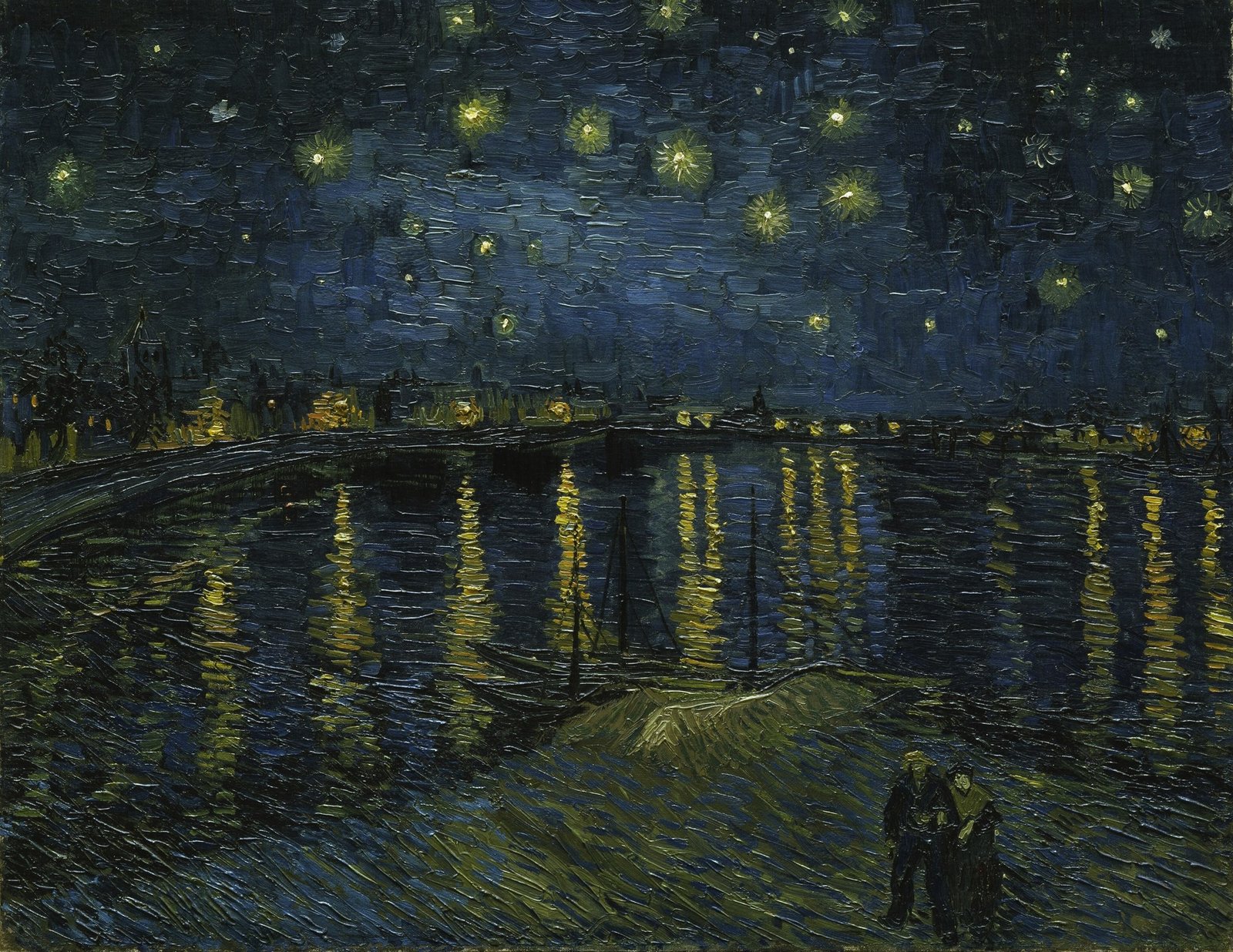
What truly sets this work apart from his later The Starry Night (painted in 1889 at Saint-Rémy) is its grounded, human quality. This is not a cosmic vision seen from a distance. Two small figures stand at the bottom of the canvas, beside the moored boats – a pair of lovers, as Van Gogh described them to his brother. They remind us that this is a real place, a real night, and a real moment witnessed by a real person who simply looked up.
Historical Context
Van Gogh arrived in Arles, in the south of France, in February 1888. He was electrified by the Mediterranean light and the vivid colors of Provence. He rented the famous Yellow House on the Place Lamartine and threw himself into work with extraordinary intensity.
The year 1888 was a pivotal moment in Western art. Impressionism had already shaken the establishment, but a new generation of painters was pushing further. Artists like Paul Gauguin, Paul Cézanne, and Van Gogh himself were asking deeper questions – not just how to paint light, but how to paint feeling.
Van Gogh painted Starry Night Over the Rhone in late September 1888 – he enclosed a sketch of it in a letter to Theo on 28 September – roughly two weeks after he had solved the same problem indoors-out on the Place du Forum with Café Terrace at Night, and about a month before Gauguin arrived in Arles for their famously turbulent collaboration. The spot he chose was a quay on the east bank at the Place Lamartine, a two-minute walk from his front door, looking south-west towards the centre of town. This is not a grand scenic destination. It is the view from the end of his street.
Gas lighting had recently been installed along the quays in Arles, and the glowing reflections of the lamps on the water fascinated Van Gogh. In addition, the painting reflects a broader cultural moment when industrialization and modernity were visibly reshaping even small provincial towns.
Symbolism and What to Look For
Stand in front of Starry Night Over the Rhone and let your eye travel upward first. Seven stars at the centre of the sky form the Great Bear – the Plough, or Big Dipper. And they should not be there. The Plough points to the North Star, so from a quay looking south-west across the river towards Arles, those stars would have been directly behind Van Gogh. He moved the most recognisable constellation in the northern sky into the half of the sky where it could never appear, because he wanted it in the picture. The painting fuses the view in front of him with the sky behind him.
Notice too how each star is surrounded by a halo of swirling colour: blues, greens, whites, and yellows all radiating outward. This is not carelessness. It is Van Gogh showing you how a star actually looks to an emotional, living eye.
Next, follow the light downward. The gas lamps along the far bank cast long, quivering golden reflections across the dark Rhone. Van Gogh applied these reflections in thick, diagonal strokes of paint. The technique – known as impasto – gives the water a tangible, almost sculptural texture. Look at where the stars sit relative to those lamps: he lined them up, so that the reflections on the water read almost as reflections of the sky.
Now look at the two figures in the foreground. They are small but they anchor the entire composition. Their presence transforms what could have been an abstract study of light into something deeply human. Van Gogh himself called them simply two coloured figures of lovers – for scale and for warmth, in a picture that is otherwise all distance.
Finally, notice the color palette, which Van Gogh set out himself in that letter to Theo: a green-blue sky, royal-blue water, mauve ground, a town in blue and violet, and yellow gaslight whose reflections run from russet gold down to green bronze. Reading his own inventory of the colours next to the canvas is the fastest way to see how deliberately it was built. It is also worth giving it more than a passing glance – research on how people actually look at art suggests the works that stay with us are the ones we return to rather than scan.
About Vincent van Gogh
Vincent Willem van Gogh was born on March 30, 1853, in Zundert, Netherlands. He did not begin painting seriously until his late twenties, yet he produced over 2,100 works in roughly a decade of intense creative activity.
Van Gogh struggled with mental illness throughout his adult life. However, his suffering never diminished his productivity or his ambition. If anything, it sharpened his sensitivity to color, light, and emotion. He corresponded extensively with his brother Theo, and those letters remain one of the richest records of any artist’s inner life ever written.
He died in Auvers-sur-Oise on July 29, 1890, at just 37 years old. During his lifetime, he sold very few paintings. Today, his works rank among the most recognized and beloved in human history.
Legacy and Influence
Starry Night Over the Rhone helped establish a new visual language for depicting emotion. Van Gogh’s swirling brushwork and bold color choices fed directly into the Expressionist movement that emerged in the early 20th century – Ernst Ludwig Kirchner and the Brücke painters worked in his wake, and the Fauves took his colour further still.
It was also one of the very few pictures he saw exhibited. The canvas went on show in Paris at the annual Société des Artistes Indépendants exhibition in 1889, while he was living in the asylum at Saint-Rémy. It then spent nearly a century in private French hands before being given to the Musée d’Orsay in 1975.
Today, the painting’s imagery has penetrated popular culture at every level – from fine art prints to album covers, film references, and countless digital recreations. Yet no reproduction fully conveys the physical presence of the original. The thick paint catches the light differently at every angle, giving the canvas an almost three-dimensional life.
More broadly, Starry Night Over the Rhone changed how people think about night itself. Van Gogh showed that darkness is not the absence of something – it is a subject full of color, movement, and meaning in its own right.
Where to See Starry Night Over the Rhone Today
Starry Night Over the Rhone – catalogued in French simply as La Nuit étoilée – is housed at the Musée d’Orsay in Paris, one of the world’s great art museums. The museum is located on the Left Bank of the Seine, in a spectacular converted railway station at 1 Rue de la Légion d’Honneur.
The Orsay is open Tuesday to Sunday from 9.30 to 18.00, with late opening until 21.45 on Thursdays, and is closed on Mondays. Book online in advance – queues can be very long, especially in summer – and note that the Thursday evening slot is by far the quietest time to stand in front of a Van Gogh. Hours shift around public holidays, so confirm on the museum’s site before you travel.
While you are there, take the time to explore the museum’s outstanding collection of Impressionist and Post-Impressionist works, on the upper level. You will find paintings by Monet, Renoir, Degas, Cézanne, and Gauguin all within easy walking distance of Van Gogh’s galleries. The Orsay also holds a version of The Bedroom – not the Arles original, but the copy Van Gogh painted at Saint-Rémy in 1889 for his mother and sister – along with the late self-portrait and Church at Auvers.
Frequently Asked Questions
Where is Starry Night Over the Rhone located?
At the Musée d’Orsay in Paris, France, on the upper level among the Post-Impressionist collection. It was donated to the museum in 1975.
When was Starry Night Over the Rhone created?
In late September 1888, during Van Gogh’s time in Arles. He described it in a letter to his brother Theo on 28 September, enclosing a sketch. He worked on it outdoors, on the bank of the Rhone, at night, by the light of a gas lamp.
Are the stars in the painting astronomically accurate?
No, and deliberately so. The seven stars at the centre form the Great Bear, which points to the North Star – but Van Gogh was facing south-west towards Arles, so that constellation was behind him. He moved it into the visible half of the sky. He also aligned the stars with the gas lamps along the quay, so the lights on the water read almost as reflections of the sky.
What does Starry Night Over the Rhone represent?
It represents Van Gogh’s belief that the night sky held spiritual comfort and emotional power. The painting also reflects his deep fascination with artificial light, human connection, and the beauty hidden in everyday surroundings.
Why is Starry Night Over the Rhone so famous?
Its fame comes from the extraordinary way Van Gogh transforms a simple riverside scene into something emotionally overwhelming. The swirling stars, glowing reflections, and vibrant color make it feel alive in a way few paintings ever achieve.
How is this painting different from The Starry Night?
Starry Night Over the Rhone was painted in Arles in 1888 and shows a real, grounded river scene with human figures. The Starry Night from 1889 was painted while Van Gogh was in an asylum in Saint-Rémy and has a more turbulent, visionary quality. Both are masterpieces, but they reflect very different states of mind.
If Starry Night Over the Rhone has sparked your curiosity, we invite you to explore more extraordinary works right here on the site. From fellow Post-Impressionist giants to other nocturnal masterpieces, there is always another painting waiting to surprise you – dive in and see where it takes you.
Image: Starry Night Over the Rhone – Vincent van Gogh (1888). License: Public Domain. Source: Wikimedia Commons.