The Nude Maja
When The Nude Maja was first unveiled in early nineteenth-century Spain, its existence was so scandalous that the Spanish Inquisition summoned Francisco Goya himself to explain who had commissioned it and why — making it one of the few paintings in history to trigger a formal religious investigation.
Quick Facts
- Artist: Francisco Goya
- Year: c. 1797–1800
- Medium: Oil on canvas
- Dimensions: 97 cm × 190 cm (38 in × 75 in)
- Movement: Romanticism
- Current location: Prado, Madrid
What Makes The Nude Maja So Unforgettable?
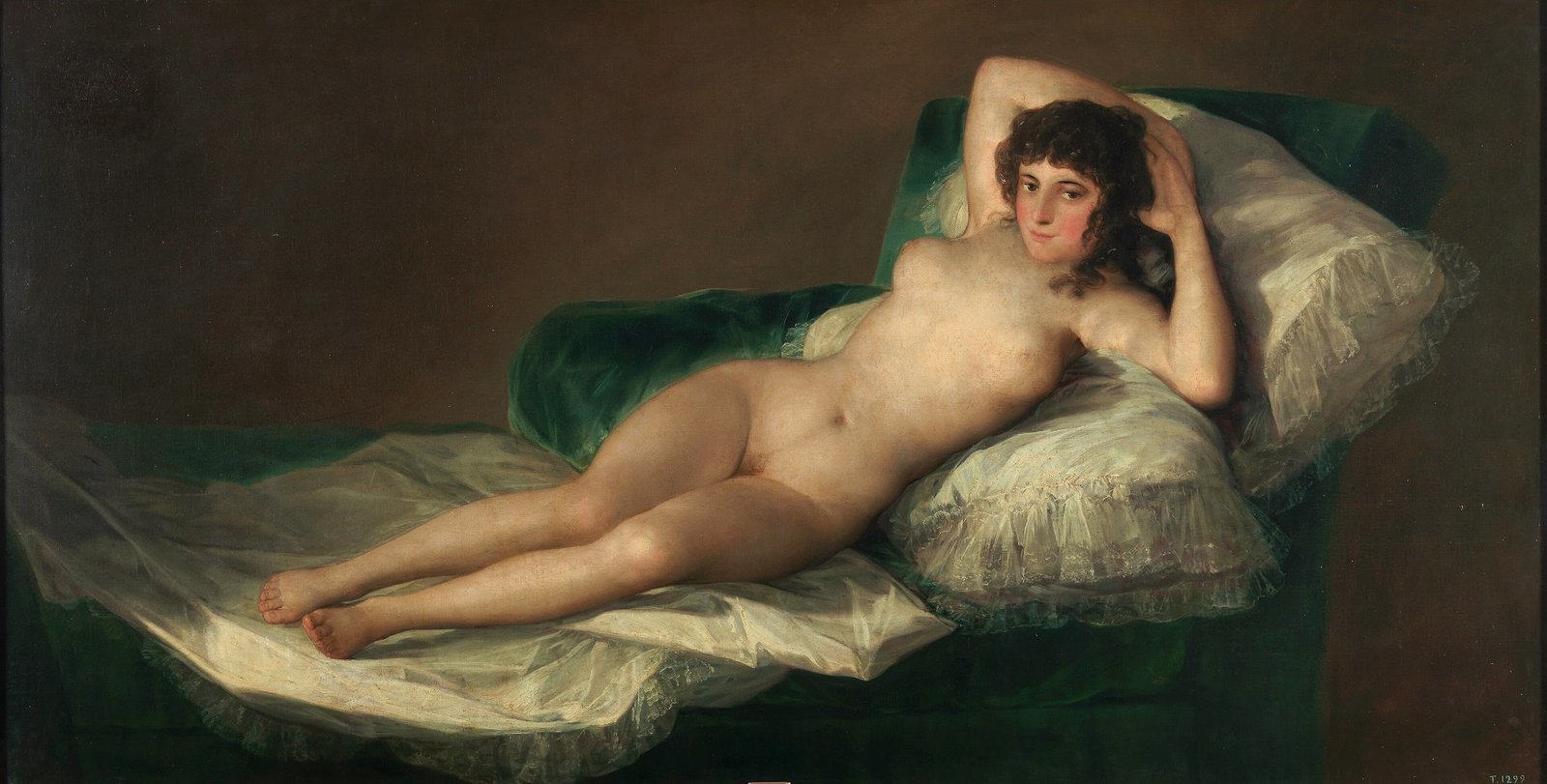
Most reclining nudes in Western art avoid your gaze. They look away, they sleep, they dream. The Nude Maja does none of that. She stares directly back at you — calm, confident, and entirely unapologetic. That directness is radical even by today’s standards.
For its era, this was almost unthinkable. Goya painted her not as a goddess, not as a mythological allegory, but as a real, contemporary woman. There are no wings, no clouds, no classical props to soften the impact. She simply exists, and she dares you to look.
In addition, Goya made a companion piece — La Maja Vestida (The Clothed Maja) — showing the same woman in the same pose, fully dressed. The two works were reportedly hung together in a special cabinet, so the clothed version could conceal the nude. That setup alone tells you everything about the tension between desire and respectability in the era.
Historical Context
Spain at the turn of the nineteenth century was a society under enormous pressure. The French Revolution had shaken European monarchies, and the Spanish Inquisition remained an active force policing morality and artistic expression. Depicting nudity outside of religious or mythological contexts was genuinely dangerous.
The painting was most likely commissioned by Manuel Godoy, the powerful chief minister of King Charles IV of Spain. Godoy kept a private cabinet specifically for nude paintings — a collection that itself represented a kind of forbidden luxury available only to the most powerful men in the country.
However, Goya was already the official court painter by this point, which gave him unusual latitude. He had spent years painting the royal family, the aristocracy, and the common people of Madrid. That closeness to power protected him — at least for a while. When the Inquisition came calling after Godoy’s political fall in 1808, Goya was interrogated but never formally punished.
Romanticism as a movement was beginning to push back against the cool rationalism of Neoclassicism. Artists were embracing emotion, individuality, and raw human experience. The Nude Maja fits perfectly into that spirit — it is intensely personal, emotionally confrontational, and deeply human.
Symbolism and What to Look For
Stand in front of The Nude Maja and start with her eyes. She meets your gaze head-on, arms folded casually behind her head in a pose of total ease. There is no shame here, and no invitation either — just a steady, self-possessed look that puts the viewer on the back foot.
Next, notice the light. Goya bathes her skin in a warm, pearlescent glow that makes her figure almost luminous against the darker background. The brushwork on her flesh is soft and blended, while the pillows and sheets beneath her are looser, more gestural — a deliberate contrast that draws your eye back to her body.
Look closely at her hair, too. It is dark and loosely arranged, reinforcing her identity as a maja — a term for fashionable working-class women of Madrid known for their bold style and confident manner. This is not an idealized classical beauty. Her proportions are naturalistic, even slightly irregular, which only adds to the sense that she is a real person.
The composition itself is strikingly horizontal. She fills the entire canvas from edge to edge, leaving almost no negative space. That choice makes the painting feel intimate and immediate — almost uncomfortably close.
About Francisco Goya
Francisco José de Goya y Lucientes was born in 1746 in Fuendetodos, a small village in the Aragon region of Spain. He rose from modest origins to become the most celebrated Spanish painter of his generation, eventually earning the title of First Court Painter to the Spanish Crown.
Goya’s career spans an extraordinary range — from cheerful tapestry cartoons in his early years to the haunting, nightmarish Black Paintings he created in old age. A serious illness in 1792 left him completely deaf, and many historians believe this turning point deepened his art, pushing him toward darker, more psychological territory.
He witnessed the horrors of the Napoleonic invasion of Spain firsthand and documented them in his devastating series The Disasters of War. Therefore, Goya is often considered a bridge between the Old Masters and the modern era — an artist who looked squarely at the ugliness of the world without flinching. He died in Bordeaux, France, in 1828.
Legacy and Influence
The Nude Maja cast a long shadow over the history of art. Édouard Manet’s Olympia (1865) is the most direct descendant — another reclining nude who stares back at the viewer with the same cool, confrontational gaze. Manet had studied in Spain and knew Goya’s work well.
Beyond painting, the image has embedded itself in popular culture. It has been reproduced on everything from postage stamps to political satire. In the twentieth century, the Spanish government actually issued stamps featuring The Nude Maja, only for the United States Post Office to refuse to handle them — a reminder that the painting’s power to provoke has never fully faded.
For example, feminist art historians have returned to the painting repeatedly, debating whether the direct gaze represents female agency or male fantasy — a conversation that remains very much alive today.
Where to See The Nude Maja Today
The Nude Maja has been part of the Museo del Prado in Madrid since 1901, and it remains one of the museum’s most visited works. The Prado is located on the Paseo del Prado in central Madrid, easily reachable by metro (Banco de España or Atocha stations).
The painting is typically displayed alongside its companion, La Maja Vestida, just as Godoy originally intended. Seeing both together is a genuinely powerful experience — the contrast between the two makes each one more meaningful.
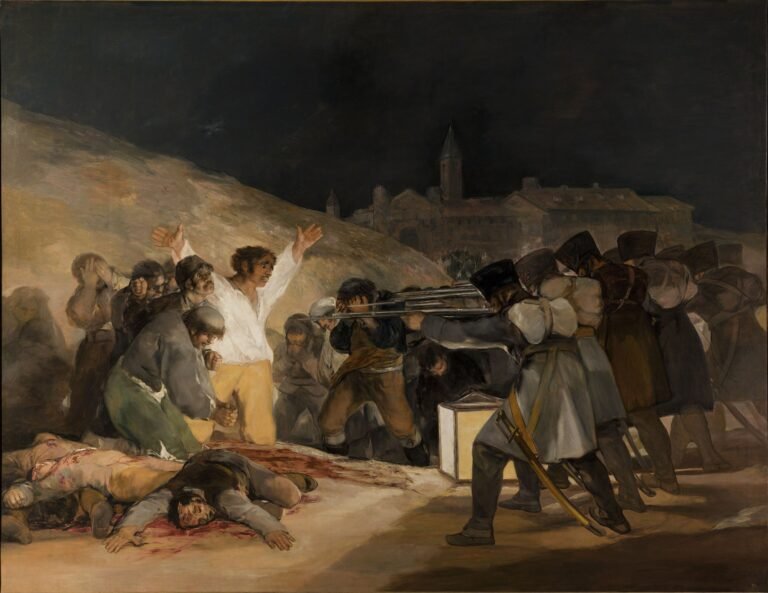
Plan to arrive early on weekdays to beat the crowds. The Prado offers free admission during the last two hours of each day, though the galleries can be busier during those windows. While you are there, do not miss Goya’s Saturn Devouring His Son and The Third of May 1808 — both are in the same collection and together they form one of the richest single-artist experiences in any museum in the world.
Frequently Asked Questions
Where is The Nude Maja located?
The painting is permanently housed at the Museo del Prado in Madrid, Spain, where it has been on display since 1901.
When was The Nude Maja created?
Goya painted it between approximately 1797 and 1800, most likely completing it around the turn of the nineteenth century.
What does The Nude Maja represent?
It represents a shift away from idealized mythological nudes toward a real, contemporary woman depicted with honesty and psychological presence. The subject is identified as a maja — a fashionable working-class woman of Madrid.
Why is The Nude Maja so famous?
Its fame comes from a combination of its scandalous history, the subject’s direct gaze, and the fact that it broke conventions by portraying a contemporary nude woman rather than a classical goddess. It was radical then, and it still feels bold today.
Who commissioned The Nude Maja?
The painting was most likely commissioned by Manuel Godoy, the powerful chief minister of King Charles IV of Spain, for his private collection of nude paintings.
If The Nude Maja has sparked your curiosity, there is so much more to explore. Browse our other features on Goya’s masterworks, discover the painters he inspired, and dive deeper into the Romanticism movement — all waiting for you right here on the site.
Image: The Nude Maja – Francisco Goya (1800). License: Public Domain. Source: Wikimedia Commons.