The School of Athens
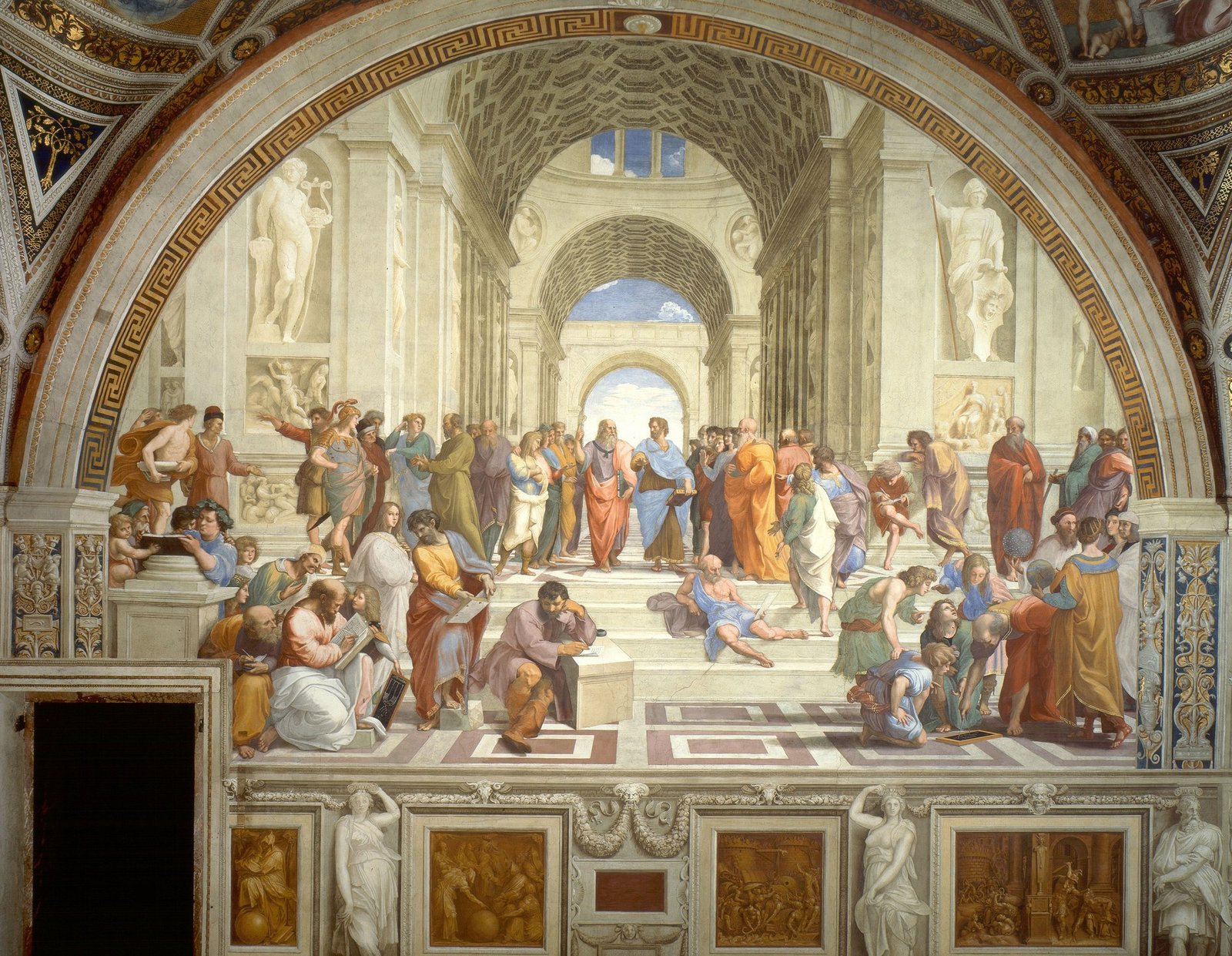
There is a seam in this fresco. The brooding figure on the steps — the one with Michelangelo’s face — does not appear in the full-size preparatory cartoon, which survives in Milan. Raphael added him after the rest was finished, on a separately laid patch of plaster. The join is still visible. He almost certainly did it after seeing part of the Sistine ceiling uncovered.
Quick Facts
- Artist: Raffaello Sanzio (1483–1520)
- Dates: 1509–1511
- Medium: Fresco
- Dimensions: c. 500 × 770 cm at the base
- Title: coined in the 17th century; Raphael never used it
- Movement: Renaissance
- Location: Stanza della Segnatura, Apostolic Palace, Vatican
What makes it unforgettable?
This is not an illustration of philosophers. It is an argument.
Raphael gathered dozens of figures from different centuries and opposing schools and made them a single community. Nobody had painted pagan philosophers in the pope’s private rooms as equal bearers of wisdom.
What matters more is that the fresco is part of a scheme. The Stanza della Segnatura was the pope’s library and study, and its four walls correspond to the four divisions of knowledge: philosophy (this fresco), theology (the Disputa), poetry (Parnassus) and law (the Cardinal and Theological Virtues). Books on each subject stood beneath the appropriate wall.
The painting does not hang in a gallery. It hangs in a working room, above a shelf of Plato.
Hidden portraits
This is the richest layer of the work.
Plato has the face of Leonardo da Vinci. Grey beard, high forehead, the distinctive nose — comparison with surviving likenesses of Leonardo leaves little doubt.
Heraclitus is Michelangelo. The figure sitting alone on the steps, leaning on one elbow, in stonemason’s boots rather than a philosopher’s robe. He is the only figure isolated from every group.
And here is the point: he is absent from the cartoon — the full-scale preparatory drawing, which survives in the Pinacoteca Ambrosiana in Milan. Every other figure is there.
Raphael added him later, laying fresh plaster over finished work. The style of the figure is noticeably different too — heavier, more sculptural, closer to Michelangelo than to Raphael.
The accepted explanation is that Raphael saw part of the Sistine ceiling while it was in progress, a few dozen metres away, and decided he had to respond. He inserted his rival into his own fresco, in his rival’s own manner.
Raphael also put himself in it — in the group at the right, in a black cap, looking straight out at the viewer. Beside him is probably his teacher Perugino, or the painter Sodoma.
One caution is worth adding: most identifications of the ancient figures are hypotheses. Raphael left no key, and names have been attached over centuries on the basis of attributes and guesswork.
Historical context
1508. Julius II — warrior pope, patron and an impatient man — set about rebuilding the Vatican. He gave Bramante the new St Peter’s, Michelangelo the Sistine ceiling, and the decoration of his own apartments to Raphael, then not quite twenty-five.
The pope refused to live in his predecessor’s rooms, those of Alexander VI Borgia, whom he detested. He had the floor above fitted out instead.
Frescoes by other painters were already there, including work by Perugino and Sodoma. Julius looked at Raphael’s first efforts and ordered everything by the previous artists destroyed, handing the whole room to one young man.
Humanism was at its height. Greek philosophy had ceased to be suspect and become a foundation for Christian thought. In these rooms, the message that reason and faith do not exclude one another was both legible and acceptable.
What to look for
The gesture at the centre. Plato points upward, to the world of forms; Aristotle extends a hand horizontally, towards the observable world. The entire philosophical argument in two hands.
The books they carry. Plato holds the Timaeus, Aristotle the Ethics. The titles are legible on the fresco.
The architecture. Modelled on Bramante’s design for the new St Peter’s, then barely begun. Raphael painted a building that did not yet exist.
Two statues. Apollo with a lyre on the left, Athena in armour on the right — poetry and wisdom flanking philosophy.
Euclid. Lower right, bent over a slate with a compass. He has Bramante’s features. On the border of his robe Raphael placed his initials: R.V.S.M. — Raphael Vrbinas Sua Manu, Raphael of Urbino, by his own hand.
Diogenes. Sprawled across the steps, half-dressed, with a bowl. He occupies the best position in the composition and nobody pays him any attention — exactly as he would have wished.
The woman. On the left, in pale robes, looking out at the viewer. Sometimes identified as Hypatia of Alexandria. According to one account a cardinal objected to a woman among the philosophers, so Raphael gave her the features of a young man — possibly Francesco Maria della Rovere, the pope’s nephew.
About Raphael
Raffaello Sanzio was born in Urbino in 1483, the son of a painter. He lost his father at eleven and his mother earlier. He trained under Perugino and quickly surpassed him.
In Florence he encountered Leonardo and Michelangelo. In Rome he received the commission that defined him.
He died on 6 April 1520, aged thirty-seven. Tradition says it was his birthday; the exact date of his birth is uncertain, and Vasari reports it from earlier accounts.
At his own request he was buried in the Pantheon. Cardinal Bembo wrote the epitaph: while he lived, nature feared to be outdone, and when he died, feared to die with him.
Legacy and influence
The composition became a model for monumental painting for three centuries. Academies copied it as the example of ideal balance.
In the nineteenth century the fresco turned into an emblem of the Enlightenment ideal of knowledge. It now appears on the covers of philosophy textbooks and on the walls of universities worldwide.
It is worth adding that the cartoon survives and is a major work in its own right. Over eight metres wide, drawn in charcoal and chalk, it is in the Pinacoteca Ambrosiana in Milan. For many scholars it is more interesting than the fresco, because it shows Raphael’s thinking before the final decisions.
Where to see it today
The fresco is in the Stanza della Segnatura, one of the four Raphael Rooms in the Apostolic Palace. Access is only through the Vatican Museums.
- Book online in advance. Without a reservation the queue can run to several hours.
- The Raphael Rooms are on the route to the Sistine Chapel — you pass through them whether you intend to or not, because the circuit is one-way. The problem is that most visitors hurry through with the Sistine already in mind. Stop.
- Look at the Disputa on the opposite wall while you are in the room. The two frescoes were conceived as a pair.
- Find Heraclitus and the boundary of the plaster around him. In good light the seam is visible.
- The museums are usually closed on Sundays, except the last Sunday of the month. Check hours before you travel.
Frequently asked questions
Who is who in the fresco?
Plato and Aristotle at the centre. Beyond them, figures generally identified as Socrates, Pythagoras, Euclid, Ptolemy, Diogenes and Heraclitus. Many of these identifications are hypotheses — Raphael left no description of the figures.
Is Michelangelo in the painting?
Yes, as Heraclitus, sitting alone on the steps. He is absent from the preparatory cartoon: Raphael added him afterwards on a separate patch of plaster, probably after seeing the Sistine ceiling in progress.
Did Raphael paint himself?
Yes, in the group on the right, in a black cap, looking directly at the viewer. He also concealed his initials on the hem of Euclid’s robe.
Where does the title come from?
From the seventeenth century. Raphael never used it, and the fresco does not depict any particular school or location.
What do Plato’s and Aristotle’s gestures mean?
Plato points upward, to the realm of ideas; Aristotle extends his hand horizontally, to the observable world. It is a visual summary of their disagreement about the source of knowledge.
Do any preparatory drawings survive?
Yes. The full-size cartoon, over eight metres wide, is in the Pinacoteca Ambrosiana in Milan and is among the largest surviving Renaissance drawings.
If The School of Athens has caught your interest, look next at The Creation of Adam — painted at the same time, a short walk away, by the man Raphael wrote into his own fresco.
Image: The School of Athens – Raphael (1509–1511). License: Public Domain. Source: Wikimedia Commons.