Self-Portrait
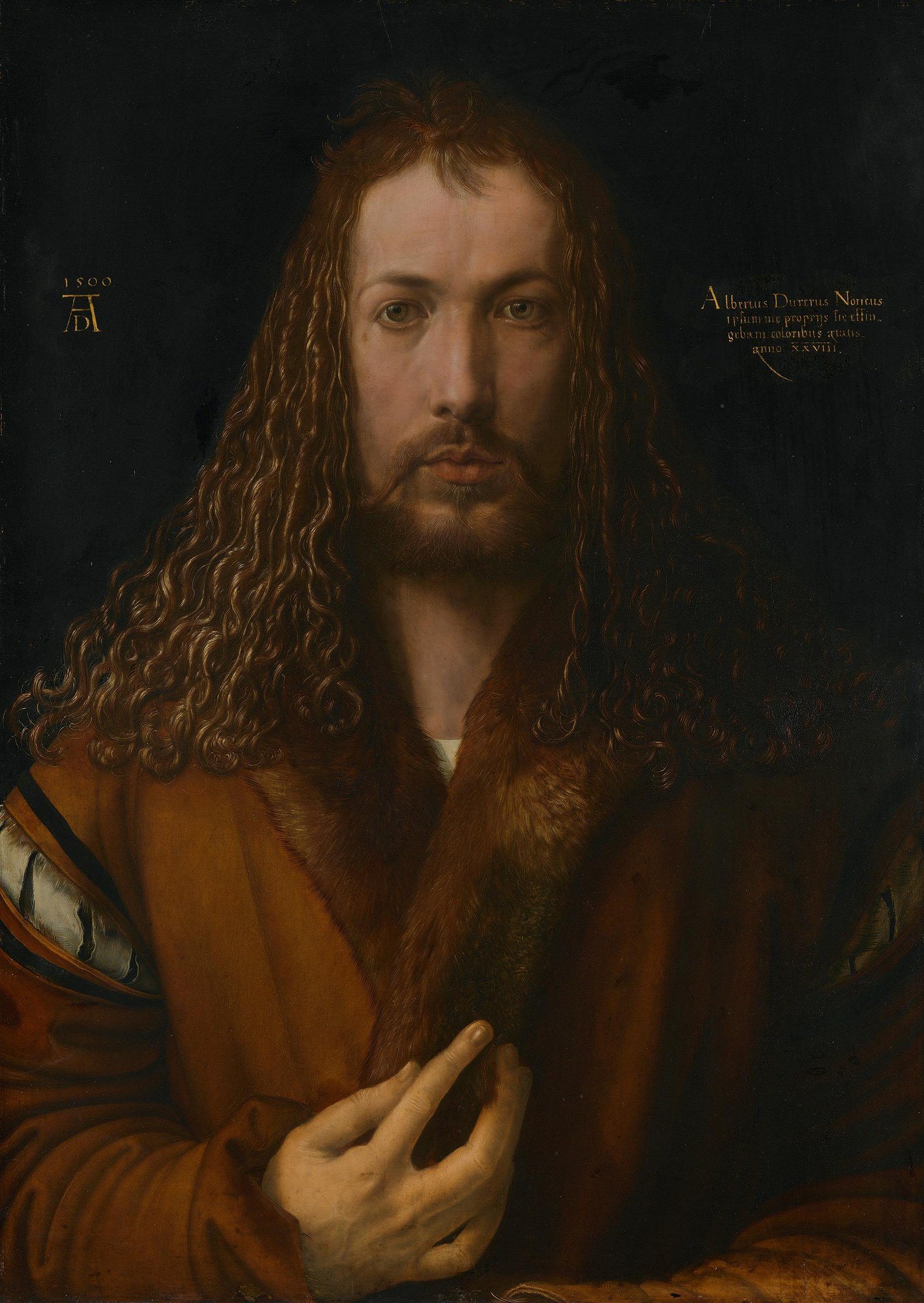
In the year 1500, a 28-year-old German painter looked into a mirror and painted himself in a pose that his contemporaries reserved for one subject only: Christ. Dürer’s Self-Portrait was audacious enough that art historians still argue over whether it was piety, arrogance, or something close to blasphemy.
Quick Facts
- Artist: Albrecht Dürer
- Year: 1500
- Medium: Oil on limewood panel
- Dimensions: 67.1 cm × 48.9 cm (26.4 in × 19.3 in)
- Movement: Northern Renaissance
- Current location: Alte Pinakothek, Munich
What Makes Self-Portrait So Unforgettable?
Most artists in 1500 did not paint themselves at all. Self-portraiture was rare, even audacious. So when Dürer placed himself at the dead center of the panel, staring forward with an almost supernatural stillness, it was a revolutionary act.
This Self-Portrait breaks every convention of its era. Dürer gazes directly out at the viewer – not at an angle, not in profile, but straight ahead. Northern European portraiture had used the three-quarters view since around 1420, and painters were proud of their skill with it. A fully frontal pose belonged to religious art, and above all to images of Christ. The implication is impossible to ignore, and historians have wrestled with it ever since.
Was Dürer claiming divine status? Was he arguing that artistic genius is itself a God-given gift? Was the painting part of a millennium celebration staged by the humanist circle around Conrad Celtis, to which he belonged? All three readings are live in the scholarly literature, and none has won. That unresolved ambiguity is exactly what makes the painting so endlessly compelling.
In addition, this is the last of his three painted self-portraits, and by far the most refined. It feels less like a record of a face and more like a manifesto.
Historical Context
The year 1500 carried enormous weight in the European imagination. People across the continent braced for apocalyptic change as the half-millennium arrived. Plague, religious upheaval, and political instability were constant companions. Meanwhile, the printing press was transforming how ideas spread – and Dürer, himself a brilliant printmaker, understood that power intimately.
Northern Renaissance art was also pushing back against the dominance of Italian masters. German and Flemish painters were developing their own sophisticated visual language, rich with symbolic detail and psychological depth. Dürer had already made one journey south, to Venice in 1494–95, and had absorbed what the Venetian colorists could teach him while remaining deeply rooted in the Northern tradition. His second, longer Italian stay came only in 1505, five years after this panel was finished.
He completed this Self-Portrait early in 1500, just before his 29th birthday, at a moment when he was already one of the most celebrated artists in Europe. However, the painting reads less like a celebration and more like a reckoning – a serious, almost solemn declaration of identity at a pivotal historical moment.
The choice of 1500 as the year for this work was almost certainly deliberate. Dürer set the date prominently in the dark field beside his head, framing the image within the charged atmosphere of the new century. In the medieval scheme of the ages of life, 28 was the year a man passed from youth into maturity – so the panel marks a turning point in the century and in the painter at the same time.
Symbolism and What to Look For
Stand in front of this painting – or study a high-resolution image – and let your eyes settle on Dürer’s gaze first. He meets you head-on. There is no evasion, no modesty. This directness alone would have startled a contemporary viewer accustomed to sitters glancing to one side. It is also worth knowing that a face is the one kind of image the brain handles unusually consistently: the research on art and the brain found a reliable signature for beautiful faces and none at all for beautiful artworks. This panel is both at once.
Next, notice the symmetry. The composition is almost perfectly balanced along a central vertical axis, a hallmark of devotional paintings of the Virgin or Christ. The Self-Portrait borrows that sacred geometry and applies it to a mortal man’s face. It feels deliberate, even provocative.
Look at the hand, raised to the middle of his chest with the fingers half-curled into the fur. Many scholars read this as echoing the gesture of Christ the Redeemer – a blessing hand, or at least a hand that echoes one. Dürer draws a direct line between the creative act and divine creation.
Then look at his hair. It is brown, parted in the middle, falling to his shoulders in the manner of late medieval images of Christ as Salvator Mundi. In his other self-portraits Dürer’s hair is reddish-blond. He changed his own colouring to fit the convention he was invoking, which is why the painting was once catalogued under the title Self-Portrait in a Wig.
The fur-trimmed coat speaks to wealth and status, signaling that the artist is no mere craftsman but a gentleman of learning and standing. The palette is muted – warm browns against a plain black background – which focuses all attention on the face and hand. Light falls from the left, modeling the features with quiet precision.
Finally, read the two inscriptions floating in the dark on either side of his head. On the left is the date, 1500, set directly above his monogram, A.D. – initials that in this position also read as Anno Domini. On the right is a line of Latin: I, Albrecht Dürer of Nuremberg, portrayed myself thus, in propriis coloribus, at the age of twenty-eight. The phrase has no settled translation. It can mean his own colours, or fitting colours, or everlasting ones, and the ambiguity is probably the point. The text itself was composed not by Dürer but by the personal secretary of the humanist Conrad Celtis.
About Albrecht Dürer
Albrecht Dürer was born in Nuremberg in 1471, the third of eighteen children of a Hungarian goldsmith. He trained under his father before apprenticing with the painter and printmaker Michael Wolgemut. By his early twenties, he had already produced woodcuts that circulated across Europe.
Dürer was a true Renaissance man – painter, printmaker, mathematician, and art theorist. His Apocalypse woodcut series of 1498 made him famous across the continent before he turned 30, and engravings such as Melencolia I secured his reputation as the most intellectually ambitious printmaker in Europe. He corresponded with humanist scholars, studied proportion obsessively, and wrote influential treatises on geometry and human proportion.
He spent much of his working life in Nuremberg, with transformative visits to Italy and the Netherlands. His patrons included Holy Roman Emperor Maximilian I and later Emperor Charles V. Alongside the great paintings and prints he produced drawings of extraordinary intimacy, among them the study known as Praying Hands. Dürer died in 1528, leaving behind a body of work that defined Northern Renaissance art for generations.
The Self-Portrait of 1500 stands as the crown jewel of his painted legacy – a work in which all his ambition, skill, and intellectual daring converge in a single face.
Legacy and Influence
Few paintings have done more to elevate the social and intellectual status of the artist. Before Dürer, painters were often regarded as skilled craftsmen. The 1500 Self-Portrait argued – visually and powerfully – that the artist was something more: a creative force touched by divine inspiration.
The clearest proof of how completely the painting obeyed religious convention is what happened to it afterwards. Around 1520 the engraver Sebald Beham used Dürer’s face as the model for a woodcut of Christ, and in 1637 Johann Georg Vischer used it again, for the Christ of a painted Christ and the Woman Taken in Adultery. A self-portrait had become a template for the Saviour.
That idea rippled outward through centuries of art history. Rembrandt’s extraordinary run of self-portraits owes something to Dürer’s daring. So do the self-mythologizing works of later painters like Gustave Courbet and even Frida Kahlo, each of whom used their own face as a site of philosophical and personal statement.
Today, the Self-Portrait is one of the most reproduced images in German cultural history. It appears on postage stamps, textbook covers, and museum merchandise worldwide. More importantly, it remains a touchstone for any discussion of artistic identity, ego, and the relationship between human creativity and the divine.
Where to See Self-Portrait Today
The painting lives in the Alte Pinakothek in Munich, Bavaria – one of the world’s great old master museums, opened in 1836 to house the collection the Wittelsbach dynasty had assembled over four centuries. The galleries span the fourteenth through eighteenth centuries and include masterworks by Rubens, Raphael, Leonardo, and van Dyck alongside Dürer’s.
You will find the Self-Portrait upstairs, among the German painting galleries, where the museum also keeps Dürer’s Four Apostles of 1526 and the Paumgartner Altarpiece. Two hours is a realistic minimum for the whole museum, three if you want to do the Rubens rooms properly – the Alte Pinakothek holds around seventy of his paintings, one of the largest groups anywhere.
The museum sits in the Kunstareal, Munich’s art district, within easy walking distance of the Pinakothek der Moderne and the Museum Brandhorst. It is closed on Mondays, open until 20:00 on Tuesdays and Wednesdays and until 18:00 from Thursday to Sunday. Admission drops to one euro on Sundays, which makes that the cheapest day and also the busiest; a Tuesday or Wednesday evening buys you the quietest room.
Frequently Asked Questions
Where is Dürer’s Self-Portrait located?
In the Alte Pinakothek in Munich, Germany. It has not always been there: Dürer sold or gave the panel to the Nuremberg city council, and it hung on public view in Nuremberg from around the time of his death in 1528 until 1805, when it was sold into the Bavarian royal collection. The Alte Pinakothek itself opened only in 1836.
When was this Self-Portrait created?
Dürer completed it early in 1500, just before his 29th birthday, which is why the inscription gives his age as twenty-eight. He set the date directly onto the panel, making the timing – the dawn of a new century – a deliberate part of the work’s meaning.
What does the inscription on Dürer’s Self-Portrait say?
The Latin line on the right translates roughly as: I, Albrecht Dürer of Nuremberg, portrayed myself thus, in propriis coloribus, at the age of twenty-eight years. Translators disagree about that phrase – it can be read as his own colours, as fitting colours, or as everlasting ones. The wording was supplied by the secretary of the humanist scholar Conrad Celtis rather than by Dürer himself. On the opposite side, the date 1500 sits above the monogram A.D., which doubles as an abbreviation of Anno Domini.
Why does Dürer have brown hair in this painting?
Because the convention he was borrowing demanded it. Late medieval images of Christ as Salvator Mundi showed him frontally, with a short beard and brown hair parted in the middle. Dürer’s other self-portraits show his hair as reddish-blond; here he adjusted it to match the type he was invoking. The painting was for a time known as Self-Portrait in a Wig for that reason.
What does the Self-Portrait represent?
Most readings turn on Dürer’s claim for the status of the artist. By adopting the frontal pose reserved for images of Christ, he suggested that creative talent is a God-given gift that elevates the artist above the rank of craftsman. Whether that was devotion, self-assertion, or provocation is exactly what scholars have never agreed on.
Why is this Self-Portrait so famous?
It is famous because it was radical for its time, technically flawless, and philosophically daring. No artist before Dürer had so boldly aligned artistic creation with divine power – and the painting makes that argument with total confidence and extraordinary beauty.
How does this Self-Portrait differ from Dürer’s earlier self-portraits?
His earlier painted self-portraits – the 1493 panel now in the Louvre and the 1498 one in the Prado – show a younger artist playing on his good looks, his hairstyle and his clothes. The 1500 version is frontal, symmetrical, and symbolic, and it drops the fashionable background altogether. It reads as a final statement rather than an experiment. Beyond these three paintings, at least a dozen self-portrait images by Dürer survive in other media, starting with a silverpoint drawing he made at thirteen.
If this deep dive into Dürer’s extraordinary Self-Portrait has sparked your curiosity, there is more of the Northern Renaissance waiting here – from van Eyck’s mirror-lit interior to Bruegel’s frozen valley. Every painting has a story worth knowing.
Image: Self-Portrait – Albrecht Dürer (1500). License: Public Domain. Source: Wikimedia Commons.