The Birth of Venus
Here is a fact that stops most people in their tracks: The Birth of Venus was painted on canvas — not wood panel — at a time when nearly every major Italian altarpiece and large-scale painting was produced on wood, making it one of the earliest surviving large-format canvas paintings in Western art history.
Quick Facts
- Artist: Sandro Botticelli
- Year: c. 1485
- Medium: Tempera on canvas
- Dimensions: 172.5 cm × 278.9 cm (67.9 in × 109.8 in)
- Movement: Renaissance
- Current location: Uffizi, Florence
What Makes The Birth of Venus So Unforgettable?
There is something almost impossible to explain about standing in front of this painting. It does not shout at you. It does not demand attention through drama or violence or religious terror. It simply floats — and that quiet confidence is precisely what makes it extraordinary.
At a time when most monumental paintings depicted scenes from the Bible, Botticelli had the boldness to fill a nearly three-metre canvas with a nude pagan goddess arriving on a shell. The subject itself was a radical departure. But it is the mood that truly sets The Birth of Venus apart: melancholic, dreamlike, almost fragile. Venus does not look triumphant. She looks as though she has just arrived somewhere she is not quite sure she belongs — and that ambiguity has captivated viewers for over five centuries.
Botticelli also broke with the conventions of idealized symmetry that dominated Renaissance figure painting. Venus’s neck is elongated, her shoulders slope unnaturally, her left arm hangs at an anatomically impossible angle. These are not mistakes. They are deliberate choices that create a figure more ethereal than human — a goddess who exists just slightly outside the laws of nature.
Historical Context
Florence in the 1480s was the intellectual and artistic center of the known world. Under the patronage of Lorenzo de’ Medici — known as Lorenzo the Magnificent — the city had become a hothouse for a new philosophical movement called Neoplatonism. Scholars at the Platonic Academy in Florence were blending ancient Greek philosophy with Christian theology, arguing that classical mythology carried deep spiritual truths beneath its surface stories.
It was in this atmosphere that Botticelli received the commission, almost certainly from a member of the Medici family or their inner circle. The painting was likely destined for a private villa rather than a church — which explains both its subject matter and its unusual canvas support, better suited to the informal setting of a country estate than a solemn altarpiece.
The rediscovery of classical antiquity was at full tide. Ancient texts were being translated, Roman sculptures were being unearthed, and artists were being urged to engage with myths not as idle entertainment but as vehicles for philosophical meaning. The Birth of Venus was a direct product of that cultural moment — a painting that asked its educated audience to see Venus not just as a goddess of love, but as a symbol of ideal beauty and divine truth made flesh.
Symbolism and What to Look For
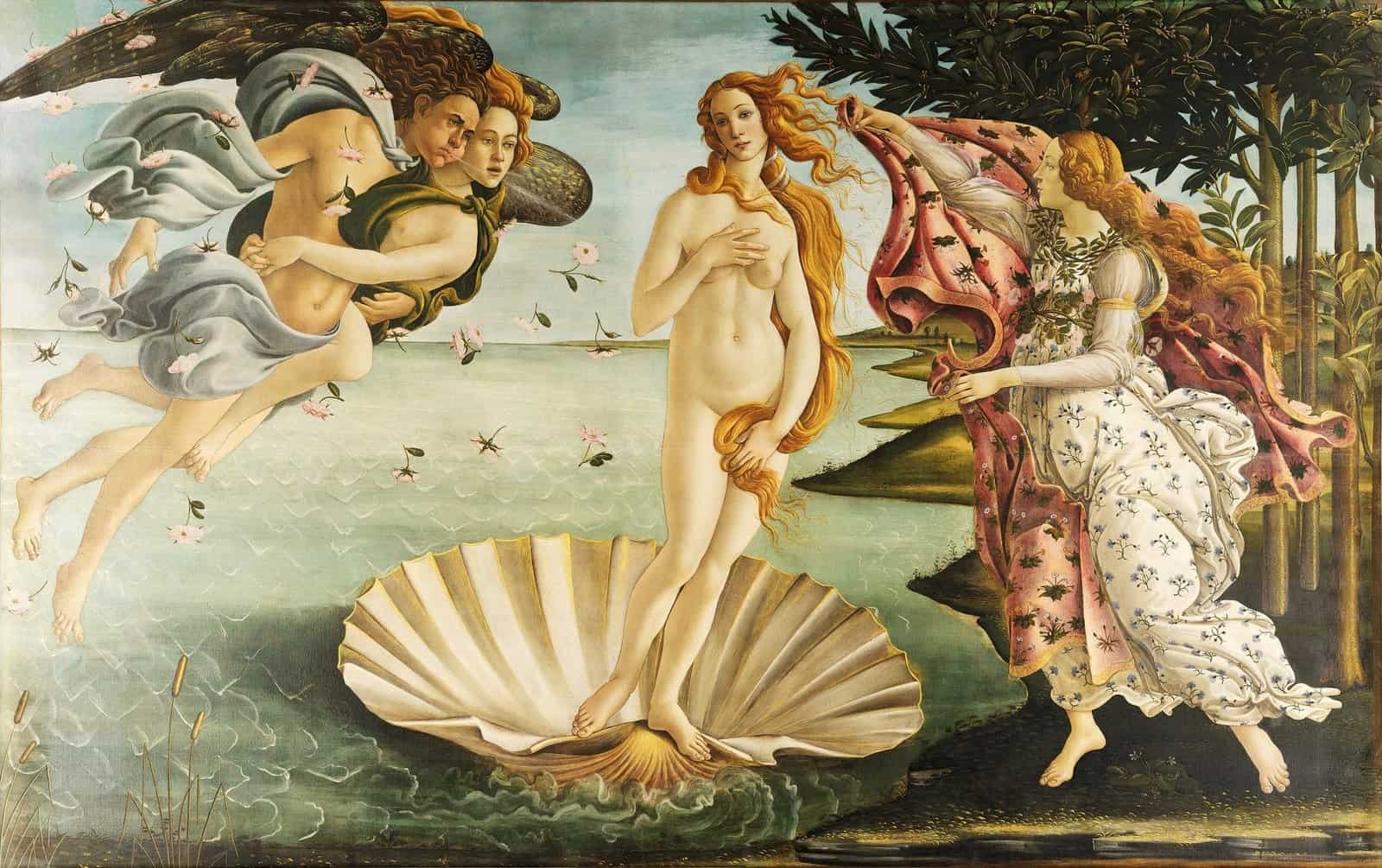
Start with Venus herself, standing on an oversized scallop shell in the centre of the composition. Her pose — one hand covering her chest, the other drawing her hair across her body — echoes the ancient sculptural type known as the Venus Pudica, or “modest Venus,” which Botticelli would have known from classical sources. She is simultaneously exposed and protected, a tension that runs through the entire image.
To the left, the wind god Zephyr embraces the nymph Chloris (or Aura, interpretations vary), and together they blow Venus toward the shore. Notice how Botticelli paints their breath as a stream of rose petals — a beautiful detail that also signals fertility and the arrival of spring.
On the right, a figure — generally identified as one of the Graces or the goddess Pomona — rushes forward with a flower-embroidered cloak, ready to dress Venus the moment she steps ashore. The cloak itself is covered in intricate botanical detail: look closely and you will see anemones, cornflowers, and daisies rendered with the precision of a manuscript illuminator.
The water is almost eerily flat, stippled with tiny white V-shapes that suggest waves without truly depicting them. The landscape behind Venus is spare and abstract. Botticelli was not interested in creating an illusion of real space — he wanted a stage, and he built one.
Finally, pay attention to the colour palette: the soft golds, the bleached sky, the pale flesh tones. There is very little deep shadow anywhere in the painting. The effect is luminous, as though the scene is lit from within rather than by any external source.
About Sandro Botticelli
Alessandro di Mariano di Vanni Filipepi — known to history as Sandro Botticelli — was born in Florence around 1445. He trained under the painter Fra Filippo Lippi and quickly established himself as one of the most sought-after artists in the city. His early career produced devotional panels and portraits, but it was his mythological works for the Medici circle — above all The Birth of Venus and the slightly earlier Primavera — that secured his lasting fame.
Botticelli was deeply affected by the fiery preacher Girolamo Savonarola in the 1490s, and his late work took a darker, more austere turn. He died in Florence in 1510, and for nearly three centuries his reputation faded almost entirely. It was not until the nineteenth century, when the Pre-Raphaelites rediscovered him, that Botticelli was restored to the pantheon of great painters.
Legacy and Influence
The Birth of Venus has had an outsized cultural life far beyond the walls of the Uffizi. Its imagery has been borrowed, quoted, and parodied by artists, advertisers, and filmmakers for generations. Andy Warhol reimagined it in silk-screen. Terry Gilliam put a version of it in The Meaning of Life. It has sold perfume, cars, and luxury travel — probably more products than any other single painting in existence.
In art history, its influence is more specific and profound. Botticelli’s willingness to treat the nude female figure as a subject worthy of monumental, serious painting helped open the door for the generations of artists who followed — from Titian to Rubens to countless others who placed the female nude at the centre of Western visual culture.
Where to See The Birth of Venus Today
The painting is permanently housed in Room 10-14 of the Uffizi Gallery in Florence, Italy, displayed alongside Botticelli’s Primavera and other works from his career. Seeing both paintings in the same room on the same visit is an extraordinary experience — they were almost certainly made for the same patron and speak directly to each other.
Practical tips: book tickets online well in advance, especially in summer, as the Uffizi sells out weeks ahead. Arrive when it opens (8:15 AM) or in the final hour before closing for smaller crowds. The Botticelli rooms are on the second floor — follow the signs from the entrance and head there first before fatigue sets in. Audio guides are available and worth renting for this section specifically.
Frequently Asked Questions
Where is The Birth of Venus located?
The painting is housed in the Uffizi Gallery in Florence, Italy, where it has been on permanent display since the late eighteenth century.
When was The Birth of Venus created?
It was most likely painted around 1485, though scholars place the date anywhere between 1484 and 1486 based on stylistic and documentary evidence.
What does The Birth of Venus represent?
On the surface it depicts the Roman goddess Venus emerging from the sea as an adult, born from the foam. More deeply, within the Neoplatonic philosophy of the Medici court, Venus symbolised ideal beauty and the divine truth that beauty reveals to those who truly perceive it.
Why is The Birth of Venus so famous?
Its fame rests on a rare combination: a radical subject for its time, a composition of haunting emotional power, and a technical execution that rewards close looking. It also arrived at exactly the right cultural moment and has never really left the popular imagination since its rediscovery in the nineteenth century.
Was The Birth of Venus considered controversial when it was painted?
Probably not to its original audience, who were sophisticated Medici patrons well versed in classical mythology. However, within a decade of its creation, the preacher Savonarola was urging Florentines to burn such “pagan” images — and the cultural climate shifted dramatically around Botticelli himself in his final years.
If The Birth of Venus has sparked your curiosity about Renaissance masterpieces, you are in exactly the right place. Explore our guides to related works — including Botticelli’s Primavera, Leonardo’s paintings from the same era, and the broader story of the Italian Renaissance — and keep discovering the extraordinary stories hidden inside history’s greatest art.
Image: The Birth of Venus – Sandro Botticelli (1485). License: Public Domain. Source: Wikimedia Commons.