Almond Blossoms
A painting about birth and hope was the last thing Van Gogh made before the worst collapse of his time at Saint-Rémy. He finished it in February 1890. Within days he went into a crisis that lasted close to two months, during which he could neither paint nor write letters. When he recovered in April, he told Theo he regretted that he had not been able to paint more blossoming trees.
Quick Facts
- Artist: Vincent van Gogh (1853–1890)
- Year: February 1890, Saint-Rémy-de-Provence
- Medium: Oil on canvas
- Dimensions: 73.3 × 92.4 cm
- Movement: Post-Impressionism
- Location: Van Gogh Museum, Amsterdam
Why it was painted
On 31 January 1890 Theo van Gogh wrote to tell his brother that he had a son. The child had been named Vincent Willem, after his uncle.
Theo added a line that Vincent remembered: he hoped the boy would be as determined and as brave as his namesake.
The reply came as a painting. Van Gogh began almost immediately and painted almond branches — the tree that flowers earliest in Provence, in February, before winter has properly ended.
It was made for a specific place: it was intended to hang above the child’s bed in Theo and Jo’s Paris apartment. It did.
What happened next
This is the context without which the painting reads too smoothly.
Van Gogh finished it in mid-February. At the end of the month he travelled to Arles and suffered an attack there. It was the longest and most severe crisis of his entire stay at Saint-Rémy — close to two months.
Through that period he did not paint and did not write.
In May he left the asylum and moved to Auvers-sur-Oise. He died on 29 July, five months after finishing this painting.
Theo died six months later, in January 1891. Vincent Willem was not yet one year old.
What makes it remarkable?
This is a different Van Gogh from the one most people know.
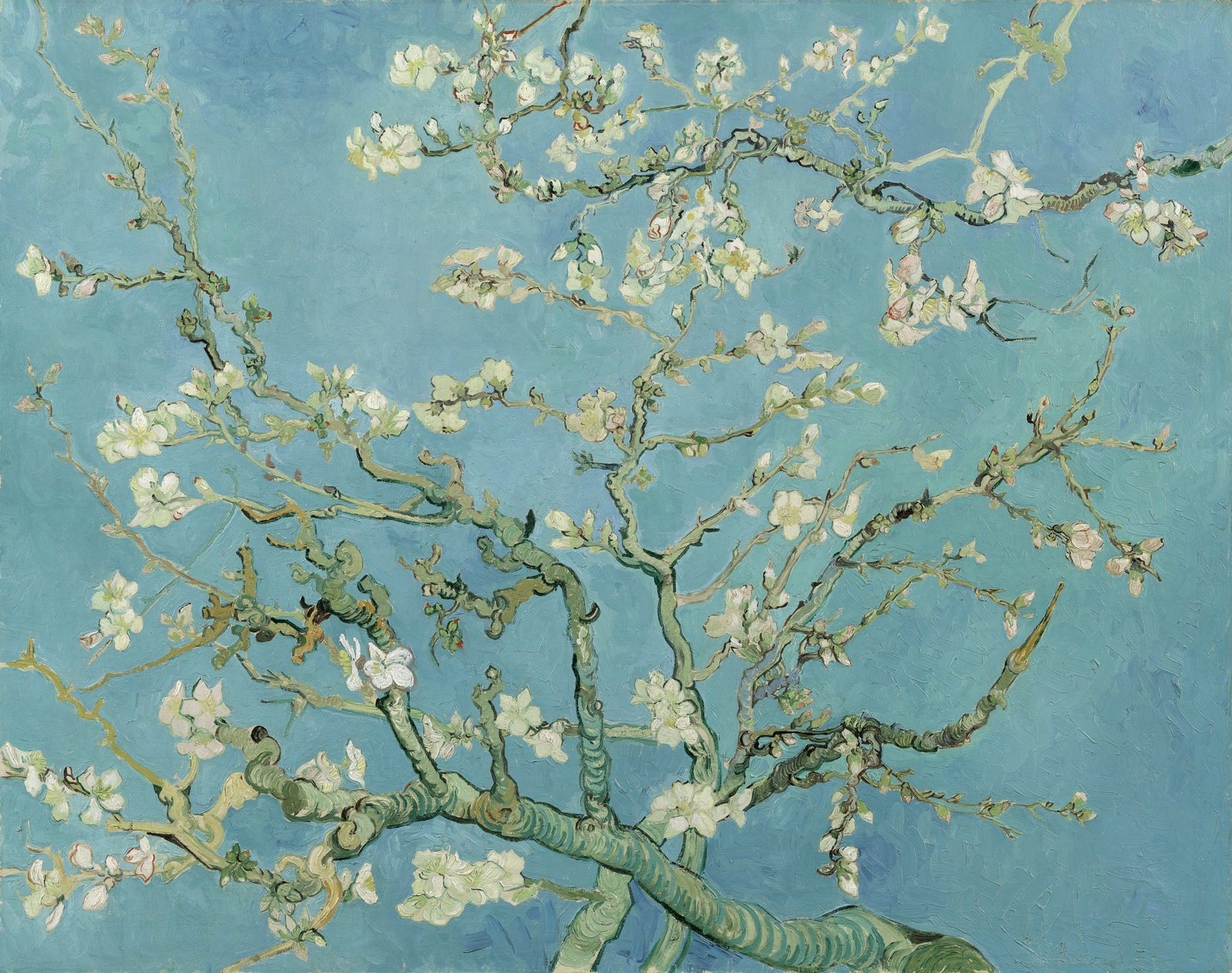
There is no swirling movement, no violent impasto, no dramatic sky. There are flat areas of colour, firm outlines, and stillness.
The composition is radically stripped down. No ground, no horizon, no trunk, no figure. Branches enter from several edges and run out of the frame, implying a tree that continues beyond it. We are looking up into the canopy.
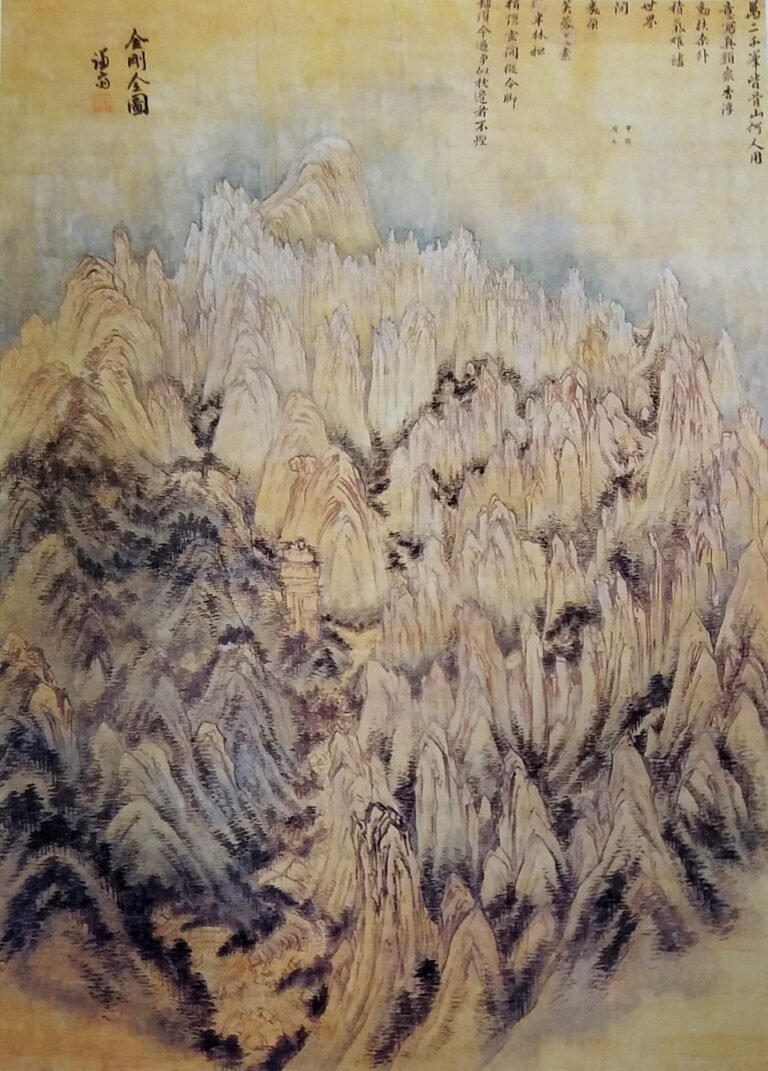
This comes directly from the Japanese woodblock prints Van Gogh collected — from Hiroshige and the whole tradition of flowering branches set against a flat ground.
The subject was not new to him. In Arles in spring 1888 he painted fourteen canvases of blossoming orchards. Those were full landscapes, with earth and sky. Here only the branches remain.
What to look for
The blue. Not an observed sky but a chosen colour — even, saturated, without cloud or gradation. It functions as a ground, not as space.
The outlines. Dark contours drawn around the branches. Rare in European oil painting; standard in Japanese printmaking.
Stages of bloom. Some flowers are fully open, some half-unfurled, some still buds. In a painting made for a newborn, that is unlikely to be accidental.
The paint. Despite the flatness of the design, the surface is thick. The blossoms have physical relief, which only becomes apparent in person.
The signature. Lower left: “Vincent” — as always, the first name only.
Historical context
Van Gogh had admitted himself voluntarily to the asylum of Saint-Paul-de-Mausole in May 1889, after the crisis in Arles.
In the year he spent there he produced around 150 paintings, including The Starry Night and a second version of The Bedroom.
Across Europe Japonisme was at its height — the enthusiasm for Japanese art that followed the opening of Japan. Van Gogh was among its most committed adherents: he and Theo assembled a collection of more than six hundred prints, and he copied several of them in oil.
It is worth adding that his situation was beginning to change in exactly these months. In January 1890 Albert Aurier published the first serious article on his painting, and The Red Vineyard was sold. Recognition arrived a few months before his death.
About Vincent van Gogh
Born on 30 March 1853 in Zundert, the Netherlands. He worked as an art dealer, a teacher and a lay preacher before taking up painting seriously in his late twenties.
In a decade he produced roughly 900 paintings and over 1,100 drawings.
It is worth correcting a persistent claim: he did not sell only one painting in his lifetime. The Red Vineyard, bought by Anna Boch, is the best-documented sale, but the Van Gogh Museum records others. He was a commercial failure, but not an absolute one.
He died on 29 July 1890 at Auvers-sur-Oise, aged thirty-seven.
Why the painting is in Amsterdam
Because it never left the family.
After the deaths of Vincent and Theo, the collection passed to Jo van Gogh-Bonger, Theo’s widow. Over the following decades she organised exhibitions, edited and published the brothers’ letters, and systematically built Vincent’s reputation. Without her he would not be a household name.
The collection was inherited by her son — the same Vincent Willem for whom this painting was made. In 1962 he transferred it to a state foundation, and in 1973 the Van Gogh Museum opened.
The painting therefore hangs in a museum that exists because of the man whose birth it celebrates.
Legacy and influence
The flat fields and strong outlines point towards Art Nouveau and early modernism — towards painting that abandons the illusion of space.
The motif of white blossom on blue is now among the most reproduced images in the world, on textiles, ceramics, stationery and wallpaper.
It also has a particular standing within the museum: it is the best-selling image in the shop and one of the most recognised works in the collection.
More usefully, it corrects a stereotype. It shows a painter capable of tenderness and calm — not only the turbulent expressionist of popular imagination.
Where to see it today
The painting hangs at the Van Gogh Museum, Museumplein 6, Amsterdam.
- Tickets are sold online only, for a timed slot. The museum does not sell them at the door — the single commonest cause of disappointment for visitors who turn up expecting to buy on arrival.
- Book ahead, particularly in summer. Slots go several days in advance.
- Early morning and the final hours are quietest.
- Get close. The composition looks flat, but the paint is thick, and that is only visible from near by.
- Also here: Sunflowers, the first version of The Bedroom, The Potato Eaters, and several of the Arles orchard paintings — worth comparing with this one.
- The Rijksmuseum and the Stedelijk are on the same square. Three museums in one day is possible but punishing.
Frequently asked questions
Why did Van Gogh paint it?
As a gift for his brother Theo and his wife Jo, marking the birth of their son, who was named Vincent Willem after the artist. It was intended to hang above the child’s bed, and it did.
What does the almond tree signify?
New life and hope. The almond is the earliest tree to flower in Provence, blossoming in February before winter has ended.
What happened to Van Gogh after he finished it?
Within days he suffered the longest crisis of his time at Saint-Rémy — close to two months during which he could not work. He died five months later.
Where does the Japanese influence come from?
Van Gogh and his brother collected more than six hundred Japanese woodblock prints, and he copied several in oil. The flat colour, dark outlines, cropped framing and absence of perspective all come from that source.
Had he painted blossom before?
Yes. In Arles in spring 1888 he made fourteen paintings of flowering orchards. The difference is that those were full landscapes; here only the branches and the sky remain.
How did the painting reach the museum?
It never left the family. Jo van Gogh-Bonger took charge of the collection after the brothers’ deaths, and it passed to her son — the Vincent Willem of the painting’s occasion. He transferred it to a state foundation in 1962, and the museum opened in 1973.
If this painting has moved you, look next at The Starry Night — made in the same asylum a few months earlier, and its exact opposite: movement and turbulence instead of stillness and flat colour.
Image: Almond Blossom – Vincent van Gogh (February 1890). License: Public Domain. Source: Wikimedia Commons.