Sudden Shower over Shin-Ōhashi Bridge and Atake
Van Gogh copied this print in oil, and while doing so made a mistake that tells you everything about what Japonisme actually was. He framed his version with a border of Japanese characters copied from other prints in his collection. They do not mean anything coherent. Fragments of advertisements and unrelated titles, transcribed by a man who admired the writing without being able to read it.
Quick Facts
- Artist: Utagawa Hiroshige (1797–1858)
- Japanese title: Ōhashi Atake no yūdachi (大はしあたけの夕立)
- Date: September 1857
- Medium: Nishiki-e polychrome woodblock print
- Dimensions: c. 36 × 24 cm (vertical ōban)
- Series: One Hundred Famous Views of Edo, plate 58
- Movement: Ukiyo-e
- Where to find it: impressions at the Metropolitan Museum, the Brooklyn Museum, the British Museum, the Van Gogh Museum
Why there is no “original”
This is a print, not a painting, and it was made by a team.
Hiroshige drew the design. A block cutter carved the blocks — one for each colour — destroying the original drawing in the process. A printer pulled the impressions by hand onto damp paper. A publisher financed the series and made the commercial decisions.
Print runs went into the hundreds, and popular designs were reprinted for years. Later impressions are visibly weaker — lines thicken, the sky gradation flattens, the rain loses its edge.
Impressions are held in museums worldwide and they differ from one another. The question is never where the original is, but which impression you are looking at.
What makes it unforgettable?
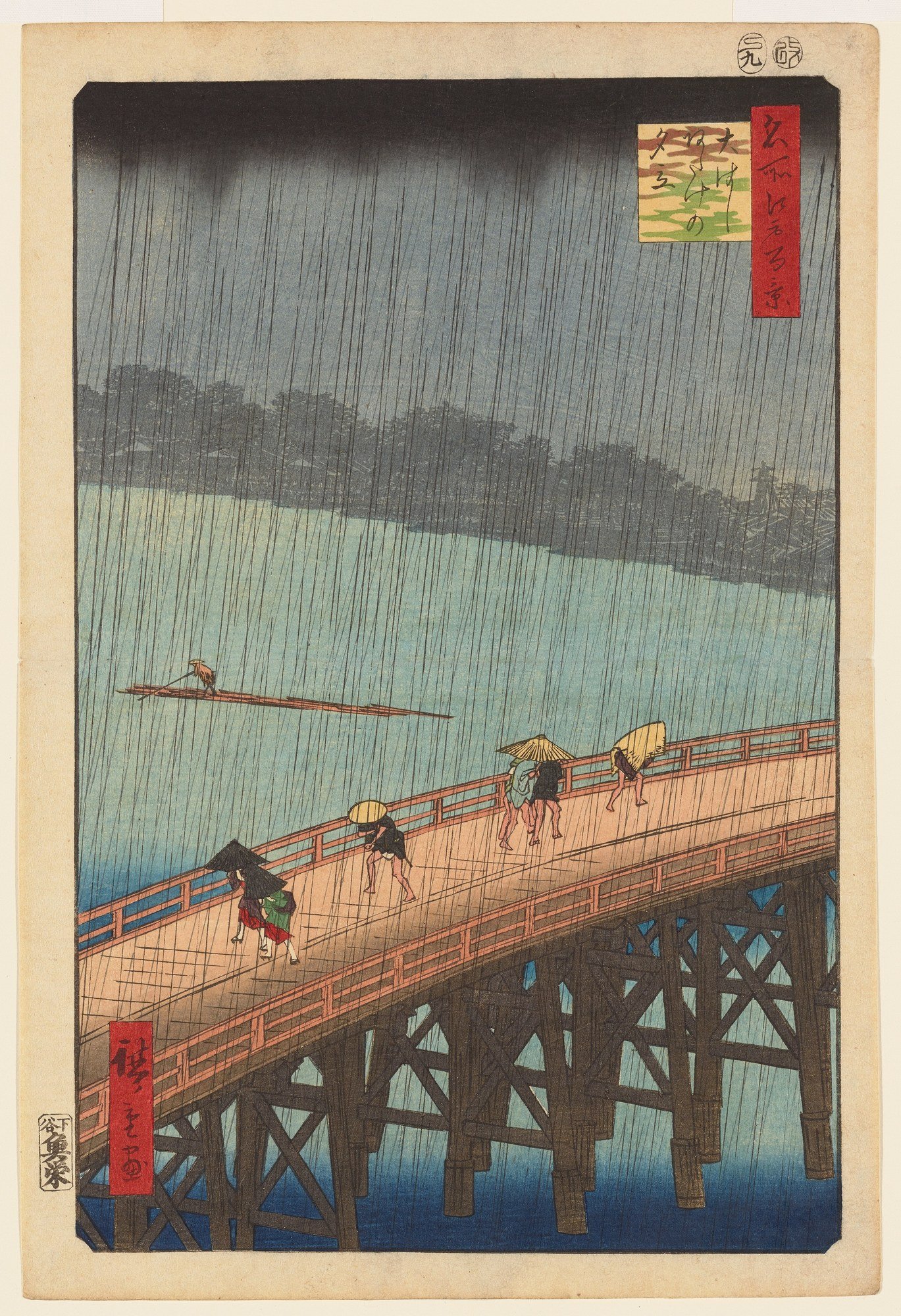
Most artists painted rain as mood or backdrop. Hiroshige made it the subject.
The execution is the extraordinary part. The rain lines were cut into separate blocks — two of them, printed at slightly different angles, which is what produces the density. Carving hundreds of long parallel grooves into cherry wood without the ridges splintering was among the most demanding tasks in the entire craft. The cutter mattered here as much as the artist.
Then there is the framing. The bridge is cut off at both edges; neither bank is fully visible. That kind of cropping — apparently accidental, almost photographic — was unthinkable in European composition at the time, and it is precisely what struck Degas and Toulouse-Lautrec.
Place and moment
The scene is locatable. The Shin-Ōhashi bridge was built across the Sumida River in 1693. Atake is the name of the district on the far bank — it took its name from the Atakemaru, a huge warship once moored there.
The dark shape on the right, barely visible through the downpour, is a raft of timber being floated downriver.
It is worth knowing that the bridge in the print was already derelict when Hiroshige made it, and was demolished shortly afterwards. He was drawing something that was disappearing — as was Edo itself, which within a decade would become Tokyo.
What to look for
Two angles of rain. Look carefully: the lines fall at two distinct inclinations. That is the trace of two separate blocks.
The black band at the top. An abrupt dark gradient across the upper edge, produced by bokashi — the printer wiping pigment from the block by hand before each pull. It looks different on every impression, and in early printings it is markedly sharper.
The figures. Eight people, all hunched, none looking towards the viewer. Two share a single umbrella; one runs with a straw mat over the head; another carries goods. They are not characters. They are weather.
The blue of the water. Early impressions used a plant-derived dayflower blue in places, which fades. On many surviving examples the river is paler now than it originally was.
The raft. Easy to miss, and it supplies the scale of the river.
Historical context
1857. Japan was four years past Commodore Perry’s Black Ships and the forced opening of the treaty ports. The Tokugawa shogunate was failing; the Meiji era was a decade away.
Hiroshige was working on One Hundred Famous Views of Edo, which functions as an extended farewell to the city. Several of the places it shows had already been damaged or destroyed — many by the great earthquake of 1855.
The series ran to 118 plates and Hiroshige did not finish it. The final designs were completed after his death by his pupil and son-in-law, Hiroshige II.
About Utagawa Hiroshige
Born in Edo in 1797, the son of a fire-brigade official. Both parents died when he was twelve; he inherited his father’s post and held it for years while working as an artist.
He trained under Utagawa Toyohiro. Where Hokusai was a formal experimenter, Hiroshige was a painter of weather, hour and mood. Fifty-three Stations of the Tōkaidō made his name in his lifetime.
He died in the Edo cholera epidemic of 1858, a year after this print appeared. He left a farewell poem saying he was leaving his brush behind in Edo and setting out to see the famous views of the Western Paradise.
Van Gogh and the copy
This is the richest thread in the print’s history.
Vincent and his brother Theo assembled a collection of more than six hundred Japanese prints. In Paris in 1887 Vincent translated two of them into oil: this one, and Hiroshige’s Plum Orchard.
His method was mechanical. He laid a grid over the print, transferred it enlarged onto canvas, and worked square by square.
The colours, though, are his own — far more intense than Hiroshige’s, with oranges and greens the original does not contain.
And he added the border of characters. He copied them from other prints he owned without understanding them; the fragments come from advertisements and titles unrelated to this scene.
The painting hangs in the Van Gogh Museum in Amsterdam — not, as is often assumed, in the Rijksmuseum a few hundred metres away.
Van Gogh wrote to Theo that Japanese artists study a single blade of grass and from it learn to draw everything. He saw in them what he wanted for himself.
Legacy and influence
Japonisme reshaped European painting at the end of the nineteenth century: cropped framing, flat colour, high horizons, asymmetry. Impressionists, Post-Impressionists and Art Nouveau designers all drew on it.
This particular design became one of the most reproduced Japanese prints of all. The convention of drawing rain as diagonal lines entered comics and animation so thoroughly that it now looks obvious.
It is worth keeping the proportions straight, though. For European painters these were revelations. For an Edo townsman they were cheap prints bought roughly the way one buys a postcard.
Where to see it
Impressions are scattered. Substantial ukiyo-e holdings exist at the Metropolitan Museum and the Brooklyn Museum in New York, the British Museum, the Musée Guimet in Paris, and the Van Gogh Museum, which holds Vincent’s collection alongside his painted copy.
- Check whether it is on display before you go. Works on paper are rotated, usually for a few weeks every few years. This is the commonest cause of disappointment.
- The Met, the Brooklyn Museum and the Van Gogh Museum all offer free high-resolution scans online.
- In Amsterdam you can see the Hiroshige and the Van Gogh in the same visit. The difference in colour is startling.
- At the Met, pay-what-you-wish admission applies to New York State residents and to students from New Jersey and Connecticut; everyone else pays a fixed rate.
Frequently asked questions
Where is Van Gogh’s copy?
In the Van Gogh Museum in Amsterdam. It is frequently confused with the Rijksmuseum, which stands on the same square.
Is there a single original of this print?
No. It is a woodblock print pulled in hundreds of impressions from the same blocks. Surviving examples differ in quality — earlier ones are sharper, with stronger sky gradation.
How was the rain made?
By carving fine parallel lines into two separate blocks, printed at slightly different angles. It was one of the most technically demanding operations in ukiyo-e printing.
What is One Hundred Famous Views of Edo?
A series of 118 prints published between 1856 and 1858, showing locations around Edo at different seasons and times of day. Hiroshige died before completing it; the last designs were finished by his pupil Hiroshige II.
Does the bridge still exist?
Not this one. The bridge in the print was already derelict in 1857 and was demolished soon after. A modern bridge of the same name crosses the Sumida today.
What is ukiyo-e?
Japanese polychrome woodblock printing, popular from the seventeenth to the nineteenth century. The name means “pictures of the floating world.” Each colour required a separate block, and the work was done by a team: artist, cutter, printer and publisher.
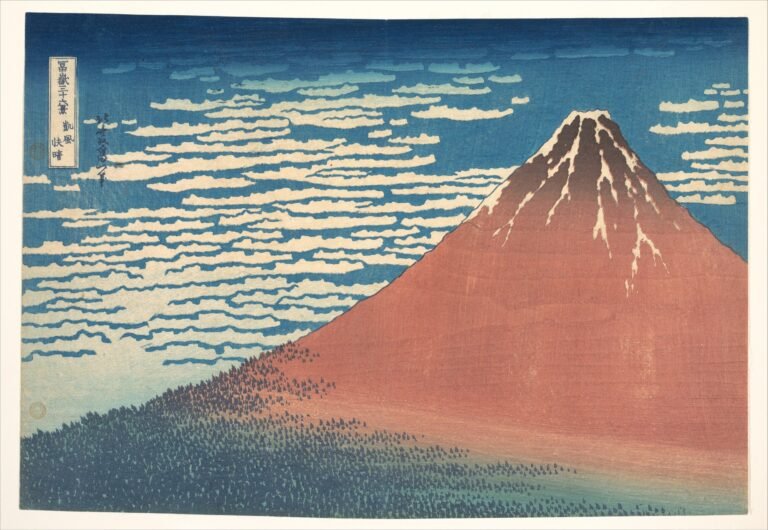
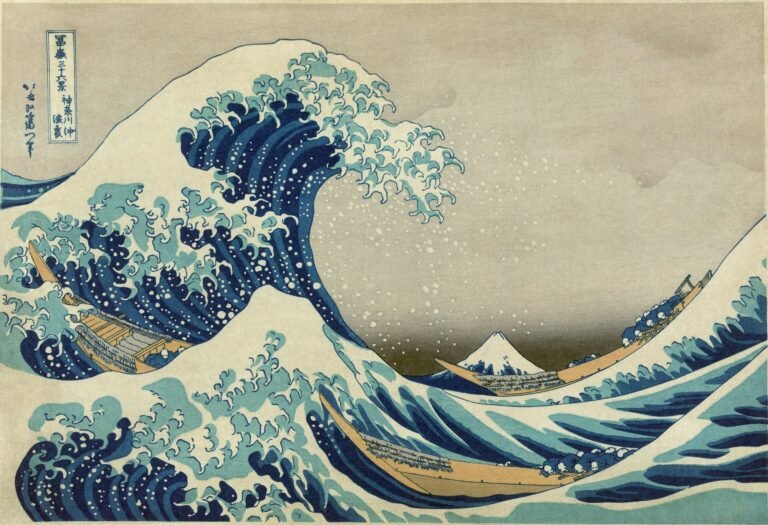
If this print has caught your interest, look next at The Great Wave off Kanagawa and Red Fuji by Hokusai — prints that reached Europe by the same route and caused the same shock.
Image: Ōhashi Atake no yūdachi – Utagawa Hiroshige, 1857, from the series One Hundred Famous Views of Edo. License: Public Domain. Source: Wikimedia Commons.