Luncheon of the Boating Party
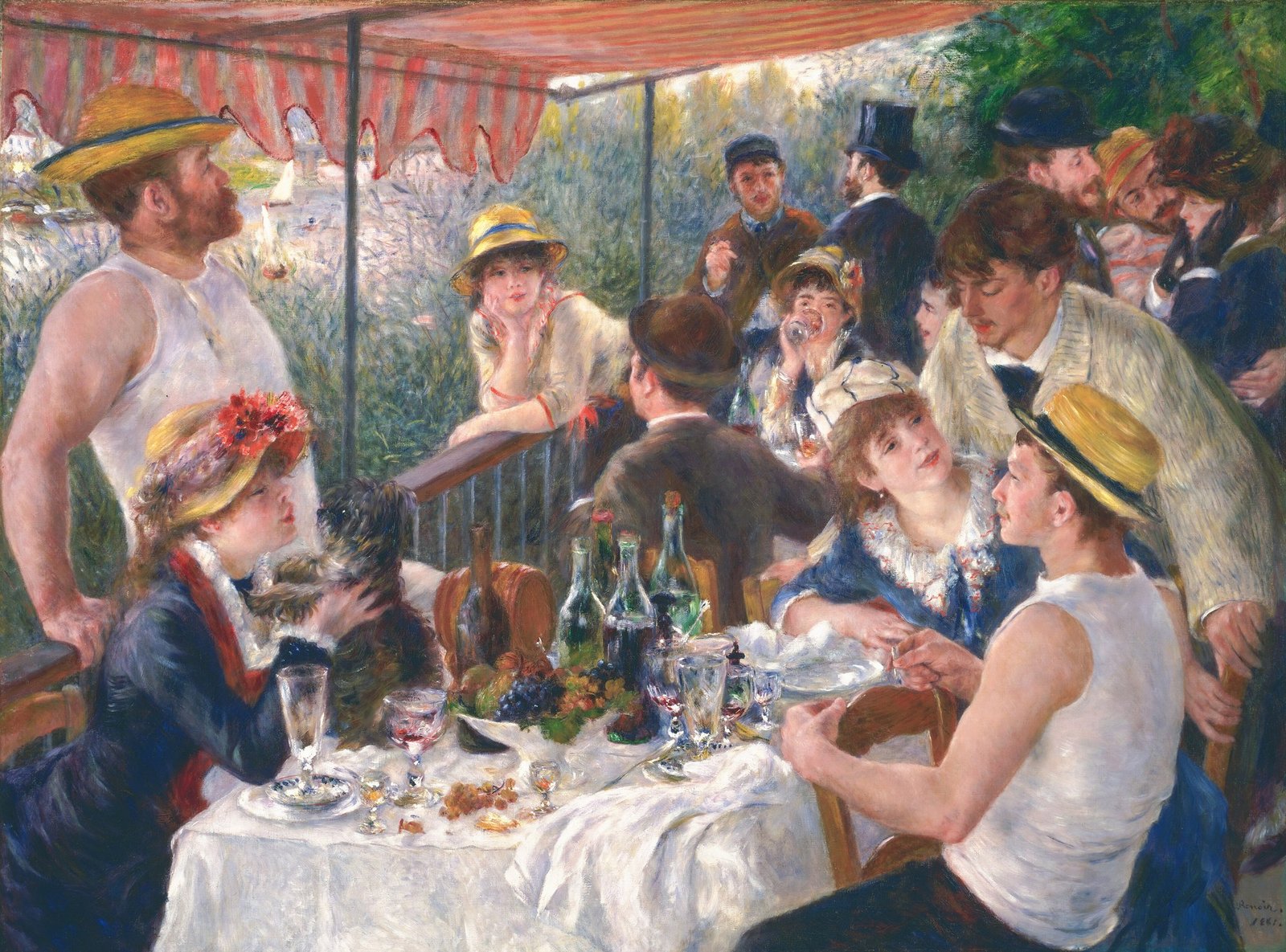
One of the men leaning on the railing wrote À la recherche du temps perdu — indirectly. The figure in the top hat at the right is Charles Ephrussi, art historian, collector and one of the models Proust drew on for Charles Swann. Renoir put him in the painting in formal dress, surrounded by people in rowing vests. He is the only man there who came in a top hat.
Quick Facts
- Artist: Pierre-Auguste Renoir (1841–1919)
- French title: Le Déjeuner des canotiers
- Years: 1880–1881
- Medium: Oil on canvas
- Dimensions: 129.9 × 172.7 cm
- Movement: Impressionism
- Location: The Phillips Collection, Washington, D.C.
Who is in it
Almost every figure is identifiable, and the group is more interesting than the scene.
Aline Charigot — lower left, with the dog. A seamstress, twenty-one years old, twenty years younger than Renoir. They married in 1890, nine years after this painting, by which time they already had a son.
Gustave Caillebotte — seated at the right, backwards on a chair, in a rowing vest and straw hat. A painter himself, a competitive sailor, and the man whose money kept the Impressionist exhibitions running.
Charles Ephrussi — standing at the back in the top hat. A banking heir, collector and editor of the Gazette des Beaux-Arts. Proust used him as one source for Swann. His family’s collection of Japanese netsuke became the subject of Edmund de Waal’s book The Hare with Amber Eyes.
Alphonsine and Alphonse Fournaise — the proprietor’s daughter, leaning on the railing at the left, and her brother in the foreground. The restaurant was their family business.
Ellen Andrée — the actress drinking, centre. She also sat for Degas’s L’Absinthe.
Angèle Legault, a model, and Jules Laforgue, the poet, are usually identified among the back figures, though not all identifications are firm.
What makes it unforgettable?
Renoir set himself a problem that ought not to work: fourteen people on a terrace, at different depths, in broken light, each doing something different, on a canvas nearly two metres wide.
Group portraits of this kind normally go stiff. Everyone faces front and waits.
Here nobody waits. One woman drinks, one man talks over his shoulder, two lean on the rail, one plays with a dog. The composition holds because Renoir built it around two diagonals — the awning above and the table below — and let the figures fill the space between them.
The still life on the table is a painting in its own right: bottles, glasses, grapes, a crumpled cloth. Renoir was proud of it and said so.
How it was made
The romantic version says a single afternoon. The reality took months.
Renoir worked at the Maison Fournaise in Chatou through the summer of 1880 and into 1881, bringing sitters out to the terrace individually or in small groups. They were not all there at once.
He wrote to a friend that he was working on a picture of boaters that he had wanted to make for a long time, that he was not getting any younger, and that it was costing him a fortune in models.
X-ray study has shown substantial changes. Figures were moved, the composition was rebalanced, and at least one person was painted out.
The result looks spontaneous and is entirely constructed.
Historical context
Chatou sits about fifteen kilometres from Paris on the Seine. The railway made it a weekend destination, and by 1880 the riverside was full of boat hire, restaurants and open-air dancing.
The canotiers — rowers — were a recognisable social type: young, urban, middle-class, out of the office and into a striped vest. Boating was the new leisure, and it mixed classes in ways that made older Parisians uncomfortable.
Renoir was painting something genuinely recent. The world of the picture was about twenty years old.
It was shown at the seventh Impressionist exhibition in 1882, and was widely singled out as the best work there.
The timing matters for another reason. Renoir was on the verge of abandoning Impressionism. Within a year he travelled to Italy, saw Raphael and the Pompeian frescoes, and entered what is called his dry or Ingresque period — hard outlines, cooler colour, a deliberate turn away from everything this painting does. It is the last great work of his Impressionist decade.
What to look for
The awning. Orange-and-white striped canvas above the table, filtering the light and tinting every face beneath it warm.
The still life. Bottles, glasses and fruit in the foreground, painted with a precision the figures do not get.
The dog. A griffon on the table in front of Aline. It later appears in other Renoir paintings — it was hers.
Two men in undershirts. Caillebotte and Alphonse Fournaise are in rowing vests with bare arms, at a table where another man wears a top hat. That mixture is the social point of the painting.
The river. Behind the railing, through the gap in the awning, sailing boats on the Seine. Easy to miss.
The hats. Straw boaters on the men, elaborate trimmed hats on the women. Renoir uses them to organise the upper half of the composition.
About Pierre-Auguste Renoir
Born in Limoges in 1841, the son of a tailor and a seamstress. He began as a porcelain painter at thirteen, decorating plates by hand, until mechanised printing destroyed the trade.
He entered Gleyre’s studio in 1862 and met Monet, Sisley and Bazille. He showed at the first Impressionist exhibition in 1874.
From the 1890s he suffered severe rheumatoid arthritis. One correction is needed: the common claim that brushes were strapped or tied to his hands is a misreading of late photographs. He wedged the brush between his deformed fingers, sometimes with an assistant placing it. Nothing was bound on.
He died in 1919 at Cagnes-sur-Mer, aged seventy-eight. Aline had died four years earlier.
How it reached Washington
The purchase is part of the painting’s fame.
Duncan Phillips bought it in 1923 from the dealer Durand-Ruel for $125,000 — at the time an extraordinary sum, and the highest Phillips ever paid for anything.
He had pursued it for years. When he got it he wrote that the picture was one of the greatest in the world and that he had no regrets about the price.
It has been in the Phillips Collection since, and has essentially never travelled. If you want to see it, you go to Washington.
Legacy and influence
The painting became shorthand for a kind of happiness — sunlit, sociable, temporary.
It appears in Amélie, where a character copies it obsessively and cannot get one girl’s expression right. Susan Vreeland’s novel Luncheon of the Boating Party (2007) reconstructs the summer of its making from the models’ perspectives.
The Maison Fournaise still stands at Chatou and operates as a restaurant with a small museum. The terrace is recognisable, though the view has changed.
Where to see it today
The painting is at The Phillips Collection, 1600 21st Street NW, Washington, D.C., near Dupont Circle on the red line.
- The museum is closed on Mondays. Check hours and prices before travelling.
- It is a converted house, not a grand museum. The rooms are small, the scale domestic, and the experience unusually unhurried for a painting this famous.
- Go close and then step well back. From two metres the still life resolves; from six the whole terrace does.
- See the Rothko Room while you are there — four paintings in a small space, designed with Rothko’s involvement.
- Also here: Cézanne, Bonnard, Braque and Van Gogh’s Entrance to the Public Garden in Arles.
Frequently asked questions
Who are the people in the painting?
Renoir’s friends and the restaurant’s family. Aline Charigot with the dog, whom he married in 1890; the painter Gustave Caillebotte in the rowing vest; the collector Charles Ephrussi in the top hat; the actress Ellen Andrée; and Alphonsine and Alphonse Fournaise, whose family owned the establishment.
Was it painted in one sitting?
No. Renoir worked on it across the summer of 1880 and into 1881, bringing sitters to the terrace separately. X-rays show figures moved and at least one painted out.
Where was it painted?
On the terrace of the Maison Fournaise at Chatou, on the Seine west of Paris. The building still exists and operates as a restaurant.
Why is it in Washington?
Duncan Phillips bought it in 1923 for $125,000, the highest price he ever paid. It has stayed in his museum ever since and rarely travels.
When did Renoir marry Aline?
In 1890, nine years after the painting, when their first son was already five. She was twenty years his junior.
What came after this painting?
A break. Renoir travelled to Italy, studied Raphael and Pompeian wall painting, and moved into a harder, more linear style. This is generally regarded as the last major work of his Impressionist period.
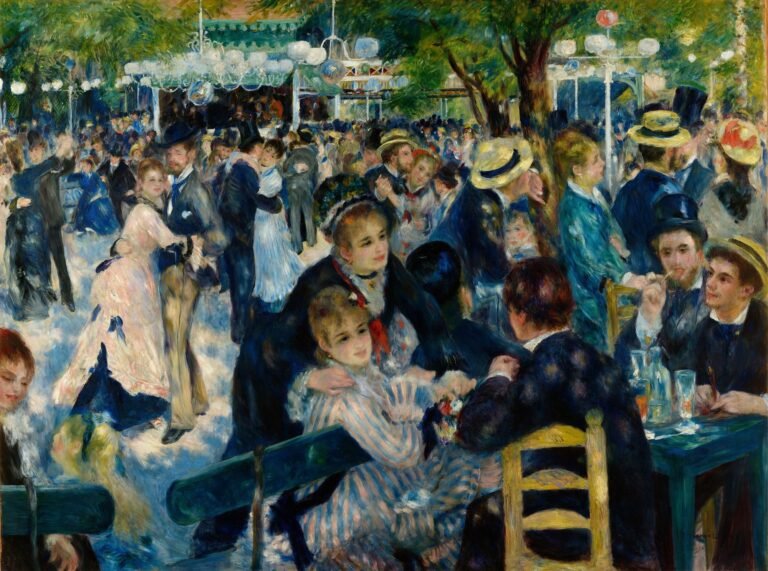
If this painting has caught your interest, look next at Bal du moulin de la Galette — painted five years earlier, on the same principle: a crowd of friends, outdoors, in broken light, constructed to look accidental.
Image: Le Déjeuner des canotiers – Pierre-Auguste Renoir (1880–1881). License: Public Domain. Source: Wikimedia Commons.