Judith Beheading Holofernes
Most paintings of violent biblical scenes keep their distance – but Judith Beheading Holofernes grabs you by the collar and forces you to watch. Caravaggio painted a widow sawing through a general’s neck with such unflinching realism that the picture was never destined for a church at all. It hung in a banker’s private rooms, then slipped out of sight so completely that the art world did not rediscover it until 1950.
Quick Facts
- Artist: Caravaggio
- Year: c. 1598–1599, or 1602 (scholars disagree)
- Medium: Oil on canvas
- Dimensions: 145 cm × 195 cm (57 in × 77 in)
- Movement: Baroque
- Current location: Palazzo Barberini, Rome
What Makes Judith Beheading Holofernes So Unforgettable?
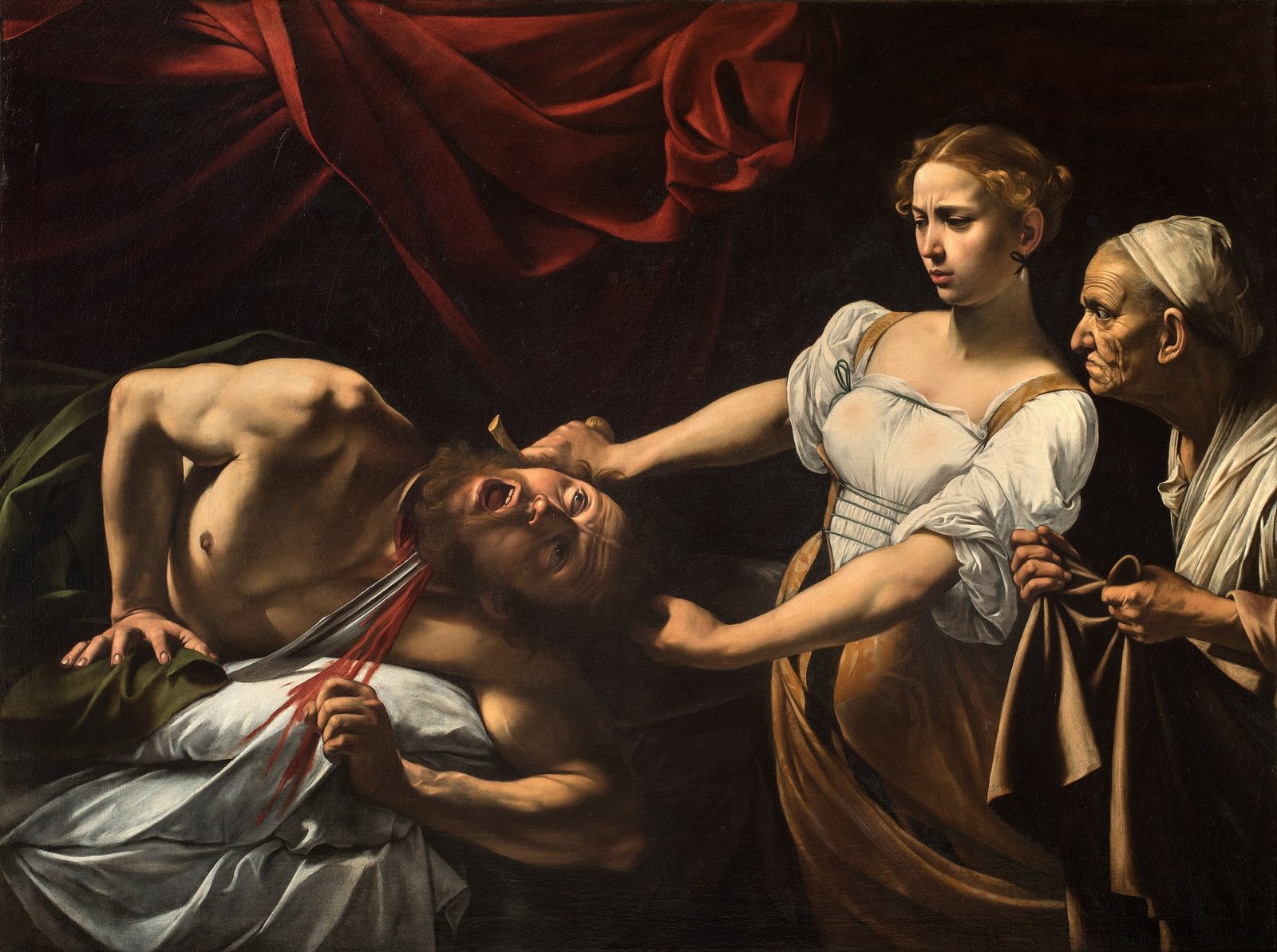
Other Renaissance painters treated this same story as a triumph. They gave Judith flowing robes, elegant poses, and a serene expression. Caravaggio did the opposite. His Judith holds determination and revulsion in the same face – her brow furrowed, her arms extended as if she wants to stay as far from the blood as possible. That psychological honesty is what sets this painting apart from everything that came before it.
There is also the sheer physicality of the act. Holofernes is mid-scream, his hands gripping the sheets in a final, desperate spasm. The blade has not finished its work yet. This is not a trophy moment. It is a process, caught at its most brutal midpoint. No other artist of the era dared to show it this way.
In addition, Caravaggio gives us the maidservant – Abra, in the biblical account – a wrinkled old woman holding a bag, utterly matter-of-fact. Her calm presence beside such violence makes the scene even more disturbing. She has seen this kind of thing before, or so her expression suggests.
Historical Context
By the late 1590s, Rome was a city in creative tension. The Counter-Reformation had pushed the Catholic Church to reclaim art as a tool of emotional persuasion. Religious painting needed to move people, to make scripture feel immediate and real. Caravaggio answered that call – radically.
He was making his name in Roman collecting circles rather than in churches. Through most of the 1590s he painted for private patrons: Cardinal Francesco Maria del Monte housed him, and it was another collector, the banker Ottavio Costa, who commissioned Judith Beheading Holofernes for his own walls. That detail matters, because it explains the picture. Costa wanted something powerful and personal, not decorative, and Caravaggio was free of the constraints a church commission would have imposed. The famous scandals – altarpieces rejected as too earthy, too common – came later, between 1601 and 1606.
The dating is genuinely contested, and it changes the story around the painting. If the traditional date of 1598–99 holds, Caravaggio made it just as he was beginning the Contarelli Chapel canvases that would make him famous. If the later dating of 1602 is right, he painted it as an established public figure. Either way, this is an artist at a creative peak – confident, experimental, and willing to push every boundary of acceptable religious imagery.
What is not in doubt is what happened next: the painting stayed in private hands and effectively disappeared from the literature. It resurfaced only in 1950, which means generations of critics and painters never saw it. Its influence had to travel by other routes.
Symbolism and What to Look For
Stand in front of Judith Beheading Holofernes and start with the light. Caravaggio floods the scene from a single source at the upper left, carving the figures out of near-total darkness. Holofernes’s torso glows almost white against the black background. That contrast is not decorative; it forces your eye to the violence and nowhere else. The technique has its own name – tenebrism, chiaroscuro pushed to its extreme.
Now look at Judith’s face. She is young, richly dressed, and physically unsuited to what she is doing – this is no warrior. Notice the tension in her arms and the way she leans back from her own hands. She is pressing the sword through his neck with visible effort while trying not to touch him. Caravaggio shows us the physical difficulty of the act, which makes it all the more real.
The model was almost certainly Fillide Melandroni, a young Roman courtesan who sat for several of Caravaggio’s paintings in these years. He did not invent an idealised heroine; he hired one from the neighbourhood, which is precisely the practice that scandalised his critics.
The maidservant on the right repays close attention. She is elderly, dark-clothed, and holds an open bag – almost certainly to receive the head. Her presence transforms Judith from a lone heroine into part of a small, purposeful team, and the contrast between the two faces carries much of the picture’s unease.
Finally, look at Holofernes. His mouth is open in agony, his eyes wide, his hands clutching the sheets with a grip that speaks of survival instinct kicking in too late. X-rays have shown that Caravaggio moved his head as the work progressed, shifting it to the right and separating it further from the shoulders – the composition was found on the canvas rather than planned in advance.
About Caravaggio
Michelangelo Merisi da Caravaggio was born in Milan in 1571 and trained as a painter in Lombardy before moving to Rome in the early 1590s. He arrived poor and ambitious. Within a decade, he was the most talked-about painter in Italy.
His signature technique used dramatic contrasts of light and shadow to create intense, three-dimensional figures. He painted from live models rather than idealized forms, which shocked and delighted audiences in equal measure. His subjects were saints who looked like peasants, martyrs who bled real blood.
His personal life was as turbulent as his art. He killed Ranuccio Tomassoni in a fight in Rome in 1606, fled the city under a death sentence, and spent his remaining years moving between Naples, Malta, and Sicily – always painting, always in trouble. He died in 1610 at roughly 38 years old. He left behind fewer than 80 confirmed works, each one a landmark.
Legacy and Influence
Judith Beheading Holofernes became a touchstone once it re-emerged in the twentieth century. Its influence on later art is vast, even if that influence traveled indirectly. Artemisia Gentileschi painted her own, fiercer version of the scene around 1612–13, now in Naples, and a second version around 1620, now in the Uffizi. Her father Orazio moved in Caravaggio’s Roman circle, and art historians treat her debt to him as established rather than speculative.
Caravaggio’s broader style spread rapidly through Europe during his lifetime. The Caravaggisti – followers in Italy, Spain, France, and the Netherlands – absorbed his lighting and his realism. Rembrandt, Rubens, and Velázquez all show his shadow in their work.
There is also a second Judith. A canvas discovered by chance in a Toulouse attic in 2014, dated to about 1607, has been attributed to Caravaggio by some specialists and rejected by others, who read it as a copy by the Flemish painter Louis Finson. It sold privately in 2019, and the argument continues.
Today, the Barberini painting appears regularly in discussions of feminist art history, of cinematic lighting, and of how images of violence work on a viewer. That last question has since been taken up by neuroscience, with results that complicate the obvious answer: brain imaging suggests repulsion and attraction are not mirror images of each other but run on different circuitry entirely. Caravaggio worked that out with a brush.
Where to See Judith Beheading Holofernes Today
The painting hangs in the Palazzo Barberini in Rome, home to the Galleria Nazionale d’Arte Antica. The palace was begun by Carlo Maderno and completed with contributions from Gian Lorenzo Bernini and Francesco Borromini – worth visiting for the architecture alone, and for Pietro da Cortona’s ceiling in the great hall.
The museum is open Tuesday to Sunday, 10:00 to 19:00, with last admission an hour before closing, and is closed on Mondays. Weekday mornings and the hour before closing are the quietest; Saturday and Sunday afternoons are the busiest. Allow around two hours for the collection, which is spread over two floors.
While you are there, the same collection holds three more Caravaggios – Narcissus, Saint Francis in Meditation and a Saint John the Baptist – along with Raphael’s La Fornarina and Hans Holbein the Younger’s portrait of Henry VIII. Look too for the portrait long known as Beatrice Cenci, attributed to Guido Reni: Cenci was publicly beheaded in Rome in September 1599, and it has often been suggested, though never demonstrated, that Caravaggio was in the crowd.
Frequently Asked Questions
Where is Judith Beheading Holofernes located?
The painting is on permanent display at the Palazzo Barberini in Rome, which houses the Galleria Nazionale d’Arte Antica. It has been there since the state acquired it after its rediscovery in 1950.
When was Judith Beheading Holofernes created?
Either around 1598–99 or in 1602 – the date is genuinely disputed. The traditional dating places it just before the Contarelli Chapel commission. The 2017–18 exhibition Dentro Caravaggio in Milan argued for 1602, on the grounds that the panel shows the light underlying sketches typical of his later work and absent from his early paintings.
Who was the model for Judith?
Almost certainly Fillide Melandroni, a Roman courtesan in her late teens or early twenties who sat for several Caravaggio paintings around this time. Using a working model from the streets of Rome for a biblical heroine was exactly the habit that made his religious pictures so controversial with church patrons.
What does Judith Beheading Holofernes represent?
It depicts the story from the Book of Judith, in which a Hebrew widow enters the tent of the Assyrian general Holofernes, waits until he is drunk, and beheads him to save her city. The story was read as a triumph of courage and righteousness, and of the vulnerable over the powerful – though Caravaggio’s version withholds most of the triumph.
Why is Judith Beheading Holofernes so famous?
Its fame rests on Caravaggio’s unprecedented realism – the grimacing general, the recoiling heroine, the brutal mid-act framing – combined with his revolutionary use of dramatic light and shadow. No painting of this subject had ever felt so viscerally alive.
Who commissioned the painting?
The seventeenth-century painter and biographer Giovanni Pietro Baglione records that it was commissioned by Ottavio Costa, a banker from the Ligurian coast working in Rome and one of Caravaggio’s most important early private patrons. It was made for a private house, not a church.
Is there a second version of this painting?
There is a second canvas of the subject, found in an attic in Toulouse in 2014 and dated to around 1607. Some specialists accept it as an autograph Caravaggio; others consider it a version by the Flemish painter Louis Finson, whose own Judith hangs in Naples. The work was sold privately in 2019 and the attribution remains unsettled.
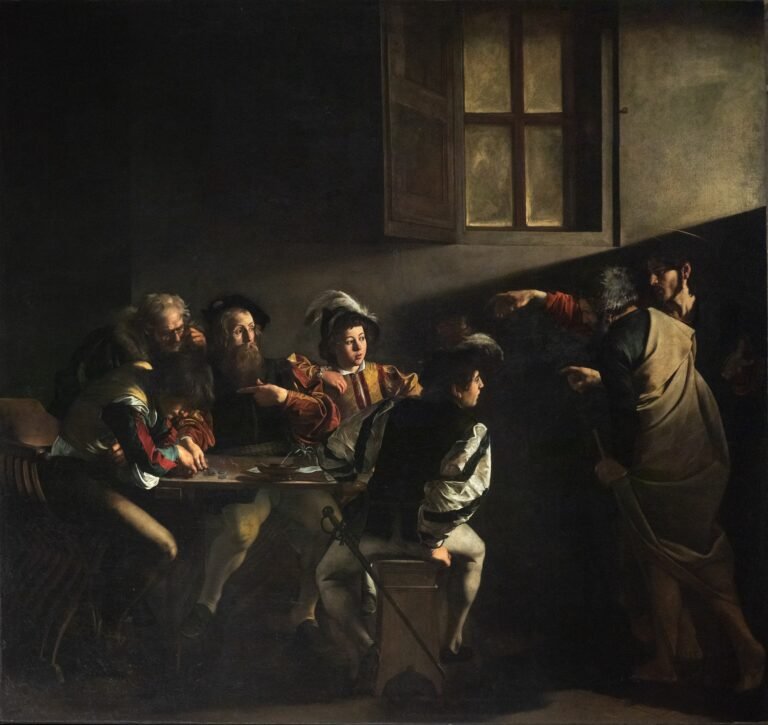
If Judith Beheading Holofernes has left you wanting more, follow Caravaggio into the church that made his name in The Calling of Saint Matthew, or explore our other guides to the painters who still have the power to shock – right here on the site.
Image: Judith Beheading Holofernes – Caravaggio (c. 1599). License: Public Domain. Source: Wikimedia Commons.