The Milkmaid
Most people walk past small paintings in museums without a second glance — but The Milkmaid, measuring just 45.5 by 41 centimetres, has stopped visitors dead in their tracks for over three and a half centuries. This modest canvas holds more visual intelligence per square inch than almost any other work in Western art history.
Quick Facts
- Artist: Johannes Vermeer
- Year: c. 1658
- Medium: Oil on canvas
- Dimensions: 45.5 × 41 cm (17.9 × 16.1 in)
- Movement: Dutch Golden Age
- Current location: Rijksmuseum, Amsterdam
What Makes The Milkmaid So Unforgettable?
There are grander paintings. There are larger ones. There are works packed with mythological drama, religious glory, and royal pomp. So why does The Milkmaid feel like the most alive painting in the room every single time?
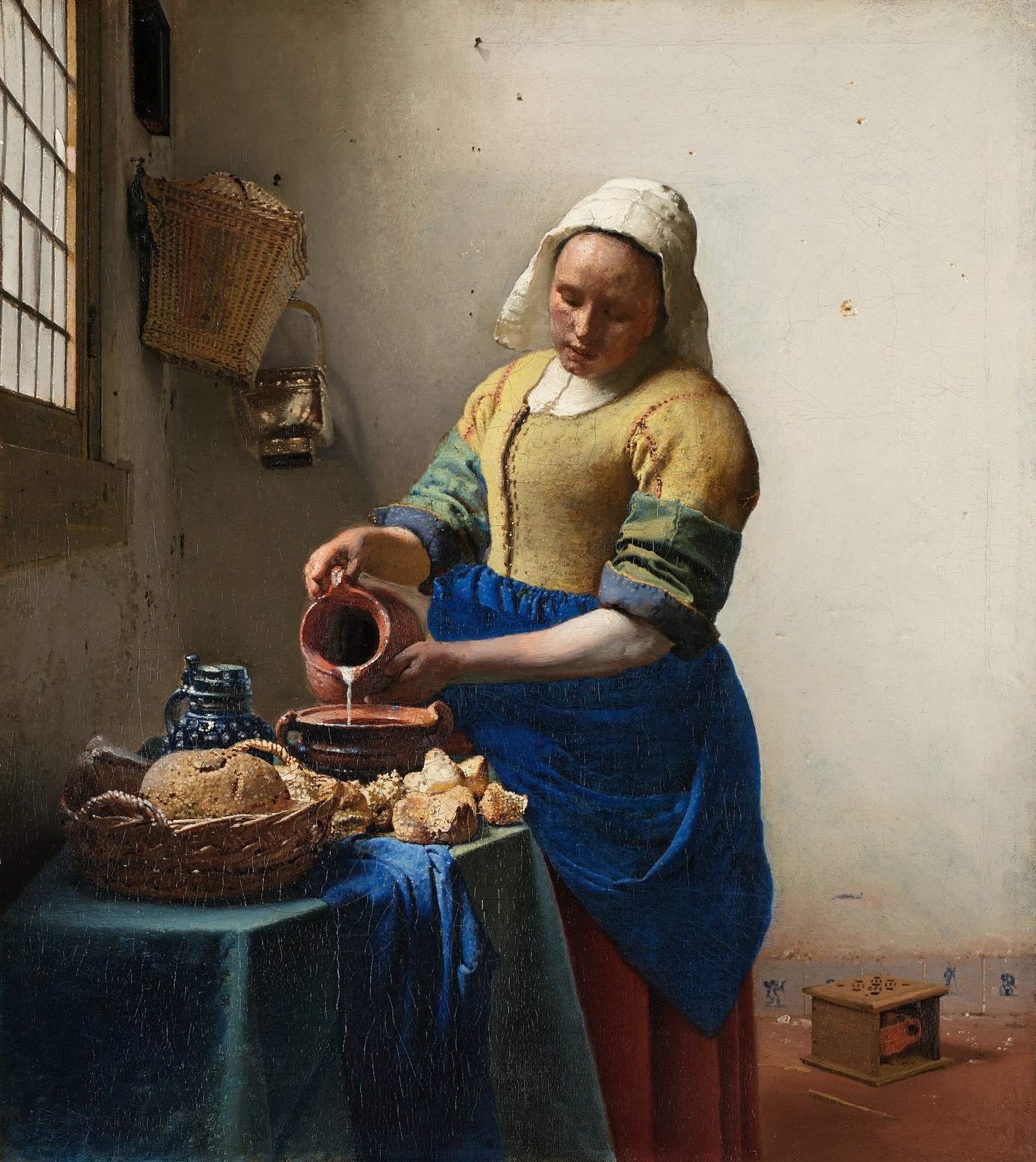
The answer lies in Vermeer’s radical decision to treat an ordinary domestic moment as something sacred. A kitchen maid pours milk. That is literally everything that happens. No allegory, no narrative climax, no moral lesson — just a woman doing her job with quiet concentration. Vermeer makes you feel that this moment matters enormously, without ever telling you why.
In addition, the sheer technical achievement is staggering. The way light falls across the bread, the linen cap, the rough plaster wall — it feels photographic, yet warmer than any photograph ever taken. Vermeer didn’t just paint a scene. He bottled a feeling.
Historical Context
By the mid-17th century, the Dutch Republic was experiencing an extraordinary cultural and economic boom. Trade through the Dutch East India Company poured wealth into cities like Amsterdam and Delft, and a new middle class emerged — one that wanted art reflecting its own life, not the lives of kings and saints.
This created a thriving market for genre painting: scenes of everyday domestic life, taverns, markets, and kitchens. However, most genre painters treated these subjects with a knowing wink, often hiding moral warnings or comic undertones in the imagery. Vermeer took a different path entirely.
Around 1658, when Vermeer almost certainly completed The Milkmaid, he was in his mid-twenties and living in Delft. He had already begun developing his extraordinary sensitivity to natural light. The Dutch Republic was at the height of its Golden Age, and Delft was a city of craftsmen, merchants, and quiet industry — the perfect environment for a painter obsessed with the poetry of ordinary things.
Therefore, The Milkmaid is not just a beautiful painting. It is a document of a specific moment in history when Dutch society decided that everyday life deserved to be immortalised.
Symbolism and What to Look For
Stand in front of The Milkmaid and resist the urge to rush. Give yourself a few minutes and you will discover layers that most visitors completely miss.
First, notice the light. It enters from the upper-left window and falls across the scene with breathtaking specificity. Look at the bread rolls in the basket — each one catches light differently. Look at the blue cloth on the table, the rough texture of the ceramic jug, the maid’s yellow bodice. Vermeer uses light not just to illuminate, but to give every object a sense of weight and presence.
Next, look at the wall. It appears bare at first glance, but look closer: there are faint nail holes and shadows where pictures once hung. This detail grounds the scene in real, lived-in space. It is not a stage set. It is someone’s actual kitchen.
That emptiness was not Vermeer’s first idea. Ahead of the Rijksmuseum’s 2023 Vermeer exhibition, the painting was examined with macro X-ray fluorescence, infrared reflectography and hyperspectral imaging. Two objects turned up beneath the paint surface: a jug rack on the back wall and a fire basket at the woman’s feet. Vermeer painted both, then painted both out. The austerity we read as restraint is the result of removal — and the same study found bold, quick underdrawing beneath the composition, which Vermeer had long been assumed not to use. More findings like this one.
Down at the bottom of the painting, look for the foot warmer and the Delft tiles along the baseboard. The tiles depict Cupid figures — a subtle nod, perhaps, to warmth and comfort rather than overt romantic symbolism. Some art historians interpret the foot warmer as a symbol of domestic virtue and hearth-centred life.
Finally, study the maid herself. She doesn’t look at us. Her gaze is fixed entirely on the stream of milk. This concentration is part of what makes the painting so powerful — she is completely absorbed in her task, and we become quiet observers rather than participants.
About Johannes Vermeer
Johannes Vermeer was born in Delft in 1632 and spent virtually his entire life there. He worked as both a painter and an art dealer, and he left behind a body of work that is astonishingly small — fewer than 40 paintings are confidently attributed to him today.
During his lifetime, Vermeer was respected locally but never achieved wide fame. He died in 1675, leaving behind a wife, eleven children, and significant debts. For nearly two centuries after his death, his work remained largely forgotten.
However, in the 19th century, the French critic Théophile Thoré-Bürger championed Vermeer’s rediscovery and helped restore his reputation. Today, Vermeer is considered one of the greatest painters who ever lived, celebrated above all for his miraculous handling of light and his ability to find profound beauty in quiet, domestic scenes.
Legacy and Influence
The Milkmaid has had a long and remarkable afterlife. For centuries it passed through private collections before entering the Rijksmuseum, where it remains one of the museum’s most celebrated treasures.
Its influence on later art is difficult to overstate. The Impressionists drew inspiration from Vermeer’s sensitivity to natural light and his focus on everyday subjects. Contemporary photographers and filmmakers regularly cite his compositions as a reference point for cinematic lighting.
In popular culture, The Milkmaid has appeared on postage stamps, inspired novels, and been referenced in advertising campaigns. Tracy Chevalier’s novel Girl with a Pearl Earring sparked renewed global fascination with Vermeer, bringing millions of new admirers to his work — including this painting.
In 2023, the Rijksmuseum staged the largest Vermeer retrospective ever mounted, bringing together twenty-eight of the fewer than forty surviving paintings and drawing record crowds. It was the technical research carried out in preparation for that exhibition that produced the findings described above.
Where to See The Milkmaid Today
The Milkmaid is on permanent display at the Rijksmuseum in Amsterdam, located on Museumplein in the heart of the city. The museum is open daily, generally from 9am to 5pm, though booking tickets online in advance is strongly recommended — especially in peak tourist season.
The painting occupies a dedicated gallery in the Dutch Masters section. Arrive early in the morning or just before closing for a quieter experience. The Rijksmuseum also holds Rembrandt’s The Night Watch and a vast collection of Delft ceramics — all worth seeking out on the same visit.
From Amsterdam Centraal station, the museum is easily reached by tram (lines 2 and 12). If you are travelling from outside Amsterdam, the city’s train connections make it an ideal day trip from Haarlem, Rotterdam, or Utrecht.
Frequently Asked Questions
Where is The Milkmaid located?
The Milkmaid is housed in the Rijksmuseum in Amsterdam, Netherlands, where it is one of the museum’s most celebrated permanent exhibits.
When was The Milkmaid created?
Vermeer painted The Milkmaid around 1658, during the height of the Dutch Golden Age, when he was in his mid-twenties and based in Delft.
What does The Milkmaid represent?
The Milkmaid represents the dignity and quiet virtue of domestic labour. Vermeer elevates an ordinary kitchen task into something almost spiritual, using light and composition to give the scene extraordinary emotional weight.
What is hidden under The Milkmaid?
Imaging carried out in 2022 revealed two objects Vermeer painted and then removed: a rack for jugs on the back wall and a basket for hot coals at the woman’s feet. The bare wall that reads as deliberate simplicity is the result of him painting them out.
Why is The Milkmaid so famous?
The Milkmaid is famous for its extraordinary technical mastery — particularly Vermeer’s handling of natural light — and for the way it transforms a simple, everyday moment into a timeless, deeply moving image.
How big is The Milkmaid painting?
Despite its enormous reputation, The Milkmaid is a relatively small painting, measuring just 45.5 by 41 centimetres. Many visitors are surprised by how intimate and compact the original feels in person.
Enjoyed discovering the world of The Milkmaid? Explore our full collection of Dutch Golden Age masterpieces, Vermeer’s other extraordinary works, and the remarkable stories behind the paintings that shaped Western art. There is always another canvas waiting to surprise you.
Image: The Milkmaid – Johannes Vermeer (1658). License: Public Domain. Source: Wikimedia Commons.