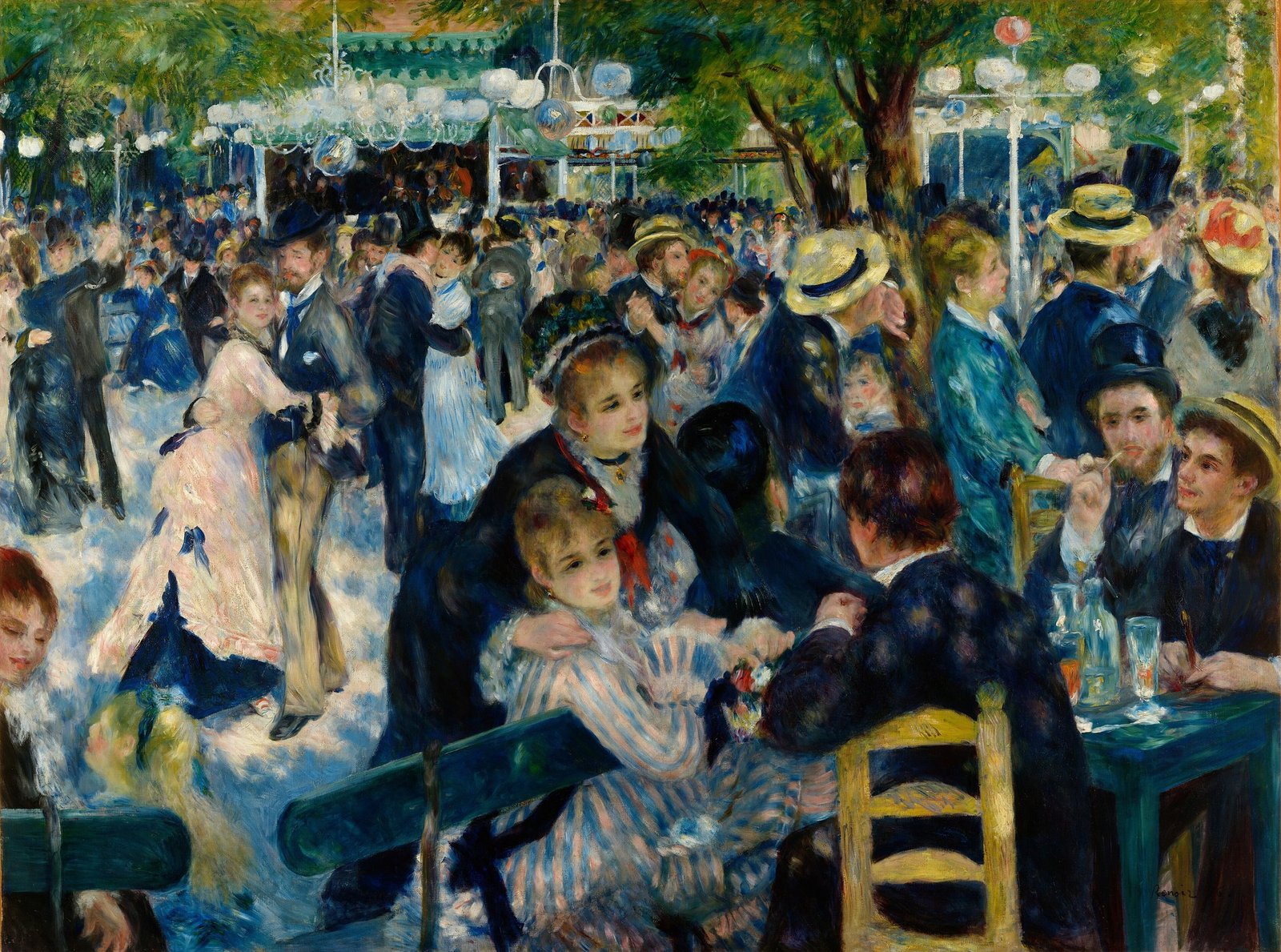
Bal du moulin de la Galette
This painting was owned by another Impressionist. Gustave Caillebotte – painter, sailor and the man who quietly bankrolled the movement – bought it and left it to the French state in his will. The state hesitated. The bequest of sixty-seven canvases caused a public row, and officials accepted only part of it. This one got in.
Quick Facts
- Artist: Pierre-Auguste Renoir (1841–1919)
- Year: 1876
- Medium: Oil on canvas
- Dimensions: 131.5 × 176.5 cm
- Exhibited: third Impressionist exhibition, April 1877
- Movement: Impressionism
- Location: Musée d’Orsay, Paris – Caillebotte bequest, 1894
What makes it unforgettable?
Large canvases were for history, mythology and the great dead. Renoir used one for a Sunday afternoon.
Nothing happens in it. People dance, drink, talk, lean towards one another. Nobody looks out at the viewer – there is no figure inviting you in, no gesture directed outward. You are looking at something that is not being performed.
The technical problem he set himself was brutal: sunlight falling through leaves onto moving faces. Patches of light that shift every second, on surfaces that will not hold still.
His solution was to abandon the idea of a fixed edge. The foreground figures are relatively defined; the further back you look, the more the crowd dissolves into strokes of colour. That gradient does the work of both depth and movement.
Was it painted on the spot?
This is worth setting out carefully, because the usual version is too neat.
The story that Renoir’s friends carried the canvas daily from his studio on the rue Cortot to the dance garden comes from Georges Rivière, who was there and who appears in the painting.
It is probably true in part. Renoir did work at the site, and he did make studies there.
But a canvas of this size cannot be finished outdoors. Technical study of the picture shows extensive reworking, layered handling and adjustments that point to studio work. The composition is constructed, not observed – the perspective of the dance floor does not resolve, and figures are arranged for balance rather than recorded where they stood.
The honest version: sketched on the spot, built in the studio.
Who is in it
Almost everyone in the foreground is identifiable, which makes this a group portrait as much as a scene.
At the table on the right sit three painters and a writer: Norbert Goeneutte, Frédéric Cordey, Pierre-Franc Lamy, and Georges Rivière, who later wrote the memoir this painting’s history depends on.
Dancing at the left is the Cuban painter Pedro Vidal de Solares y Cárdenas, partnered by a Montmartre girl known as Margot – Marguerite Legrand.
Seated in the foreground, in the blue-and-pink striped dress, is Estelle, sister of Jeanne, one of Renoir’s regular models.
There is a sad postscript. Margot died in 1879, in her twenties. Renoir paid for her treatment and wrote anxiously about her to his friend the doctor Georges de Bellio. She did not recover.
Historical context
Paris in 1876 was five years past the siege and the Commune. The city had been through starvation, bombardment and mass executions, and was rebuilding both its streets and its nerve.
The Moulin de la Galette was a real establishment at the top of the Butte Montmartre, named after the galettes it sold. It was not glamorous. The clientele were seamstresses, clerks, labourers and artists; entry cost a few sous.
Montmartre was then still semi-rural, with windmills and small vineyards, and outside the Paris customs boundary – which is why drink was cheaper there.
The painting was shown in April 1877, at the third Impressionist exhibition, not the second. The reception was mixed. One critic wrote that the figures looked as though they were dancing on a surface of purple cloud; the blue-violet shadows were read as a defect of vision.
What to look for
The shadows. On the white dresses and the men’s jackets they are blue and violet, not grey or brown. This was the point of contention in 1877, and it is now the most obviously correct thing in the painting.
The light on the back. The man seated with his back to us, lower left, has sunlight falling across his jacket in loose patches. It is the clearest single passage of dappled light on the canvas.
The gas globes. Above the crowd hang round lamps. The dance went on into the evening, and the picture holds both kinds of light.
The girl in the foreground. Estelle leans on the bench with her back partly turned. She is the most finished figure in the painting and the point at which the eye enters.
The dissolving crowd. Cover the foreground with your hand and look only at the back half. It is almost abstract.
About Pierre-Auguste Renoir
Born in Limoges in 1841 to a tailor and a seamstress. He began as a porcelain painter at thirteen, decorating plates by hand – a trade that trained his eye for colour laid on a bright ground and left a permanent mark on his palette.
The trade was destroyed by mechanised printing. He moved to painting and entered Gleyre’s studio in 1862, where he met Monet, Sisley and Bazille.
He and Monet painted side by side at La Grenouillère in 1869, in what is usually taken as the first fully Impressionist work.
From the 1890s he suffered from severe rheumatoid arthritis. One correction is needed here: the widespread claim that brushes were strapped or tied to his hands is a misunderstanding of photographs from his last years. He wedged the brush between his deformed fingers, and an assistant sometimes placed it there. Nothing was tied on.
He painted until the end, and died in 1919 at Cagnes-sur-Mer, aged seventy-eight.
Two versions, and a record price
There is a second, smaller canvas of the same scene, roughly 78 × 114 cm.
It is usually described as a preparatory version, though some scholars argue it was painted afterwards, as a reduced replica for sale. The question is open.
In May 1990 it sold at Sotheby’s in New York for 78.1 million dollars – at the time the second-highest price ever paid for a painting.
The buyer was the Japanese paper magnate Ryoei Saito, who two days earlier had bought Van Gogh’s Portrait of Dr Gachet for 82.5 million. He later said he wanted both cremated with him. He did not do it, and both were sold after his death.
The smaller version has not been publicly exhibited since. Its whereabouts are not confirmed; it is generally assumed to be in a private collection in Switzerland.
Legacy and influence
The painting made leisure a legitimate subject for a monumental canvas. What had belonged to history painting was handed to a Sunday afternoon.
Its immediate descendants are easy to trace – through the Nabis, through Bonnard and Vuillard, through Matisse’s interiors.
The Caillebotte bequest matters more than it sounds. When he died in 1894 aged forty-five, Caillebotte left the state sixty-seven Impressionist paintings. The Académie des Beaux-Arts objected; there was a public dispute; the state accepted thirty-eight and declined the rest. Those refusals later became some of the most valuable paintings in private hands worldwide.
The Moulin de la Galette still stands at 83 rue Lepic in Montmartre – a restaurant beneath the surviving Blute-fin windmill.
Where to see it today
The painting is at the Musée d’Orsay, in the Impressionist galleries on the top floor.
- The museum is closed on Mondays. Check hours and prices before you travel; there is late opening on one evening a week.
- Book online. Queues without a reservation can be long.
- Stand back first. From six metres the crowd coheres into a single mass of light. Then go close and watch it break apart into strokes.
- Renoir’s Dance in the City and Dance in the Country of 1883 are in the same museum – painted seven years later, and far more posed. The comparison is instructive.
- Also here: Olympia, Luncheon of the Boating Party is not – that one is in Washington, at the Phillips Collection.
Montmartre is a twenty-minute métro ride. The site is at 83 rue Lepic; the view no longer resembles the painting, but the windmill is there.
Frequently asked questions
When was it exhibited?
At the third Impressionist exhibition, in April 1877. The canvas is dated 1876, which is why the two dates are often conflated.
Did Renoir paint it outdoors?
Partly. He worked at the site and made studies there, but a canvas of this size was finished in the studio. Technical examination shows extensive reworking, and the composition is constructed rather than recorded.
Who are the figures?
Friends and neighbours. At the table: the painters Goeneutte, Cordey and Lamy with the writer Georges Rivière. Dancing at the left: the Cuban painter Pedro Vidal with Margot, a Montmartre girl who died two years later. In the foreground: Estelle, sister of one of Renoir’s models.
Is there a second version?
Yes, a smaller canvas whose status – study or later replica – is disputed. It sold in 1990 for 78.1 million dollars and has not been publicly exhibited since.
How did the painting reach the museum?
Through the bequest of Gustave Caillebotte, who died in 1894. The state accepted only part of his collection after a public dispute; this painting was among the works taken.
Does the Moulin de la Galette still exist?
Yes, at 83 rue Lepic in Montmartre, as a restaurant beneath the old Blute-fin windmill.
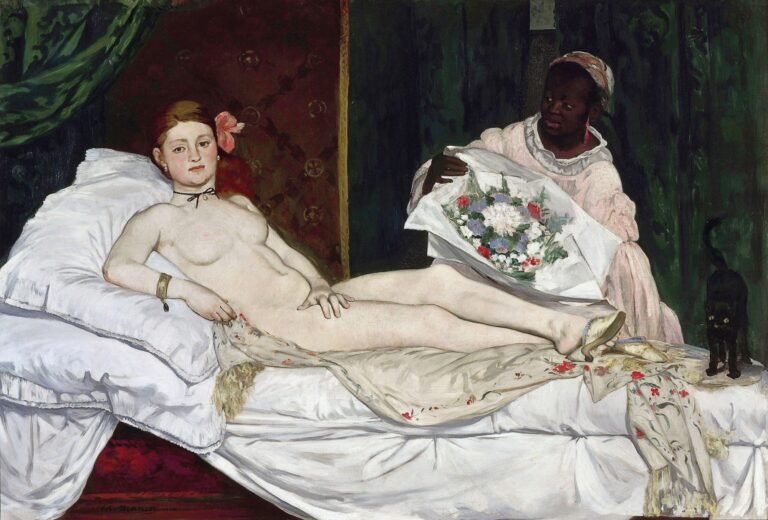
If this painting has caught your interest, look next at Olympia by Manet, in the same museum – painted eleven years earlier and provoking the opposite reaction: not a crowd enjoying itself, but a single figure the public could not forgive.
Image: Bal du moulin de la Galette – Pierre-Auguste Renoir (1876). License: Public Domain. Source: Wikimedia Commons.