Inwangjesaekdo (Clearing after Rain on Mt. Inwang)
Here is a striking thought: one of Korea’s most treasured paintings was created by an 76-year-old artist painting a mountain he could see from his childhood home — and Inwangjesaekdo (Clearing after Rain on Mt. Inwang) captures that mountain not as an idealized fantasy, but as a living, breathing, rain-soaked reality unlike anything seen in East Asian landscape painting before it.
Quick Facts
- Artist: Jeong Seon
- Year: 1751
- Medium: Ink on paper (hanging scroll)
- Dimensions: 79.2 × 138.2 cm
- Movement: Joseon Art
- Current location: National Museum of Korea, Seoul
What Makes Inwangjesaekdo (Clearing after Rain on Mt. Inwang) So Unforgettable?
Most landscape paintings of 18th-century East Asia followed a strict visual grammar. Artists painted imagined mountains, borrowed compositions from Chinese masters, and produced elegant scenes that spoke of philosophical ideals rather than real places. Jeong Seon broke all of that.
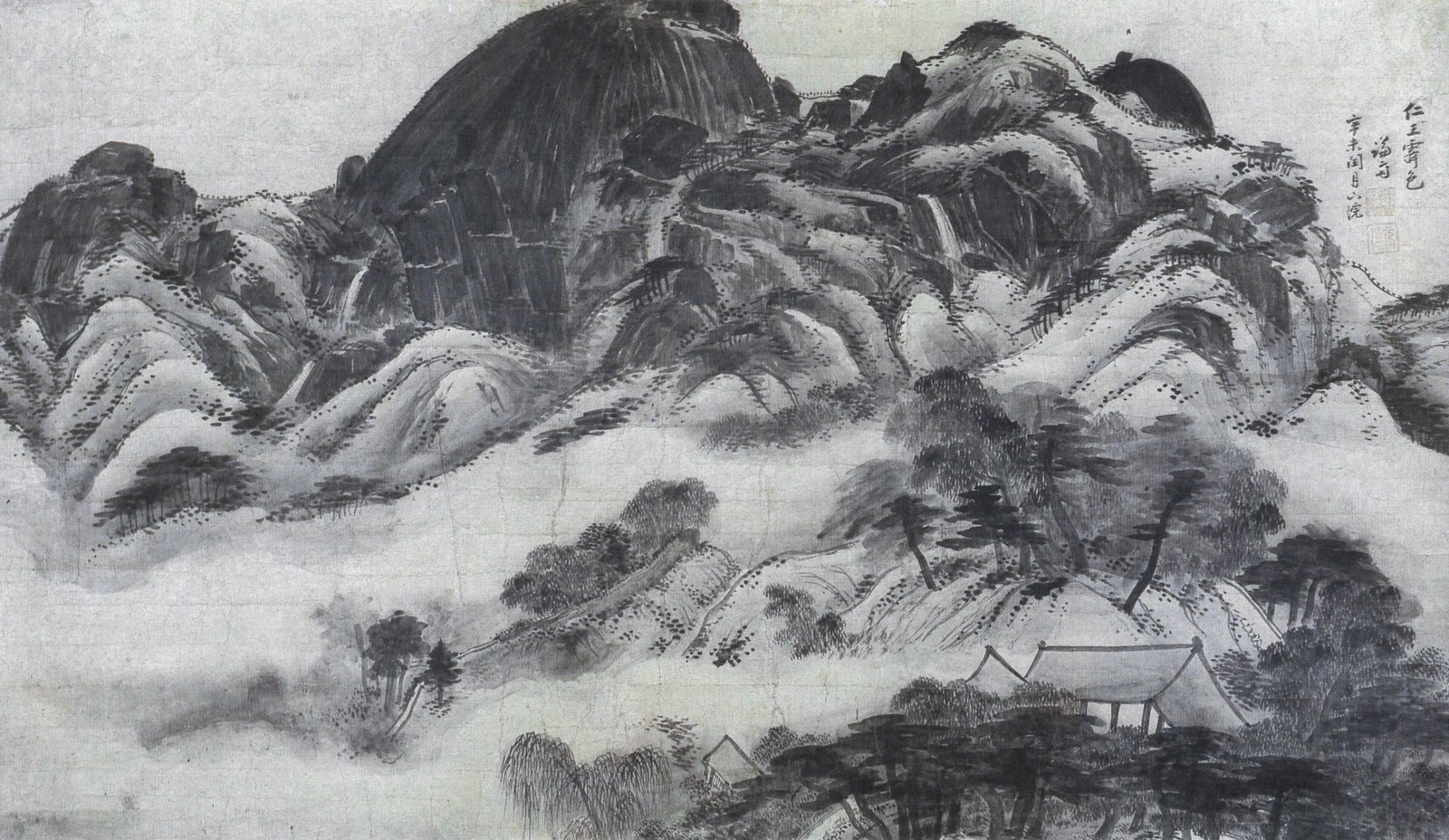
Inwangjesaekdo (Clearing after Rain on Mt. Inwang) depicts an actual mountain — Mt. Inwang, which still rises over northwestern Seoul today. Jeong Seon painted it from personal memory and direct observation, right after a summer rainstorm. The result feels urgent, almost reportorial. You sense the wet air. You feel the granite boulders still slick with rain. This was revolutionary.
In addition, the painting carries deep personal weight. Jeong Seon created it in 1751, reportedly to honor a dying friend. That emotional undercurrent runs through every bold, wet brushstroke. This is not a painting made to impress a court. It is a painting made from grief, love, and a lifelong relationship with a familiar landscape.
Historical Context
The early 18th century was a remarkable moment for Korean culture. Under King Yeongjo’s long reign, the Joseon Dynasty experienced a cultural renaissance sometimes called the Joseon Renaissance. Scholars, artists, and writers began questioning the dominance of Chinese artistic models. They asked: why should Korean artists only paint Chinese mountains?
This mood gave rise to the Jingyeong movement — “true-view” landscape painting. Artists started painting real Korean geography: actual rivers, familiar hills, recognizable streets. Jeong Seon led this movement almost single-handedly. By the time he painted Inwangjesaekdo (Clearing after Rain on Mt. Inwang), he had spent decades developing a distinctly Korean visual language.
Therefore, this painting sits at a crossroads. It is the culmination of one artist’s career and the high-water mark of an entire cultural movement. It also arrives at a personal crossroads for Jeong Seon himself — painted near the end of his life, in the neighborhood where he was born, looking at a mountain he had known for over seven decades.
Symbolism and What to Look For
Stand in front of this painting — or study it closely in reproduction — and let your eye travel upward. The lower half of the composition is soft, misty, and atmospheric. Pine trees emerge from fog. Rooftops peek through the haze. Everything feels damp and indistinct.
Then look at the upper half. The granite peaks of Mt. Inwang burst through the mist with tremendous force. Jeong Seon painted those boulders using bold, broad strokes of ink — what scholars call mibeopjun (hemp-fiber texture strokes) pushed to an almost aggressive extreme. The contrast is electric. The mountain does not float serenely. It erupts.
Notice the mist itself. Jeong Seon left areas of the paper completely unpainted to suggest the lingering clouds after rain. This use of negative space is masterful. The emptiness is not absence — it is atmosphere. It is the moment just after a storm, when the air still holds its breath.
Look also for the small human presence — modest buildings nestled at the mountain’s base. They remind us of scale. Mt. Inwang is enormous; human life is small and sheltered beneath it. For example, the tiny rooftops near the bottom anchor the composition and give us our place within this vast natural world.
About Jeong Seon
Jeong Seon (1676–1759) was born in Cheongun-dong, a neighborhood in what is now central Seoul, almost within sight of Mt. Inwang itself. He lived an extraordinarily long life — 84 years — and spent most of it painting the Korean landscape with a devotion that bordered on obsession.
He served in various official roles during the Joseon Dynasty but always remained, at heart, a painter. He traveled widely across Korea, sketching mountains, rivers, and coastlines. His brushwork evolved into something highly personal: powerful, confident, and unmistakably Korean. Later generations gave him the honorary title Gyeomjae, meaning “humble study,” though his work is anything but timid.
By the time he painted Inwangjesaekdo (Clearing after Rain on Mt. Inwang) at age 75 or 76, he had produced hundreds of landscapes. However, this one stands apart. It is widely considered his masterpiece — the work where technique, emotion, and place align perfectly.
Legacy and Influence
The South Korean government recognized the importance of Inwangjesaekdo (Clearing after Rain on Mt. Inwang) by designating it National Treasure No. 216 on August 6, 1984. That designation places it among the most culturally significant objects in Korean history.
The painting’s legacy extends far beyond official recognition. It fundamentally shaped how Koreans see their own landscape. Later generations of Korean artists drew on the Jingyeong tradition that Jeong Seon established. The idea that Korean nature — Korean mountains, Korean rivers, Korean rain — was worthy of serious artistic attention remains a cornerstone of Korean visual culture.
In addition, the painting’s journey adds to its cultural weight. It was once part of the private collection of Lee Kun-hee, the late Samsung chairman. Following his death in 2020, it was donated to the National Museum of Korea, making it accessible to the public for the first time. That transition — from private hands to national institution — was itself a major cultural moment in South Korea.
Where to See Inwangjesaekdo (Clearing after Rain on Mt. Inwang) Today
Inwangjesaekdo (Clearing after Rain on Mt. Inwang) is now held at the National Museum of Korea in Yongsan-gu, Seoul. The museum is one of Asia’s largest and most beautifully designed, set within a landscaped park near the Han River.
Getting there is straightforward. Take Seoul Metro Line 4 to Ichon Station and use the museum exit — you will be there in minutes. Admission to the permanent collection is free, which makes this one of the world’s great cultural bargains.
Plan to spend at least two to three hours. The museum’s Korean art galleries are exceptional. Look out for other masterworks of Joseon painting and calligraphy nearby. If you visit during spring or autumn, the museum’s outdoor grounds are stunning — a fitting backdrop for art that celebrates the Korean landscape.
Check the museum’s official website before visiting, as special exhibitions sometimes temporarily relocate major works within the building.
Frequently Asked Questions
Where is Inwangjesaekdo (Clearing after Rain on Mt. Inwang) located?
The painting is currently housed at the National Museum of Korea in Seoul, South Korea, following its donation to the institution after the death of collector Lee Kun-hee in 2020.
When was Inwangjesaekdo (Clearing after Rain on Mt. Inwang) created?
Jeong Seon painted it in 1751, during the reign of King Yeongjo of the Joseon Dynasty. He created it near his birthplace in the Cheongun-dong area of what is now central Seoul.
What does Inwangjesaekdo (Clearing after Rain on Mt. Inwang) represent?
The painting depicts Mt. Inwang after a summer rainstorm — a real, recognizable Seoul landmark. Beyond its literal subject, it represents Korean artistic independence, the beauty of the actual Korean landscape, and the deeply personal relationship between an artist and his hometown.
Why is Inwangjesaekdo (Clearing after Rain on Mt. Inwang) so famous?
It is famous because it broke with convention, choosing direct observation of a real Korean mountain over the idealized Chinese landscape traditions that dominated East Asian painting at the time. It is also a technically extraordinary work and a deeply moving personal statement from a master at the peak of his powers.
Is Inwangjesaekdo (Clearing after Rain on Mt. Inwang) a National Treasure?
Yes. The South Korean government officially designated it National Treasure No. 216 on August 6, 1984, recognizing it as one of the most culturally significant artworks in Korean history.
If this glimpse into Jeong Seon’s extraordinary vision has sparked your curiosity, we warmly invite you to explore more masterworks from the Joseon era and beyond right here on the site. Each painting has a story waiting to pull you in — and the next one might surprise you just as much as this one did.
Image: Inwangjesaekdo (Clearing after Rain on Mt. Inwang) – Jeong Seon (1751). License: Public Domain. Source: Wikimedia Commons.