The Arnolfini Portrait
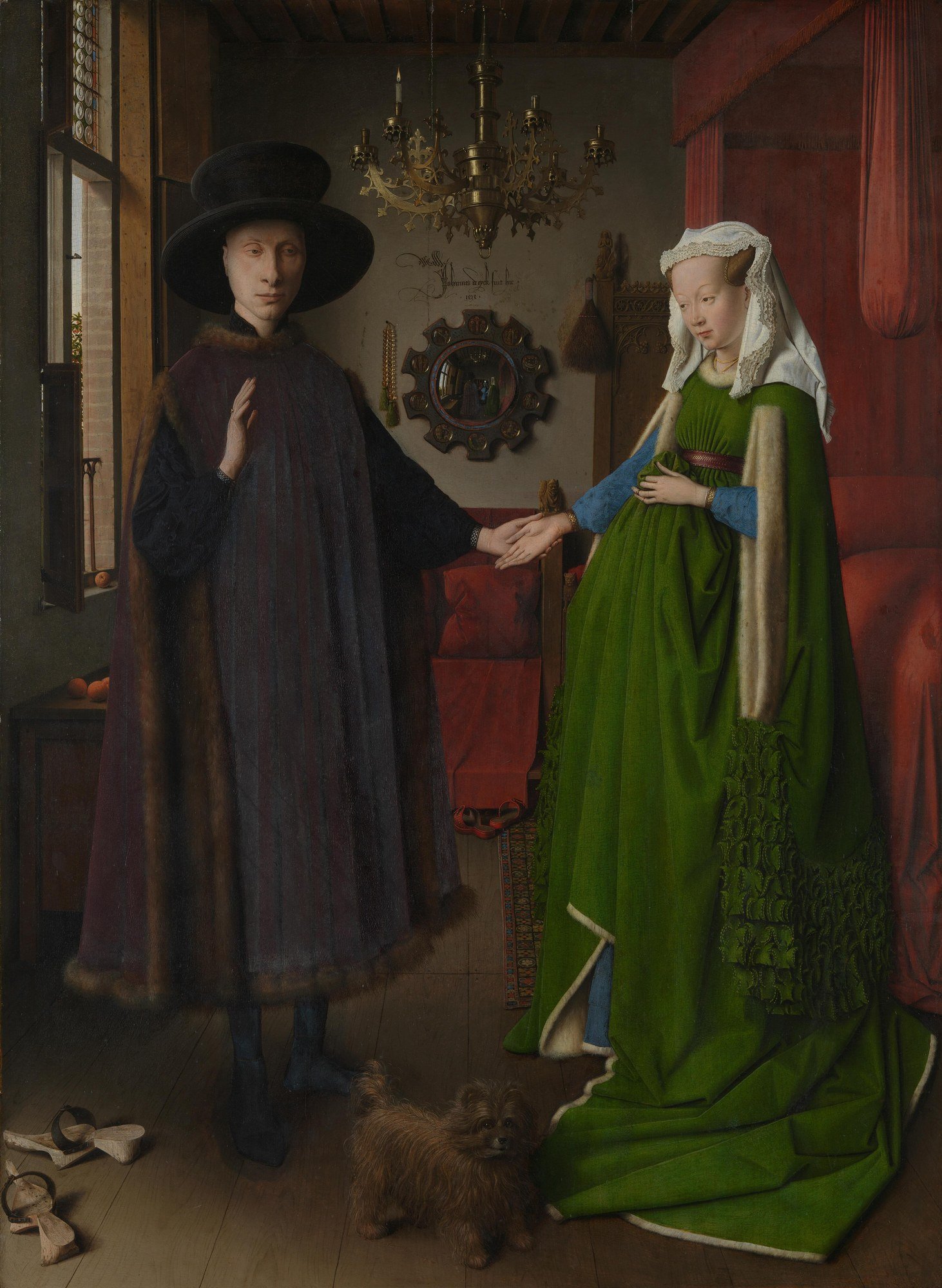
Hidden inside one of the most studied paintings in Western art history, a tiny convex mirror reflects two figures standing in a doorway – one of whom may be the artist himself, silently witnessing the scene he painted. The Arnolfini Portrait, completed in 1434, is packed with so many layers of meaning, technical wizardry, and unresolved mystery that art historians are still arguing about it nearly six centuries later – including about who the two people in it actually are.
Quick Facts
- Artist: Jan van Eyck
- Year: 1434
- Medium: Oil on oak panel
- Dimensions: 82.2 cm × 60 cm (32.4 in × 23.6 in)
- Movement: Northern Renaissance
- Current location: National Gallery, London – Sainsbury Wing
What Makes The Arnolfini Portrait So Unforgettable?
Most portraits from the early fifteenth century feel flat – formal faces staring blankly into the void. The Arnolfini Portrait does something radically different. It places two real people inside a real room, surrounded by real objects, bathed in real light. You feel as though you could step through the frame and smell the beeswax candle burning above their heads.
What truly sets this painting apart is its ambition. Jan van Eyck was not simply recording two wealthy people. He was constructing an entire world in miniature, one where every object carries weight, every texture tells a story, and the space itself breathes. The result is less a portrait and more a philosophical statement about presence, witness, and the power of paint.
However, the painting’s genius runs even deeper than its visual richness. Van Eyck signed the work in a startlingly unusual way – not modestly in a corner, but boldly across the back wall in Latin: Johannes de Eyck fuit hic, meaning “Jan van Eyck was here.” It reads less like a signature and more like a declaration – or, as several scholars have argued, like a witness statement.
Historical Context
By 1434, Bruges was one of the wealthiest cities in all of Europe. Merchants from across the continent settled there, drawn by its thriving textile trade and international banking networks. Giovanni di Nicolao Arnolfini was one such merchant – an Italian businessman from Lucca operating in this cosmopolitan Flemish city.
Early Netherlandish painting was undergoing a revolution at exactly this moment. Oil paint, which van Eyck helped pioneer and perfect, allowed artists to build up translucent layers of colour and achieve a depth of detail that tempera simply could not match. For the first time, painters could convincingly render the sheen of silk, the glint of brass, and the soft fall of afternoon light through a window.
In addition, this was a period before photography, before legal documentation as we know it. Some scholars have argued that paintings like The Arnolfini Portrait may have served a quasi-legal function – a visual record of a significant moment, perhaps a betrothal or marriage contract. Whether or not that theory holds, it tells us something important: images carried enormous social and legal gravity in this world.
Symbolism and What to Look For
Stand in front of The Arnolfini Portrait and resist the urge to take in everything at once. Instead, start small and work outward – and give it more time than feels natural, because research on how people actually look at art finds that the average museum visitor spends only seconds in front of a painting, which is nowhere near enough for this one.
First, look at the convex mirror on the back wall. It is astonishing. Van Eyck has painted the entire room reflected in it – including two tiny figures in the doorway. Ten small medallions surround the mirror’s frame, each depicting a scene from the Passion of Christ. This detail alone would take a skilled painter days to execute.
Next, notice the single candle burning in the ornate brass chandelier above the couple, despite the daylight flooding the room. In Flemish tradition, a single flame often symbolised the presence of God or the solemnity of an oath. It burns on the man’s side; the woman’s side is unlit.
The little dog at their feet is a griffon-type breed, a popular symbol of fidelity and loyalty. The discarded shoes near the window suggest holy ground – a space set apart for something sacred. Meanwhile, the woman’s green dress speaks to the couple’s considerable wealth, though not for the reason people usually assume: it is the sheer volume of expensive woollen cloth, and the fur lining it, that signals money.
Which brings us to the thing everyone asks about. She is not pregnant. She is holding a mass of gathered fabric up against her stomach, exactly as fashion of the 1430s demanded – the same silhouette appears on unmarried women and on painted virgin saints of the period. The bump is cloth, not a child.
Finally, look at the joined hands at the centre of the composition. They are the painting’s true focal point – two hands meeting in a gesture that feels both intimate and ceremonial. Everything in the composition draws your eye back to this moment of connection.
Who Are They, Actually?
For most of the twentieth century the answer looked settled: Giovanni di Arrigo Arnolfini and his wife Giovanna Cenami. Then archival work in the 1990s turned up the record of their marriage, dated 1447 – thirteen years after the painting, and six years after van Eyck was dead.
The man is now generally identified as a different Arnolfini, Giovanni di Nicolao, a cousin also living in Bruges. The woman is the harder question. His first wife, Costanza Trenta, appears to have died by 1433, the year before the panel is dated. If she is the sitter, this is not a wedding picture at all but a memorial – and some scholars point to the dog at her feet, a motif from tomb effigies, and to the extinguished candle on her side of the chandelier, as support. Others read the painting as neither wedding nor memorial, but simply a very expensive record of a couple, their piety and their standing.
Nobody has closed the case. That is worth knowing before you read any confident caption underneath a reproduction.
About Jan van Eyck
Jan van Eyck was born around 1390, most likely in the region of Maaseik in what is now Belgium. He rose to become court painter to Philip the Good, Duke of Burgundy – one of the most powerful rulers in Europe. Philip valued him enormously, reportedly intervening personally when van Eyck’s salary was delayed.
Van Eyck did not invent oil painting, as was once believed, but he transformed it. He developed techniques for layering translucent glazes that produced a luminosity no artist had achieved before. His works glow from within rather than simply reflecting light off their surface.
He died in Bruges in 1441, leaving behind a relatively small body of work. However, every surviving painting crackles with the same obsessive attention to detail, the same conviction that the visible world is worthy of the most exacting love.
Legacy and Influence
The Arnolfini Portrait shaped the course of European portraiture. Its concept of placing subjects within a fully realised domestic interior – rather than against a plain background – became a template that painters returned to for centuries. You can trace a direct line from this painting to the domestic interiors of Vermeer, two hundred years later. Van Eyck’s assertive inscription also set a precedent that later northern painters took up, most spectacularly in Dürer’s Self-Portrait of 1500.
In the twentieth century, the painting attracted fresh waves of scholarly debate. Art historian Erwin Panofsky famously argued in 1934 that it depicted a wedding ceremony, with van Eyck himself as witness. Later scholars pushed back, and the archival discoveries of the 1990s complicated the picture further. That ongoing argument is itself a testament to the painting’s depth – it keeps generating new questions.
Today, The Arnolfini Portrait appears everywhere: on book covers, in films, in advertising, and in countless parodies and homages. Its visual language has seeped so deeply into Western culture that many people recognise the image without knowing its name.
Where to See The Arnolfini Portrait Today
The painting hangs in the Sainsbury Wing of the National Gallery on Trafalgar Square in London, among the early Netherlandish rooms. One warning: the Sainsbury Wing reopened in May 2025 after a major refurbishment and the collection was rehung, so room numbers printed in older guidebooks no longer match. It is currently listed in Room 52; check the gallery’s own map on the day rather than trusting a number you read somewhere else.
Admission to the National Gallery is free, which makes it one of the best-value cultural experiences in the world. The gallery opens at 10am daily and closes at 6pm, with Friday late openings until 9pm – a genuinely lovely time to visit, when the crowds thin out. Arrive early on a weekday morning if you want a quiet moment in front of the painting; weekends can be crowded.
While you are there, look out for van Eyck’s Portrait of a Man (Self Portrait?) of 1433, better known as the Man in a Red Turban, in the same wing. The Sainsbury Wing also houses a superb collection of Early Netherlandish and Italian Renaissance works that provide wonderful context for understanding the world in which The Arnolfini Portrait was made.
Frequently Asked Questions
Where is The Arnolfini Portrait located?
In the Sainsbury Wing of the National Gallery in London, on Trafalgar Square. Entry is free. The painting had passed through the Spanish royal collection before Colonel James Hay acquired it in the aftermath of the Napoleonic wars; the gallery bought it from him in 1842.
When was The Arnolfini Portrait created?
Jan van Eyck dated and signed the painting in 1434. The inscription on the back wall reads: “Johannes de Eyck fuit hic 1434” – “Jan van Eyck was here 1434.”
Is the woman in The Arnolfini Portrait pregnant?
No. She is gathering up the heavy folds of her gown and holding them against her body, which was the fashionable posture of the 1430s – the same shape appears in paintings of women who were demonstrably not expecting, including virgin saints. The volume of cloth was a display of wealth, not a bump.
What does The Arnolfini Portrait represent?
It depicts a wealthy Italian merchant and a woman in a bedchamber in Bruges. Scholars have long debated whether it records a marriage, a betrothal, a memorial to a dead wife, or simply a formal portrait of a prosperous couple. The symbolism woven throughout – the candle, the mirror, the dog, the shoes – suggests the scene carries deep ceremonial significance, but its exact occasion is unresolved.
Why is The Arnolfini Portrait so famous?
It combines technical brilliance with layers of symbolic mystery in a way that feels modern even today. The convex mirror alone is a jaw-dropping feat of painting. Add the unresolved questions about its meaning, and you have a work that rewards repeated looking across a lifetime.
Who are the two figures in the painting?
The man is generally identified as Giovanni di Nicolao Arnolfini, a merchant from Lucca based in Bruges. The woman’s identity is genuinely unknown. She was long assumed to be Giovanna Cenami, until documents surfaced in the 1990s showing that the marriage in question took place in 1447 – six years after van Eyck’s death. One candidate is Arnolfini’s first wife, Costanza Trenta, who seems to have died by 1433, which would make the painting a memorial.
If The Arnolfini Portrait has sparked your curiosity about Early Netherlandish painting and the masters who transformed European art, we invite you to explore our other features on Jan van Eyck, the paintings of the Flemish Renaissance, and the extraordinary collections at the National Gallery. There is always more to discover – and every great painting leads to another.
Image: The Arnolfini Portrait – Jan van Eyck (1434). License: Public Domain. Source: Wikimedia Commons.