Las Meninas
Most visitors who stand before Las Meninas for the first time experience a quietly unsettling feeling – as if they have just walked into a room uninvited, and everyone in it already knew they were coming.
Quick Facts
- Artist: Diego Velázquez
- Year: 1656
- Medium: Oil on canvas
- Dimensions: 318 cm × 276 cm (125.2 in × 108.7 in)
- Movement: Baroque
- Current location: Prado, Madrid – Room 012
What Makes Las Meninas So Unforgettable?
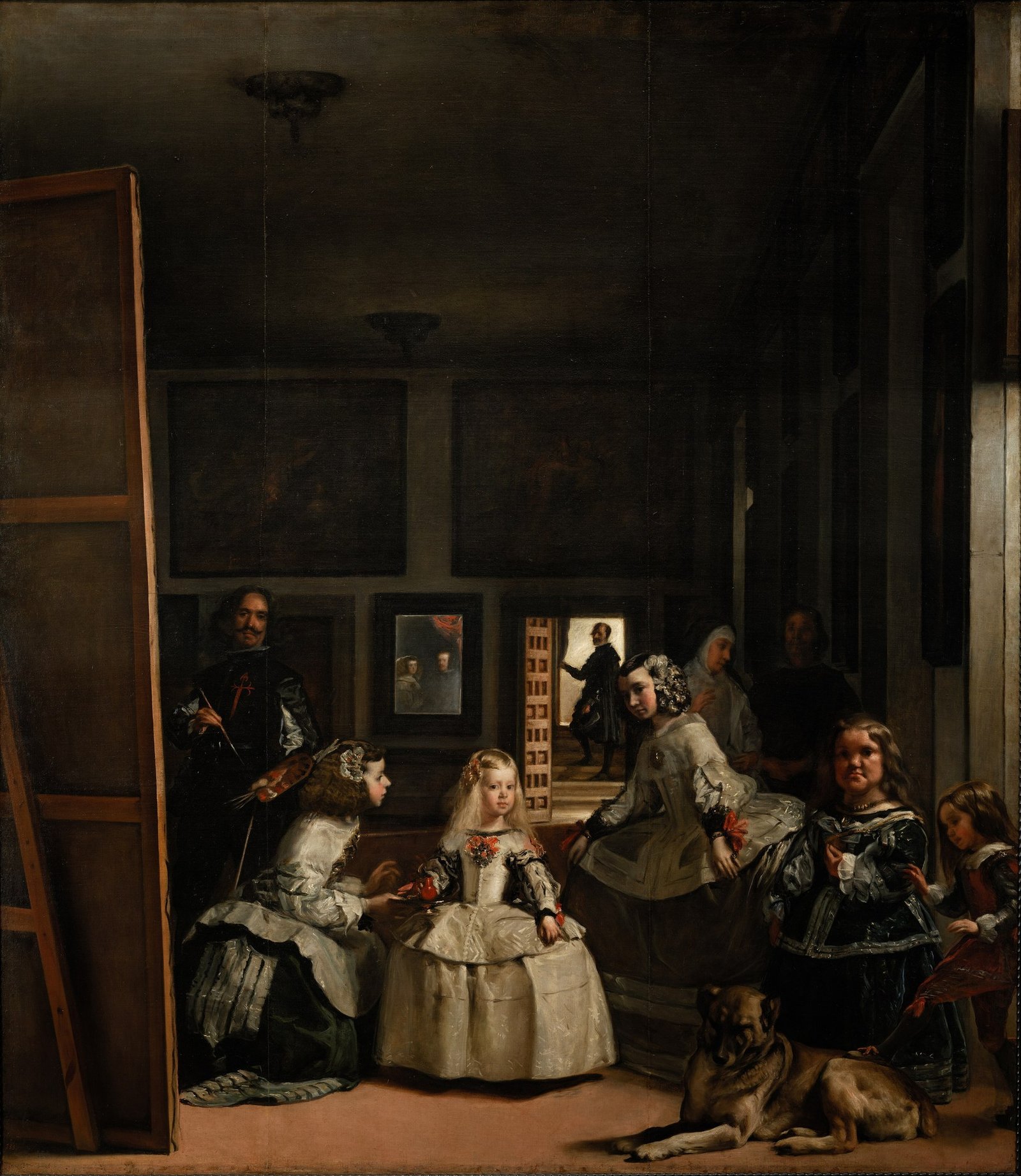
There is a reason art historians, philosophers, and curious visitors have been arguing about this painting for nearly four centuries. Las Meninas does not simply depict a scene – it pulls you inside one. Velázquez painted himself into the composition, brush in hand, apparently working on a large canvas whose face we cannot see. The five-year-old Infanta Margarita stands at the center, surrounded by her ladies-in-waiting (the “meninas” of the title), two court dwarfs, a dog, and attendants. In the background, a mirror reflects what appears to be the King and Queen of Spain – the very people whose portrait Velázquez may be painting.
So who, exactly, is the subject here? Is it the Infanta? The royal couple glimpsed in the mirror? Or is it you – the viewer – standing where the monarchs would have stood? That layered, almost theatrical ambiguity is what separates Las Meninas from every other court portrait of its era. It does not record a moment; it recreates the experience of being present in one.
Historical Context
By 1656, Spain’s political dominance in Europe was waning. The once-mighty empire was exhausted by decades of war, and the reign of King Philip IV was marked as much by cultural brilliance as by military and economic strain. Yet it was precisely this court – gilded, rigid, obsessed with ceremony and status – that produced one of the most psychologically complex paintings in Western art.
Velázquez had served Philip IV as court painter since 1623, holding enormous trust and privilege. He was not merely a hired brush; he was a confidant who moved freely through the royal apartments. This access gave him an insider’s eye, and Las Meninas is the ultimate expression of it – a painting that could only have been made by someone who truly understood the architecture of power and protocol surrounding the Spanish Crown.
It also hung where almost nobody could see it. The picture stayed in the king’s private apartments in the Alcázar, not in a public gallery. When the Neapolitan painter Luca Giordano was granted access in 1692, he came out calling it the theology of painting – a phrase that has followed the work ever since.
The Baroque period in which Velázquez worked was defined by dramatic contrasts of light and shadow, emotional intensity, and a new interest in realism over idealized forms. But Velázquez pushed further than almost any of his contemporaries, achieving a painterly looseness and atmospheric depth that would not be fully understood or appreciated until centuries later, when Manet called him the painter of painters and the Impressionists claimed him as an ancestor.
Symbolism and What to Look For
When you stand in front of Las Meninas, start with the light. Velázquez floods the scene from a window on the right, and the effect is breathtakingly natural – the kind of ambient, dusty afternoon light you might find in any large room. Notice how the figures closest to the light source are rendered most crisply, while those further away dissolve into shadow and suggestion. This is not accident; it is a masterclass in how eyes actually see.
Next, find the mirror on the back wall. It is easy to miss at first – a small, hazy rectangle hanging between two paintings. The reflected figures within it, Philip IV and Queen Mariana, are painted almost impressionistically, as if Velázquez knew that reflections are never quite as sharp as the things they mirror. This detail transforms the entire spatial logic of the painting. If the King and Queen are in the mirror, they must be standing roughly where we, the viewers, are standing. We have taken the place of royalty.
Look also at Velázquez himself, positioned on the left with his palette and brush, glancing outward with a calm, almost appraising expression. His inclusion here is extraordinary – painters rarely inserted themselves into royal commissions as equals. On his chest, a red cross of the Order of Santiago is visible, though art historians note this emblem was almost certainly added after the painting was completed, when Velázquez was awarded the honor in 1659, just a year before his death.
Now look at the Infanta’s left cheek – the side facing the light. Almost all of it is not by Velázquez. The paint there was lost in a fire in 1734 and repainted by a later court artist, which is worth knowing before you draw conclusions about how he modelled her face.
Finally, notice the man in the doorway at the back of the room, illuminated against the dark staircase behind him. He is José Nieto Velázquez, the queen’s chamberlain, whose job included opening doors for her. He pauses mid-step, as if caught between entering and leaving – another figure whose relationship to the scene remains beautifully unresolved.
About Diego Velázquez
Born in Seville in 1599, Diego Rodríguez de Silva y Velázquez showed exceptional talent from childhood, apprenticing under Francisco Pacheco and producing technically accomplished work before he was twenty. His move to Madrid in 1622 and subsequent appointment as court painter to Philip IV the following year set the trajectory of his entire career.
Velázquez traveled to Italy twice – in 1629 and again in 1649 – where he studied the great Renaissance masters and acquired paintings for the royal collection. These trips deepened his understanding of space, anatomy, and color. Back in Madrid, his style became increasingly free and gestural, anticipating techniques that would not become mainstream for another two hundred years. He died in Madrid in 1660, just months after completing arrangements for the royal marriage at the French border – a logistical triumph that exhausted him fatally.
The Painting Almost Did Not Survive
On Christmas Eve 1734 the Royal Alcázar of Madrid burned to the ground. Las Meninas was among the works pulled out of the flames, reportedly thrown from a window, and it did not come through unscathed. The court painter Juan García de Miranda restored it afterwards, repainting most of the Infanta’s left cheek where the pigment had been destroyed. At some point the canvas was also trimmed along both the left and right edges, so the composition you see is very slightly narrower than the one Velázquez laid out.
The painting has stayed put ever since. It entered the Prado when the museum opened in 1819, and the museum does not lend it. If you want to see Las Meninas, Madrid is the only address.
Legacy and Influence
Las Meninas has never stopped generating conversation. The philosopher Michel Foucault used it as the opening image in his landmark 1966 work The Order of Things, arguing that it represents a fundamental shift in how Western culture understands representation itself. Pablo Picasso shut himself away in 1957 and produced 58 variations on it, now held together at the Museu Picasso in Barcelona. Salvador Dalí, Joel-Peter Witkin, and countless contemporary artists have returned to it again and again. Francis Bacon’s screaming popes, often mentioned in the same breath, are in fact reworkings of a different Velázquez – his portrait of Pope Innocent X, painted in Rome in 1650.
Its influence on cinema and photography has been equally profound. The idea of the gaze – who is looking at whom, and what power that implies – which sits at the heart of Las Meninas, became central to twentieth-century visual theory. Every time a filmmaker turns the camera on the audience, or a photographer includes themselves in a reflective surface, they are working within a tradition this painting helped define.
Where to See Las Meninas Today
Las Meninas hangs in the Museo del Prado in Madrid, in Room 012, which is given over to Velázquez. The museum is on the Paseo del Prado and is open Monday to Saturday from 10.00 to 20.00, and Sundays and public holidays from 10.00 to 19.00. Admission is free during the last two hours of each day – from 18.00 Monday to Saturday, and from 17.00 on Sundays and holidays – but those slots cannot be booked, queues form well before they open, and Room 012 is the first place everyone heads.
Arrive at opening if you can. Experiencing Las Meninas with space to breathe – to step back, step forward, and let Velázquez’s spatial tricks work on you – makes a real difference, and it takes longer than you think. Research on how people actually look at art finds that the average visitor gives a painting a matter of seconds; this one repays several minutes and a few changes of position.
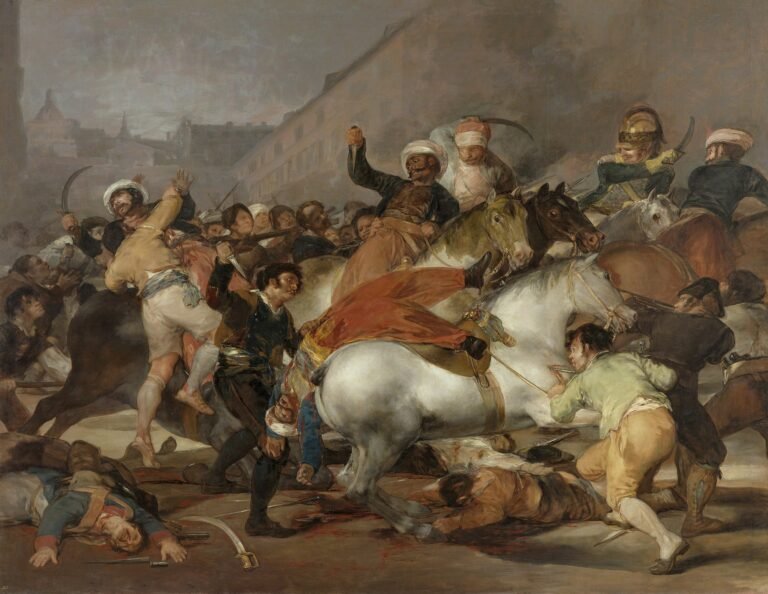
While you are at the Prado, do not miss Velázquez’s other masterworks in the same wing: The Surrender of Breda, Las Hilanderas, The Triumph of Bacchus and his royal equestrian portraits. Goya’s The Third of May 1808 and Bosch’s The Garden of Earthly Delights are both a few rooms away, and make for a compelling conversation across the centuries.
Frequently Asked Questions
Where is Las Meninas located?
Las Meninas is housed in the Museo del Prado in Madrid, Spain, in Room 012, which is dedicated to the works of Diego Velázquez. The Prado does not lend it, so it is not seen anywhere else.
When was Las Meninas created?
Velázquez completed Las Meninas in 1656, near the end of his life and after more than three decades of service as court painter to King Philip IV.
What does Las Meninas represent?
On the surface, it depicts the Infanta Margarita and her attendants in a royal chamber. On a deeper level, it explores the nature of seeing, painting, and power – questioning who is watching whom and blurring the line between the artwork and its audience.
Why is Las Meninas so famous?
Its fame comes from its radical compositional puzzle: the viewer seems to occupy the space of the King and Queen, Velázquez paints himself as an equal participant, and a mirror implicates the royal couple without showing them directly. No painting before it had played so boldly with perspective, identity, and illusion.
Who are the “meninas” in the painting?
The word refers to the young ladies-in-waiting who served the Infanta Margarita. The two most prominent are María Agustina Sarmiento, who offers the Infanta a drink, and Isabel de Velasco, who curtsies on the right. Also in the room are the court dwarfs Maribárbola and Nicolás Pertusato, the latter nudging the sleeping mastiff with his foot.
Why is it called Las Meninas?
Not because Velázquez said so. A 1666 palace inventory listed it as a portrait of the empress with her ladies and a dwarf; for most of the following two centuries it was simply known as The Family. The name Las Meninas appears in the Prado’s catalogue of 1843, and it stuck.
Was Las Meninas ever damaged?
Yes. It was rescued from the fire that destroyed the Royal Alcázar in 1734 and was left with real losses, including most of the Infanta’s left cheek, which the court painter Juan García de Miranda repainted. The canvas has also been cut down slightly on both sides.
If Las Meninas has sparked your curiosity about the Golden Age of Spanish painting or the broader world of Baroque art, explore our related posts on Velázquez’s other masterworks, the artists who were inspired by him, and the great museums where their legacies live on. There is always more to discover – and every great painting leads to another.
Image: Las Meninas – Diego Velázquez (1656). License: Public Domain. Source: Wikimedia Commons.