Saturn Devouring His Son
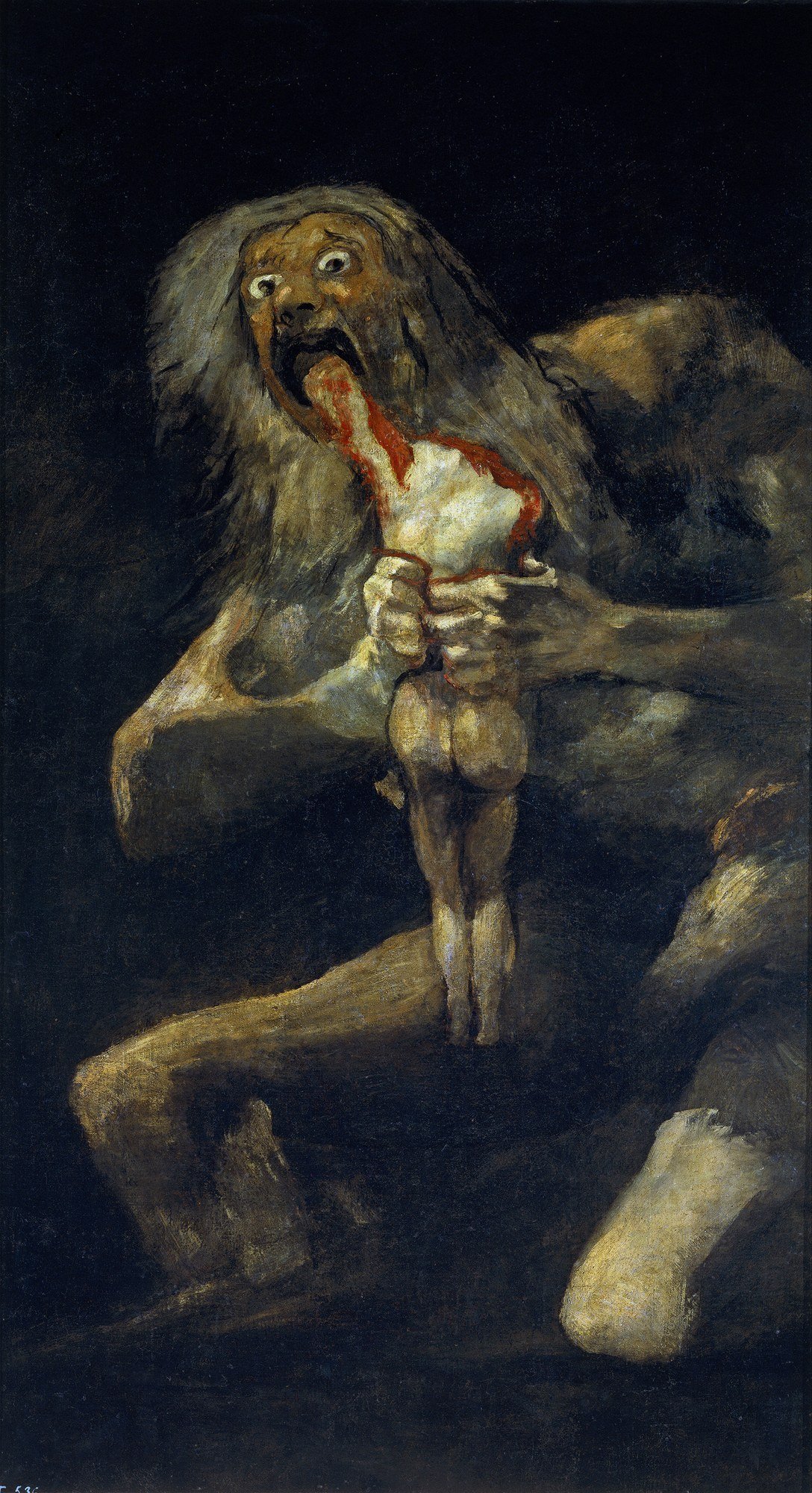
This is not quite what Goya painted. Before the mural was transferred from wall to canvas in 1874, the photographer Jean Laurent recorded it — and the photograph shows something else. The image was wider, and elements on the right no longer exist. The restorer removed them during the transfer. What hangs in the Prado is a cropped, repaired version of the original.
Quick Facts
- Artist: Francisco Goya (1746–1828)
- Painted: c. 1820–1823, as a wall mural
- Transferred to canvas: 1874, by Salvador Martínez Cubells
- Medium: oil on plaster, transferred to canvas
- Current dimensions: 143.5 × 81.4 cm
- Title: assigned after Goya’s death; he titled none of these works
- Movement: Romanticism, anticipating Expressionism
- Location: Museo del Prado, Madrid
What makes it unforgettable?
There is no comfortable way to look at this.
An emaciated giant with staring eyes bites into a body he grips in both hands. The background is almost entirely black. No landscape, no context, nothing to rest the eye on.
Comparison shows how far Goya went. Rubens painted the same subject in 1636 — it hangs in the same museum — and it is dramatic but governed by classical rules: the body is powerful, the composition legible, the violence contained by form. In Goya the form disintegrates along with the figure.
The crucial point is where this was. Not in a gallery, but in a dining room. Goya painted it on the wall of his own house, for himself, with no intention of showing it to anyone.
What the Laurent photograph shows
This is the most interesting chapter in the painting’s history, and it is rarely told.
Before the murals were moved, the French photographer Jean Laurent, working in Madrid, photographed them. The images survive and are now a primary source for scholars.
They show that the mural was noticeably wider than the present canvas. Elements on the right were cut away; some researchers read one of them as a further shape, variously interpreted as part of a body or an additional figure.
Other things changed too. The restorer Salvador Martínez Cubells did not only lift the paint — he filled losses and smoothed the composition. The mural was badly damaged by damp, and the nineteenth-century transfer technique inevitably destroyed parts of the paint layer.
In other words, the most uncompromising image Goya made has passed through the hands of a Victorian restorer with his own idea of how it ought to look.
Historical context
In 1819 Goya bought a house outside Madrid known as the Quinta del Sordo — the Deaf Man’s House. The name was not his; a previous owner had also been deaf.
He was seventy-three, completely deaf for nearly thirty years, and had just recovered from a serious illness — after which he painted a votive picture for his doctor.
Spain was drowning in political violence. After the war against Napoleon, Ferdinand VII restored absolutism and the Inquisition, and in 1823 French intervention crushed the three-year liberal government.
In 1824 Goya left for France and never returned. He died in Bordeaux four years later.
Fourteen paintings on the walls
Saturn is not a standalone work. It is one of fourteen images with which Goya covered the walls of two rooms.
He painted directly onto plaster, in oil — an unusual and unstable technique. He did not sign them, did not title them, and never mentioned them in any surviving letter or document.
We know about them only because an inventory was drawn up after his death.
One caveat is worth adding, and it is rarely mentioned. The attribution has been challenged. The Spanish art historian Juan José Junquera pointed out that the upper floor, where some of the murals were located, appears to have been added after Goya’s death — which would suggest his son Javier as the author. Most scholars do not accept this, but the question has not been formally closed.
On the other side of the same room hung Judith and Holofernes — another beheading. Goya ate his meals between two paintings about killing.
What to look for
The eyes. Disproportionately large, staring sideways. This is not the look of a predator. It is the look of someone terrified.
The body. Look closely: it has no head and no right arm, and the proportions are adult, not infantile. Some scholars argue this is not the child of the myth at all, which changes the reading of the scene.
The hands. Fingers dug into the back hard enough to deform the flesh. The most physical passage in the painting.
The black. The background is not painted so much as left. Goya worked broadly and fast, leaving the dark areas almost untouched.
The scale. The canvas is under a metre and a half high. Reproductions make it feel monumental; in person it is startlingly intimate.
About Francisco Goya
Born in Fuendetodos, Aragon, in 1746. He began designing tapestry cartoons for the royal manufactory and rose to First Painter to the Crown in 1799.
A severe illness in 1793 left him permanently deaf. The cause is unknown — lead poisoning from his pigments, Ménière’s disease and infection have all been proposed.
From that point his output divided. In public, court portraits. In private, the Caprichos, the Disasters of War, and finally the Black Paintings — series he largely did not publish in his lifetime.
He died in Bordeaux in 1828, aged eighty-two, still working.
How it reached the Prado
The afterlife of these paintings is nearly as strange as the paintings.
The house changed hands and the murals decayed. In 1873 the Belgian banker Baron Frédéric Émile d’Erlanger bought the property and commissioned the transfer of the murals to canvas — intending to sell them.
He exhibited them at the Paris World’s Fair in 1878. Nobody bought them. Critics found them repellent and the public found them incomprehensible.
In 1881 the baron gave them to the Spanish state. The Prado accepted without enthusiasm and kept them for decades in storage or on the margins of the display.
The house itself was demolished in 1909. Nothing of it remains.
Legacy and influence
The Black Paintings were a century ahead of their moment. Expressionists and Surrealists recognised the kinship only in the twentieth century.
Francis Bacon returned repeatedly to Goya, as did the Chapman brothers, who reworked the Disasters of War. In mass culture Saturn functions as shorthand for power consuming its own.
The painting also changed what art was permitted to be about. It established private anguish as a legitimate subject for serious painting — without a patron, without a title, without an audience.
Where to see it today
The painting hangs in the Museo del Prado in Madrid, in a room devoted entirely to the Black Paintings. All fourteen are together.
- The Prado opens on Mondays too: Monday to Saturday 10–20, Sundays and holidays 10–19. Hours change from time to time — check before travelling.
- Admission is free for the last two hours. These places cannot be booked and a queue forms well in advance.
- The Black Paintings room is oppressive, and that is intentional. Give it its own time rather than passing through.
- Look for Witches’ Sabbath and The Dog in the same room — the latter is, for many visitors, the strangest painting in the entire museum.
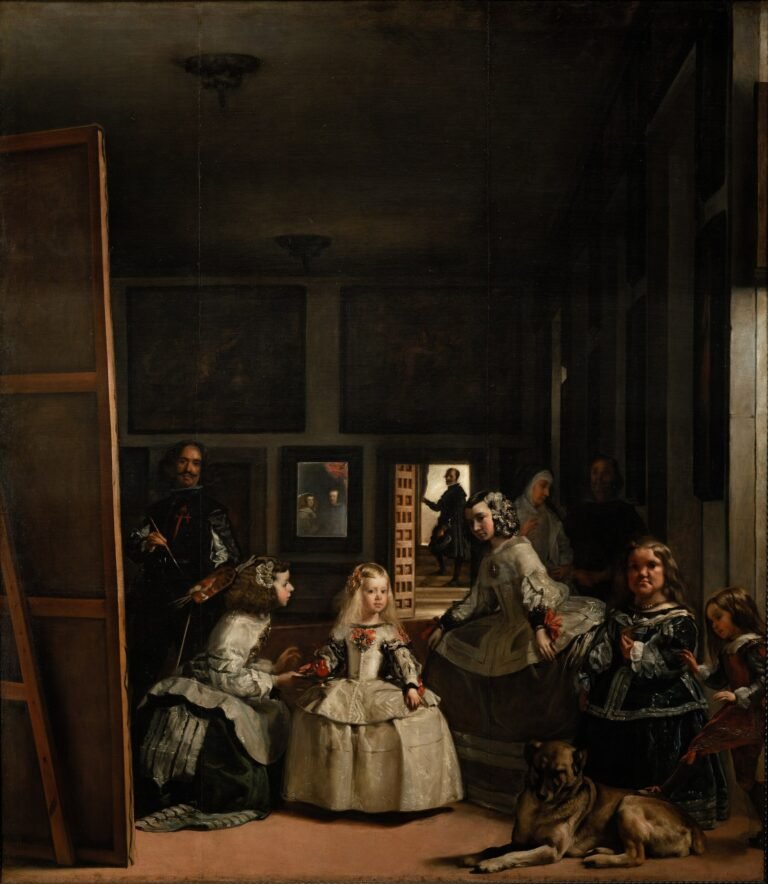
- Elsewhere in the Prado: The Third of May 1808, The Nude Maja, and Las Meninas by Velázquez.
Frequently asked questions
Does the painting look as Goya made it?
Not entirely. A photograph taken by Jean Laurent before the 1874 transfer shows a wider composition with elements on the right that were removed. The restorer also filled losses, since the mural was badly damaged by damp.
Who is being devoured?
In the myth, Saturn’s own child. On the canvas the body has adult proportions and no head, which has led some scholars to question the identification.
Did Goya give it this title?
No. He signed none of the Black Paintings, titled none of them, and never referred to them in writing. The names come from an inventory made after his death.
Is the attribution certain?
Overwhelmingly accepted, but not unanimous. Juan José Junquera argued that the floor housing some of the murals was built after Goya’s death, pointing to his son as the author. The theory has not gained wide support.
Is it the same myth Rubens painted?
Yes — the Roman Saturn, the Greek Cronus, devouring his children to forestall a prophecy. Both paintings are in the Prado and can be seen on the same visit. The difference in treatment is striking.
Where was Goya’s house?
The Quinta del Sordo stood beside the Manzanares river outside Madrid. It was demolished in 1909 and nothing survives.
If this painting has affected you, look next at The Third of May 1808 — painted by the same artist six years earlier, where the violence is equally uncompromising but directed outward rather than inward.
Image: Saturn Devouring His Son – Francisco Goya (c. 1820–1823). License: Public Domain. Source: Wikimedia Commons.