The Garden of Earthly Delights
Most paintings hang quietly on museum walls – but The Garden of Earthly Delights has been sparking arguments, inspiring nightmares, and baffling scholars for over five hundred years. It also contains a scrap of musical notation inked across a damned soul’s buttocks, which a student transcribed in 2014 and turned into an internet phenomenon.
Quick Facts
- Artist: Hieronymus Bosch
- Year: c. 1490–1510
- Medium: Oil on oak panel
- Dimensions: 205.5 cm × 384.9 cm (81 in × 152 in) with the wings open
- Movement: Northern Renaissance
- Current location: Prado, Madrid – Room 56A
What Makes The Garden of Earthly Delights So Unforgettable?
Most great paintings have one central idea. The Garden of Earthly Delights has hundreds – and none of them agree with each other. That is precisely the point. Bosch built a world so dense with detail, so relentlessly strange, that every viewer finds something different to fear or desire inside it.
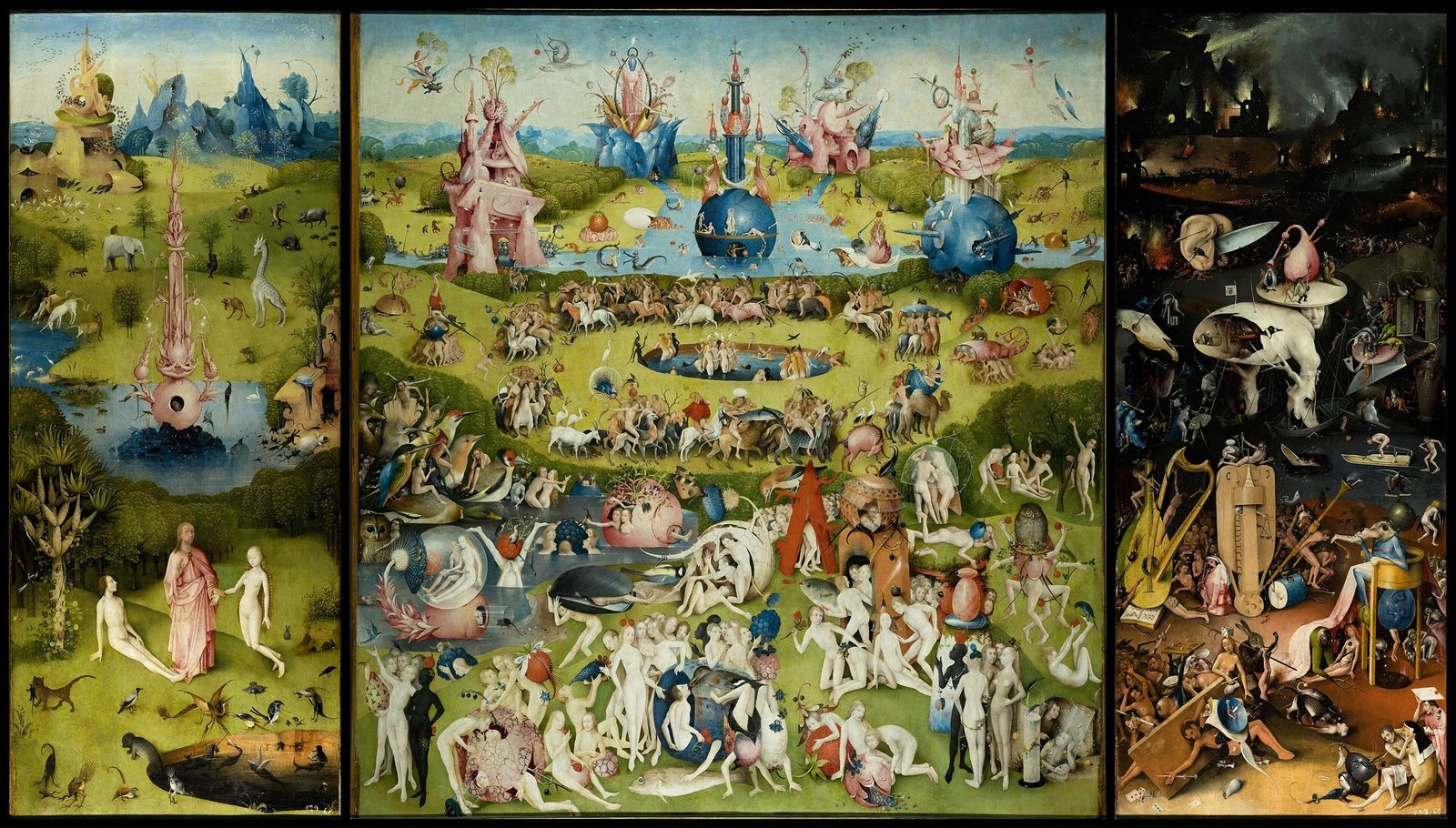
The triptych unfolds across three panels. On the left, a serene Eden. In the center, a vast and frenzied playground of human pleasure. On the right, a pitch-black Hell filled with grotesque punishments and impossible architecture. Together, they form a moral journey – but Bosch refuses to make it comfortable or simple.
What truly sets this work apart is its ambiguity. Even today, experts disagree on whether the central panel celebrates pleasure or condemns it. That unresolved tension is not a flaw. It is the engine that has kept this painting alive and electric for centuries.
Even the name is a modern imposition. Bosch left no title. The monk José de Sigüenza, writing at the Escorial in 1605, called it the picture of the strawberry tree – the madroño, whose fruit is sweet, gaudy and gone before you have tasted it. A 1700 inventory filed it as a painting of the creation of the world. The title we use today comes from a catalogue of 1857.
Historical Context
Bosch created this masterpiece during a period of intense religious anxiety across Europe. The late 15th and early 16th centuries saw the Catholic Church facing growing criticism. Questions about sin, salvation, and the afterlife dominated everyday life and public conversation.
In the Netherlands, where Bosch lived and worked, trade wealth was rising rapidly. Cities were growing. New ideas were circulating. However, alongside that prosperity came a deep cultural fear – that material comfort and earthly pleasure were leading souls away from God.
The Northern Renaissance, unlike its Italian counterpart, was less concerned with classical beauty and more focused on moral storytelling. Artists in the Low Countries used minutely observed detail to pack meaning into every inch of a composition. Bosch took that tradition and pushed it into visionary, almost surreal territory.
The painting’s early history is better documented than most of Bosch’s life. The Italian traveller Antonio de Beatis saw it in 1517, one year after Bosch’s death, hanging in the Brussels palace of Henry III of Nassau – so it was made for the highest level of Netherlandish aristocracy. It stayed in that family until 1568, when Spanish forces confiscated it from William of Orange during the revolt in the Low Countries. It then belonged to Fernando de Toledo, Prior of the Order of St John, until his death in 1591. Philip II bought it at the auction of his estate and sent it to the monastery of El Escorial in 1593, where it hung for the next three and a half centuries.
Symbolism and What to Look For
Stand in front of The Garden of Earthly Delights and start at the far left. The Eden panel is calm, green, and intimate. God presents Eve to Adam beside a fantastical pink fountain. Even here, Bosch plants unease – strange hybrid creatures lurk at the edges, hinting that paradise is already fragile.
Now move to the enormous central panel. At first glance, it looks like a celebration. Hundreds of naked figures ride oversized birds, bathe in pools, and handle giant fruits and flowers. Look closer, however, and the joy starts to curdle. The scale is wrong. The gestures are frantic. The fruit – traditionally a symbol of temptation – is everywhere and enormous.
The pink central fountain is worth your full attention. It rises from a circular pool and appears almost organic, as though it grew rather than was built. Around it, figures move in endless, purposeless circles. Bosch may be suggesting that pleasure without meaning is simply an endless loop.
Then turn to the right panel – Hell. The palette shifts dramatically to black, orange, and sickly yellow. Here, sinners are punished through the very instruments of their pleasure. A glutton vomits. A musician is stretched across the strings of a harp. In the same corner, a figure lies crushed beneath an enormous lute, and across his backside Bosch inked a short line of musical notation – the detail that would make this painting a viral sensation five hundred years later.
Throughout all three panels, pay attention to the color red. Bosch uses it sparingly – which makes every red object feel like a warning flag. And give the whole thing more time than feels natural: research on how people actually look at art finds that most visitors spend seconds in front of a painting, which is not remotely enough for a picture with this much inside it.
Finally, if the museum has the triptych displayed open, look for a reproduction of the closed exterior nearby. Painted in grey monochrome, it shows the world on the third day of creation inside a transparent globe, with God small in the upper left corner and two Latin inscriptions from the Psalms: he spoke, and it was done; he commanded, and they were created.
About Hieronymus Bosch
Hieronymus Bosch was born around 1450 in ‘s-Hertogenbosch, a city in what is now the Netherlands. He took his professional name from his hometown. Beyond that, his biography is surprisingly thin – no diaries survive, no long correspondence, and no confirmed self-portrait.
What we do know is that he was a successful and respected painter during his lifetime, a member of a local religious brotherhood, and almost certainly a devout Christian. That last fact matters enormously when reading his work. His hellscapes were not the fantasies of a rebel – they were the warnings of a true believer.
He died in 1516, leaving behind fewer than 25 paintings that scholars confidently attribute to him. Yet those works had an outsized influence on everything that came after. Within a generation, publishers in Antwerp were marketing Pieter Bruegel the Elder as the second Bosch. The Garden of Earthly Delights stands as his most ambitious and enduring achievement.
Legacy and Influence
The Garden of Earthly Delights cast a long shadow across Western art. The Surrealists of the 20th century – Joan Miró and Salvador Dalí among them – claimed Bosch as an ancestor when building their own dreamlike, logic-defying worlds. It is worth remembering that the resemblance runs one way: Bosch was not dreaming freely but working inside a strict religious idiom, and the Surrealist reading is something the twentieth century brought to him.
In addition, the painting has seeped into popular culture in ways Bosch could never have imagined. It has appeared on album covers, in film set designs, in fashion collections, and across countless online communities dedicated to its mysteries. In 2014 an American undergraduate, Amelia Hamrick, transcribed the notation from the Hell panel into modern notation and posted the result on her blog. It spread worldwide within days, and other musicians have since arranged and recorded it for choir. Five centuries of viewers had looked at those notes without thinking to play them – one of several cases where something hiding in plain sight on a famous painting was noticed only recently. Here are the others.
For contemporary artists working with themes of technology, consumption, and moral confusion, The Garden of Earthly Delights remains startlingly relevant. Its central question – what happens to a society that mistakes pleasure for purpose – feels as urgent now as it did five centuries ago.
Where to See The Garden of Earthly Delights Today
The painting is at the Museo del Prado in Madrid, in Room 56A on the ground floor, among the museum’s Flemish holdings. It has not been there as long as you might assume: it arrived only in 1939, at the end of the Spanish Civil War, after three and a half centuries at El Escorial.
The Prado is open Monday to Saturday from 10.00 to 20.00, and Sundays and public holidays from 10.00 to 19.00. Room 56A sits on the main visitor route and fills up fast, so arriving at opening is the single best move you can make.
Admission is free during the last two hours of the day – Monday to Saturday from 18.00 to 20.00, and Sundays and holidays from 17.00 to 19.00. Those slots cannot be booked online and queues build well before they open, so the free hour usually costs you forty-five minutes on the pavement and leaves you closer to ninety minutes inside. If your priority is standing in front of this triptych without a crowd behind you, a paid ticket on a weekday morning is the better trade.
While you are there, look for Bosch’s other works nearby, including The Haywain Triptych, The Table of the Seven Deadly Sins and The Temptations of Saint Anthony. Rogier van der Weyden’s Descent from the Cross hangs in the same part of the museum – a perfect companion for understanding the Netherlandish tradition that shaped Bosch.
Frequently Asked Questions
Where is The Garden of Earthly Delights located?
At the Museo del Prado in Madrid, Spain, in Room 56A. It has been in the Prado since 1939; before that it spent nearly 350 years at the monastery of El Escorial outside Madrid.
When was The Garden of Earthly Delights created?
Bosch painted it between approximately 1490 and 1510, during the height of his career. The first firm sighting of it comes in 1517, when an Italian visitor described it hanging in a palace in Brussels.
How did a Dutch painting end up in Spain?
By confiscation and then by auction. The triptych belonged to the House of Nassau in Brussels until 1568, when Spanish forces seized it from William of Orange during the revolt in the Low Countries. It passed to Fernando de Toledo, Prior of the Order of St John, and after his death in 1591 Philip II bought it from his estate. In 1593 the king sent it to El Escorial.
What is the “butt music” in the Hell panel?
In the musicians’ corner of Hell, a figure lies pinned beneath a giant lute with a line of musical notation painted across his buttocks. It had been visible for centuries, but in 2014 an American student named Amelia Hamrick transcribed it into modern notation and posted a recording online. The result went viral, and choral arrangements followed. It is a real notation, though what Bosch intended by it is anyone’s guess.
What does The Garden of Earthly Delights represent?
Most scholars interpret it as a moral warning about sin and temptation, moving from Eden through human indulgence to eternal damnation. However, the central panel’s meaning remains actively debated – some see condemnation, others see a more complex meditation on human nature.
Why is The Garden of Earthly Delights so famous?
Its combination of extraordinary detail, unresolved ambiguity, and sheer visual strangeness has made it endlessly fascinating. No other painting from the period looks remotely like it, and five centuries of debate have only deepened its reputation.
Is The Garden of Earthly Delights a triptych, and what do the outer panels show?
Yes, it is a triptych – three hinged panels that close like a book. The outer panels, visible when the work is closed, show a grisaille (grey-scale) image of the world on the third day of creation, enclosed in a transparent sphere, with two lines from the Psalms naming God as its maker. It is quieter and stranger than anything on the inner panels.
If The Garden of Earthly Delights has sparked your curiosity, you will find plenty more to explore right here. Browse our guides to other Northern Renaissance masterpieces, discover more of Bosch’s extraordinary vision, or dive into the art of the Prado’s remarkable collection – there is always another layer waiting to be uncovered.
Image: The Garden of Earthly Delights – Hieronymus Bosch (c. 1490–1510). License: Public Domain. Source: Wikimedia Commons.