Café Terrace at Night
Most people assume Van Gogh painted his famous starry skies from imagination – but Café Terrace at Night was made on the spot, on the cobblestones of Arles, with a gas lantern blazing over the terrace and the real September sky overhead. Astronomers have since matched the stars in it to a specific night: around 16 September 1888.
Quick Facts
- Artist: Vincent van Gogh
- Year: 1888
- Medium: Oil on canvas
- Dimensions: 80.7 cm × 65.3 cm (31.8 in × 25.7 in)
- Movement: Post-Impressionism
- Current location: Kröller-Müller Museum, Otterlo
What Makes Café Terrace at Night So Unforgettable?
There is something almost physically warm about this painting. You feel the heat still rising from the sun-baked stones. You catch the distant hum of conversation spilling out onto the terrace. Café Terrace at Night does something remarkable – it makes night feel welcoming rather than threatening.
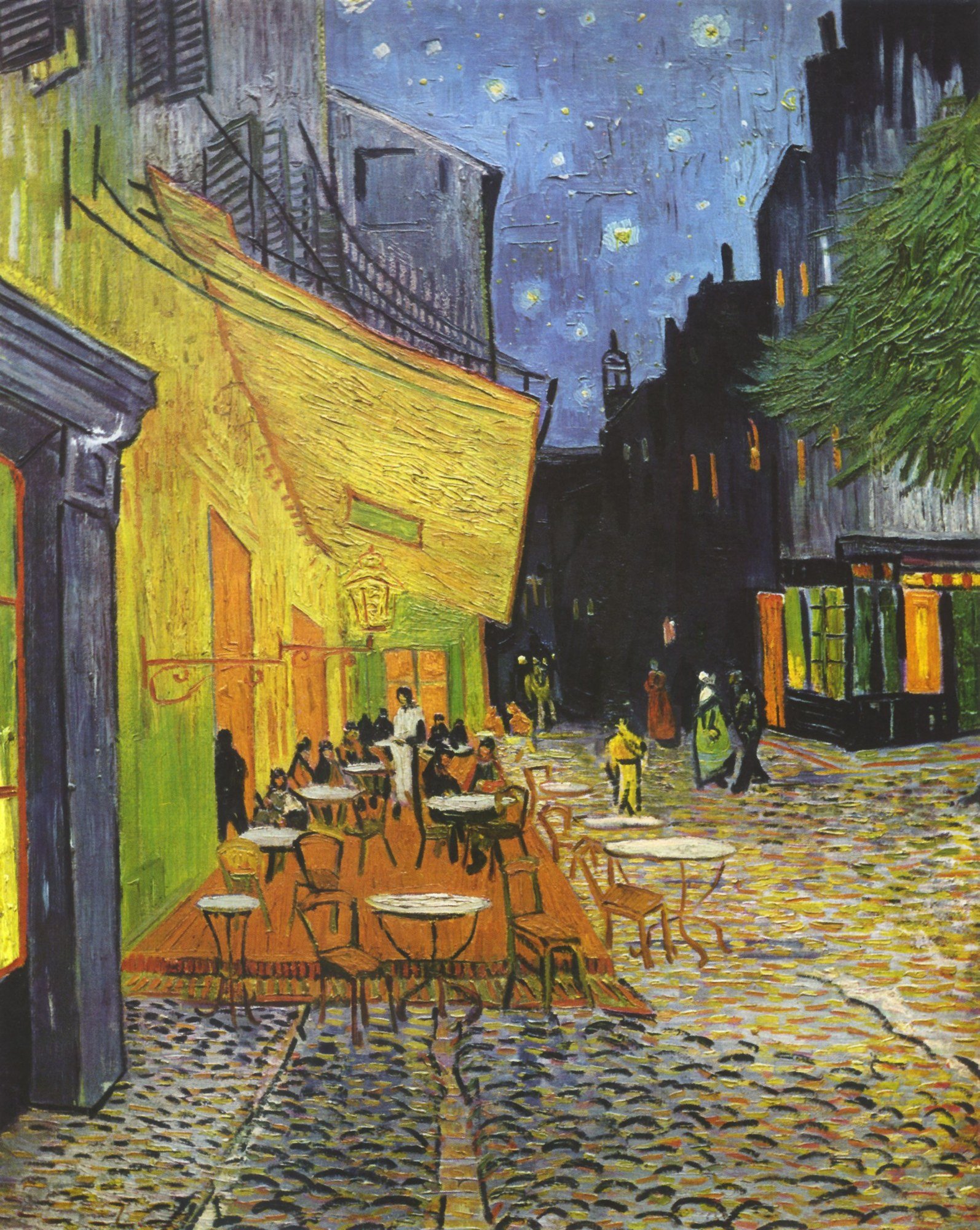
Van Gogh achieved this by setting himself a rule that sounds impossible: paint the night without using any black at all. He was proud enough of it to tell his sister so directly – a night picture with no black in it, built from blue, violet and green, with the lit square coming out in pale sulphur and lemon yellow. Painters had been doing nocturnes for centuries, but almost always by darkening everything. Van Gogh did the opposite. The café glows golden. The cobblestones throw that warmth back upward. Above it all, a deep blue sky is crowded with stars that feel close enough to touch.
What truly sets this painting apart is its emotional honesty. Van Gogh was not chasing prestige or technique. He was recording a feeling – the specific pleasure of sitting outside on a warm September night in southern France, surrounded by strangers, under a tremendous sky. That feeling travels across more than a century without losing any of its power.
Historical Context
Van Gogh painted Café Terrace at Night in September 1888, just months after arriving in Arles, in the south of France. He had moved there in February of that year, searching for intense southern light and a fresh start after the heavy artistic atmosphere of Paris.
In 1888, Post-Impressionism was still taking shape. The Impressionists had already loosened painting’s relationship with photographic realism. However, Van Gogh and his contemporaries – Paul Gauguin, Paul Cézanne, Georges Seurat – were pushing further still, using color and form to express interior emotional states rather than simply exterior appearances.
The Place du Forum in Arles, where this scene is set, was a lively hub of evening life, and the terrace was lit by gas – the enormous yellow lantern Van Gogh describes in his letters, throwing light across the façade, the pavement and even the cobblestones of the street. That single artificial light source is what the whole painting is built around.
Importantly, this is the first painting in which Van Gogh put a starry sky on canvas. He wrote to his sister Willemien that he found the night far more richly colored than the day, and within weeks he had followed it with Starry Night over the Rhône. The idea that night was a subject full of colour rather than an absence of it runs from this terrace straight through to The Starry Night a year later.
Symbolism and What to Look For
Stand in front of this painting and let your eye follow the light. The café awning burns a vivid yellow-orange, pulling your gaze immediately to the center-left of the composition. That warm glow spills across the terrace and onto the uneven cobblestones below, creating a path of reflected light that draws you physically into the scene.
Now look up. The blue of the sky is not a flat, uniform tone. Van Gogh built it in layers – deep cobalt near the rooflines, lightening slightly where it meets the stars. Those stars are not delicate pinpricks. They are thick, confident swirls of paint, applied with urgency. And nowhere in any of it is there a stroke of black.
Notice the contrast between the lit terrace and the dark street to the right. Figures move through that shadow – faceless, anonymous, part of the night. This tension between warmth and darkness, belonging and solitude, gives Café Terrace at Night much of its emotional complexity. It is also worth standing there longer than the few seconds most people give a painting: research on how people actually look at art suggests the works that stay with us are the ones we return to rather than pass.
You may run into a theory that the composition hides Christian symbolism – twelve figures at the tables around a long-haired central figure, echoing the Last Supper. It surfaced around 2010 and has circulated widely online since. Van Gogh was certainly steeped in religious imagery, having worked as a lay preacher. But the reading has not been taken up by Van Gogh specialists, and nothing in his three surviving letters about the painting points to it. Treat it as a curiosity rather than an established layer of meaning.
Finally, notice the perspective. Van Gogh positioned himself looking slightly downward and across the terrace, giving the scene an intimate, ground-level energy. You are not observing from above. You are almost there, at the edge of the terrace, deciding whether to sit down.
About Vincent van Gogh
Vincent Willem van Gogh was born on 30 March 1853 in Zundert, in the Netherlands. He did not begin painting seriously until his late twenties, yet in roughly a decade of intense work he produced over 2,100 artworks – including around 860 oil paintings.
His path was restless and often painful. He worked as an art dealer, a teacher, and a lay preacher before committing fully to art. He studied briefly in Antwerp, then moved to Paris in 1886, where he encountered Impressionism and the Japanese woodblock prints that would transform his use of color and line.
Van Gogh struggled profoundly with mental illness throughout his adult life. His time in Arles, which began so productively, ended with the famous incident in December 1888 when he severed part of his own ear. He spent time in a psychiatric hospital in Saint-Rémy before moving to Auvers-sur-Oise, where he died in July 1890 at the age of 37.
During his lifetime, he sold almost nothing. Today, his works rank among the most valuable and recognizable in human history.
Legacy and Influence
Café Terrace at Night helped redefine what painters were allowed to do with color and artificial light. It demonstrated that night scenes could be joyful and saturated – built out of colour rather than out of darkness.
Its influence appears across twentieth-century art, from Edward Hopper’s nocturnal café scenes to the neon-lit cityscapes of pop art. The idea of depicting ordinary social spaces at night – with emotional rather than literal accuracy – runs through a huge range of later work.
The painting itself is unsigned. We know it is his, and roughly when he made it, from three letters – to his brother Theo, to his sister Willemien, and to the painter Eugène Boch – and from a large pen-and-ink study of the same composition that survived in his estate and is now in Dallas.
Where to See Café Terrace at Night Today
The painting belongs to the Kröller-Müller Museum in Otterlo, in the Netherlands – but check before you travel, because it does travel. Through most of 2026 it has been on loan to a major Van Gogh exhibition in Japan, and the museum lists it as back on display in Otterlo from 15 September 2026. Helene Kröller-Müller bought it for her collection, and it has been one of the museum’s showpieces ever since.
The museum sits inside the Hoge Veluwe National Park – a genuinely beautiful setting that makes the visit feel like an escape as much as a cultural trip. It holds one of the finest Van Gogh collections in the world, with nearly 90 paintings and more than 180 drawings, so a single visit can offer an extraordinary survey of his development. Because the collection is too large to hang at once, works are rotated.
Practical points. The museum sits inside a national park, so you need two tickets: one for the park and one for the museum. It is open Tuesday to Sunday, 10.00 to 17.00, closed on Mondays outside the summer holidays. You can drive right up to the museum, but you pay a separate day ticket for bringing a car into the park; the cheaper and much nicer option is to park at one of the three park entrances – Otterlo is the closest, about 2.5 km away – and ride in on one of the park’s free white bicycles. Allow at least three hours for the museum and its sculpture garden, and a full day if you want the park too.
If you visit Arles itself, the Place du Forum still looks remarkably similar to Van Gogh’s painting. The building he painted stands on the square and is still painted yellow, though what is there now is a recreation done up in the 1990s rather than a surviving interior. It traded for years as the Café Van Gogh, but it has been shut since July 2023 following legal problems, and recent visitors find it closed. Go for the square and the façade, not for the coffee.
Frequently Asked Questions
Where is Café Terrace at Night located?
It belongs to the Kröller-Müller Museum in Otterlo, the Netherlands, inside the Hoge Veluwe National Park. It is not permanently in the galleries, though – it goes out on loan, and spent much of 2026 travelling in Japan. The museum’s website lists its current display status.
When was Café Terrace at Night created?
In September 1888, during Van Gogh’s productive and turbulent stay in Arles. The star positions he painted are accurate enough that astronomers have narrowed the night down to around 16 September.
Did Van Gogh really paint it outdoors at night?
Yes – he wrote that he greatly enjoyed painting on the spot at night, and this was done outdoors on the Place du Forum. The light he worked by came from the café’s large gas lantern, the same one lighting the scene in the picture. The often-repeated story that he fixed lit candles to his hat brim is a later anecdote rather than something documented in his letters about this painting.
Is there really no black in the painting?
That was the point of the exercise. Van Gogh described it to his sister as a night painting with no black in it, made instead from blue, violet and green, with the lit terrace pushed to pale sulphur and lemon yellow. It is the technical achievement he was proudest of in this canvas.
What does Café Terrace at Night represent?
On the surface, a busy café terrace on the Place du Forum in Arles on a warm evening. More deeply, it represents Van Gogh’s belief that night is full of color and life – and his ability to transform an everyday moment into an emotionally powerful experience.
Why is Café Terrace at Night so famous?
Because it solved a problem other painters had answered by dimming everything: how to paint darkness with colour. It is also the first of Van Gogh’s starry skies, the beginning of a line that runs to The Starry Night, and its warmth and intimacy have made it one of the most reproduced images in Western art.
Can I visit the café in Arles?
You can stand in front of it. The building on the Place du Forum is the one in the painting and is still painted yellow, but the establishment that traded there as the Café Van Gogh has been closed since July 2023. The square itself remains open, free and instantly recognisable.
If Café Terrace at Night has sparked your curiosity, we invite you to explore more masterworks right here on the site. Discover other Post-Impressionist paintings, dive deeper into Van Gogh’s extraordinary body of work, or browse our guides to the world’s great museums – there is always another canvas waiting to pull you in.
Image: Café Terrace at Night – Vincent van Gogh (1888). License: Public Domain. Source: Wikimedia Commons.