Sunflowers
Here is a fact that stops most people in their tracks: Vincent van Gogh painted the iconic Sunflowers series not as a simple still life exercise, but as a deliberate act of friendship — decorating his home in Arles to welcome fellow artist Paul Gauguin, hoping the vivid blooms would impress his guest and cement a creative partnership he desperately craved.
Quick Facts
- Artist: Vincent van Gogh
- Year: 1888
- Medium: Oil on canvas
- Dimensions: 92.1 cm × 73 cm (36.2 in × 28.7 in)
- Movement: Post-Impressionism
- Current location: National Gallery, London
What Makes Sunflowers So Unforgettable?
Plenty of artists painted flowers before Van Gogh. So why do these particular Sunflowers feel so different? The answer lies in their raw emotional charge. Van Gogh did not simply observe sunflowers — he projected himself into them. Each bloom pulses with a kind of urgent, almost desperate energy that you rarely find in traditional still life painting.
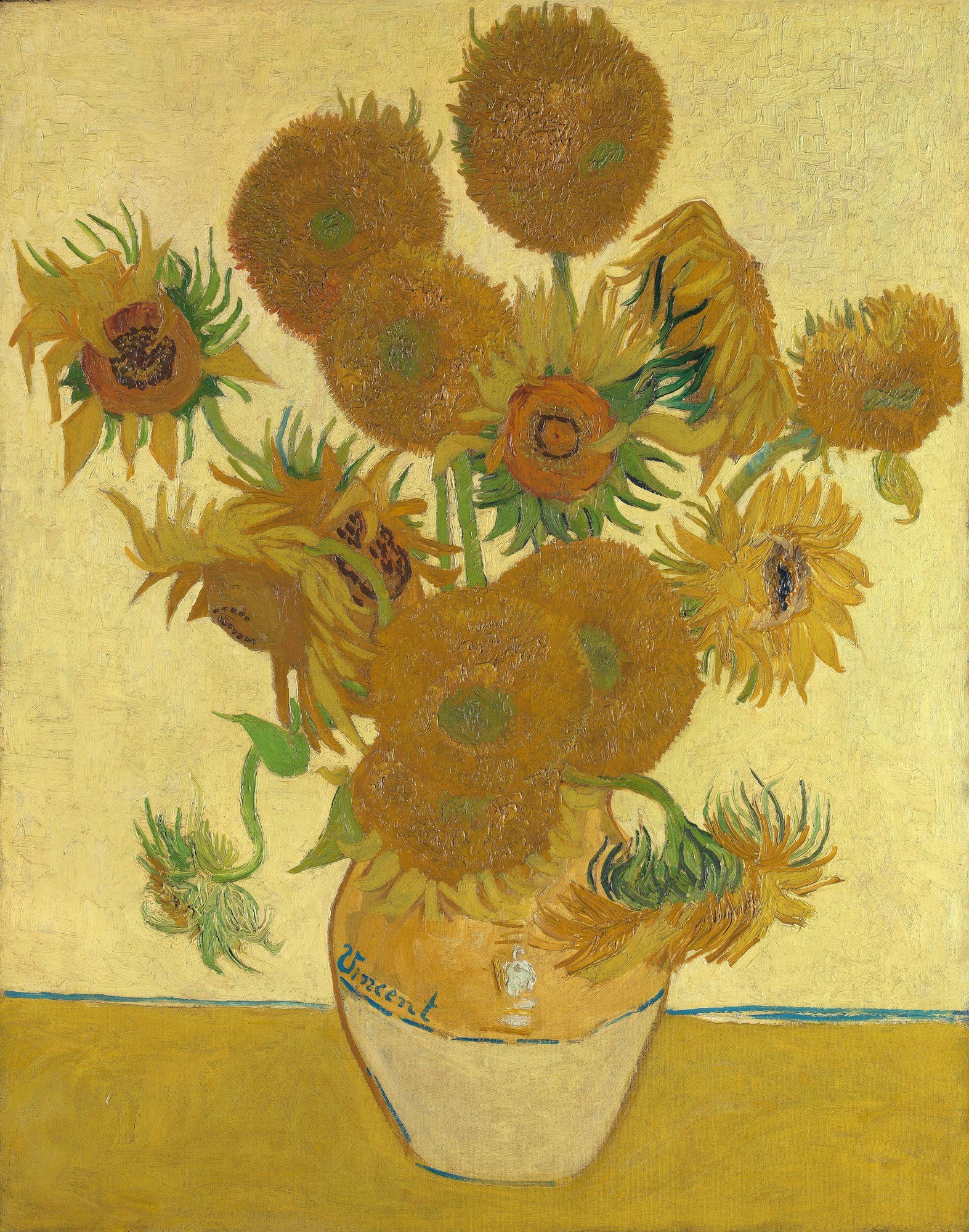
The brushwork is the key. Rather than blending paint smoothly, Van Gogh built up thick, spiralling strokes that give every petal a physical presence. The paint itself seems alive. Stand close to the canvas in London and you can see the ridges and peaks of pigment that no photograph ever fully captures.
In addition, the palette he chose is remarkably daring. He restricted himself almost entirely to yellows and ochres, proving that a single colour family, handled with enough variation and intensity, can carry an entire composition. In a letter to Theo he described the ambition precisely: not yellow against blue, but yellow on yellow. That discipline, combined with the wild expressiveness of his technique, is what sets Sunflowers apart from everything that came before it.
Historical Context
Van Gogh arrived in Arles, in the south of France, in February 1888. He was thirty-four years old, restless, and hungry for sunlight after the grey winters of Paris. The south delivered everything he hoped for — blazing heat, vivid colour, and a creative explosion that would produce some of the most celebrated paintings in history.
This was a turbulent moment for art in general. Impressionism had already shaken the Paris establishment, but a younger generation of painters was pushing even further. Artists like Paul Cézanne, Georges Seurat, and Van Gogh himself were each developing deeply personal visual languages that prioritised emotion and structure over faithful representation.
Meanwhile, Van Gogh was renting a house in Arles — the now-famous Yellow House — and dreaming of turning it into an artists’ community. He invited Gauguin to join him, and he painted the first versions of Sunflowers specifically to hang in the guest bedroom. He worked fast, and he had to: cut sunflowers droop within days, and he wrote to Theo that he was painting from early morning before the flowers faded. The paintings were therefore not just artworks; they were a statement of hope, hospitality, and artistic ambition all at once.
However, the arrangement with Gauguin would end in catastrophe. The two men clashed bitterly, and it was during this period that Van Gogh suffered the breakdown that led to the infamous incident involving his ear. The Sunflowers, painted in such a spirit of optimism, became forever associated with that tragedy.
There is a coda worth knowing. After Arles, Gauguin asked Van Gogh to let him have one of the canvases in exchange for works of his own. Van Gogh refused. By then they had become too personal to trade.
Seven Were Painted. One Burned.
The Arles series runs to seven canvases. Six survive.
The seventh, Five Sunflowers, was bought in 1920 by the Japanese industrialist Koyata Yamamoto and hung at his house in Ashiya, near Kobe. It arrived there through a movement of Japanese writers and collectors — the Shirakaba group — who were trying to bring Van Gogh’s work to Japan.
On 6 August 1945 the house was destroyed in an air raid. The painting burned with it. There had been talk of evacuating it to safety; it never happened. Today the canvas exists only in black-and-white photographs taken before the war.
A different version, Fourteen Sunflowers, went to auction at Christie’s in March 1987 and was bought by Yasuda Fire & Marine Insurance for £24.75 million including premium — then a record for any painting at auction, and a defining moment of Japan’s bubble economy. It now hangs at the Sompo Museum of Art in Shinjuku, Tokyo.
So of the seven, one was destroyed in Japan and one remains there. The rest are in London, Amsterdam, Munich, Philadelphia, and a private collection.
The Yellow Is Fading
Here is something the National Gallery would rather you knew than didn’t.
Van Gogh used chrome-based yellow pigments — cheap, brilliant, and newly available in the 1880s. Analysis published in 2011 by researchers using synchrotron X-ray techniques showed that chrome yellow is chemically unstable: exposed to light, it reduces and browns.
Parts of this canvas are measurably darker than when they were painted. The effect is uneven, which means the tonal relationships Van Gogh so carefully calibrated have shifted. This is why the gallery keeps the lighting low, and why the process cannot be reversed — only slowed.
It is one of several cases where what we assume about a famous painting turns out to be a product of age rather than intention. See the full list.
Symbolism and What to Look For
When you stand in front of Sunflowers at the National Gallery, resist the urge to step back immediately. Start close. Notice how no two flowers are identical. Some bloom fully and face you directly. Others droop, wilt, or turn away. Van Gogh was deeply aware of the sunflower’s lifecycle, and he captured every stage — from bud to full flower to dying head — within a single vase.
That range is deliberate. For Van Gogh, sunflowers symbolised gratitude and devotion. He associated them with the sun itself, which he saw as a source of life and spiritual energy. Therefore, the painting carries layers of meaning beneath its cheerful surface — it is simultaneously a celebration of vitality and a meditation on transience.
Look closely at the background, too. Van Gogh used two distinct shades of yellow — a warmer tone for the wall and a cooler, lighter tone for the surface below the vase. This subtle contrast creates depth without using traditional shadow. The vase itself bears his signature, written in blue along its side — Vincent, not his surname, which he used because he knew Dutch speakers abroad would mangle it.
Finally, pay attention to the variety of textures. The tight, spiky centres of the flowers contrast with the looser, broader petals around them. Van Gogh achieved this through changes in his brushstroke direction — a technique that rewards slow, careful looking. The seed heads at the centre are built up so thickly that in raking light they cast their own shadows on the canvas.
About Vincent van Gogh
Vincent Willem van Gogh was born in the Netherlands in 1853. He came to painting relatively late, only committing to it seriously in his late twenties after working as an art dealer and a lay preacher. He produced over 2,000 works in roughly a decade.
The familiar claim that he sold only one painting in his lifetime is not quite accurate. The Red Vineyard, bought by Anna Boch for 400 francs, is the famous sale, but the Van Gogh Museum documents other transactions, including a commission from his uncle Cor. He was a commercial failure rather than an absolute one — a smaller distinction, but a truer one.
He moved through phases rapidly — absorbing influences from Dutch masters, then the Impressionists in Paris, then developing his own explosive Post-Impressionist style in the south of France. His letters to his brother Theo remain one of the richest documents of an artistic mind in history, revealing a man of extraordinary intelligence and emotional depth.
Van Gogh died in July 1890, aged thirty-seven, just two years after painting Sunflowers. In the decades that followed, the world slowly recognised what it had lost — and what it had been given.
Legacy and Influence
Sunflowers influenced virtually every subsequent generation of painters interested in colour and expression. The Fauves — particularly Henri Matisse — took direct inspiration from Van Gogh’s bold use of unmodulated colour. The Expressionist movement in Germany drew heavily on his emotional intensity.
Today, Sunflowers is one of the most reproduced images in the history of art, appearing on everything from museum merchandise to postage stamps.
In October 2022, activists from the group Just Stop Oil threw tomato soup at this canvas and glued themselves to the wall beneath it. The protective glazing did its job and the paint layer was undamaged, though the frame sustained minor harm; the painting was back on display the same day. Three months earlier the same group had targeted Constable’s The Hay Wain in the same building. The incident made global headlines and, ironically, introduced an entirely new generation to the painting.
Where to See Sunflowers Today
The London version of Sunflowers hangs at the National Gallery on Trafalgar Square. Admission to the permanent collection is free, which makes it one of the best-value art experiences in the world. The gallery opens daily, and early mornings on weekdays are the quietest time to visit.
Room numbering changed after the major rehang completed in 2025, so check the gallery map on arrival rather than relying on older guides. Note also that the lighting in the room is deliberately dim — this is a conservation measure, not a design choice.
While you are there, look out for other Post-Impressionist masterworks nearby, including works by Cézanne and Seurat. The National Gallery also holds Van Gogh’s Van Gogh’s Chair (1888), painted the same year as Sunflowers and a perfect companion piece, as well as Turner’s The Fighting Temeraire.
Other surviving versions are at the Van Gogh Museum in Amsterdam, the Neue Pinakothek in Munich, the Philadelphia Museum of Art, and — for anyone in Japan — the Sompo Museum of Art in Tokyo.
Frequently Asked Questions
Where is Sunflowers located?
The most famous version of Sunflowers is on permanent display at the National Gallery in London. Entry to the permanent collection is free.
When was Sunflowers created?
Van Gogh painted this version of Sunflowers in August 1888, during his highly productive period living in Arles in the south of France.
How many versions of Sunflowers did Van Gogh paint?
Van Gogh created two distinct series. The first, painted in Paris in 1887, showed flowers lying flat on a surface. The second, painted in Arles in 1888, showed bouquets in a vase — seven canvases in total, of which six survive. The seventh was destroyed in an air raid in Japan in 1945.
Is the yellow in Sunflowers fading?
Yes. Van Gogh used chrome-based yellow pigments, which analysis published in 2011 confirmed are unstable under light and darken to brown over time. Parts of the canvas are measurably duller than when he painted them. The process can be slowed by low lighting but not reversed.
What does Sunflowers represent?
Sunflowers represented gratitude, devotion, and the life-giving power of the sun for Van Gogh. He also used the varying stages of the flowers — from bloom to decay — to reflect on the cycle of life itself.
Why is Sunflowers so famous?
The painting is famous for its extraordinary use of colour, its emotionally charged brushwork, and the deeply personal story behind its creation. The record-breaking 1987 auction of another version, and the 2022 protest at the National Gallery, have each kept it in the public eye.
If Sunflowers has sparked your curiosity, there is so much more to discover. Explore our guides to other landmark works by Van Gogh, dive deeper into the Post-Impressionist movement, or browse the full collection of masterpieces held at the National Gallery — all waiting for you right here on the site.
Image: Sunflowers – Vincent van Gogh (1888). License: Public Domain. Source: Wikimedia Commons.