Olympia
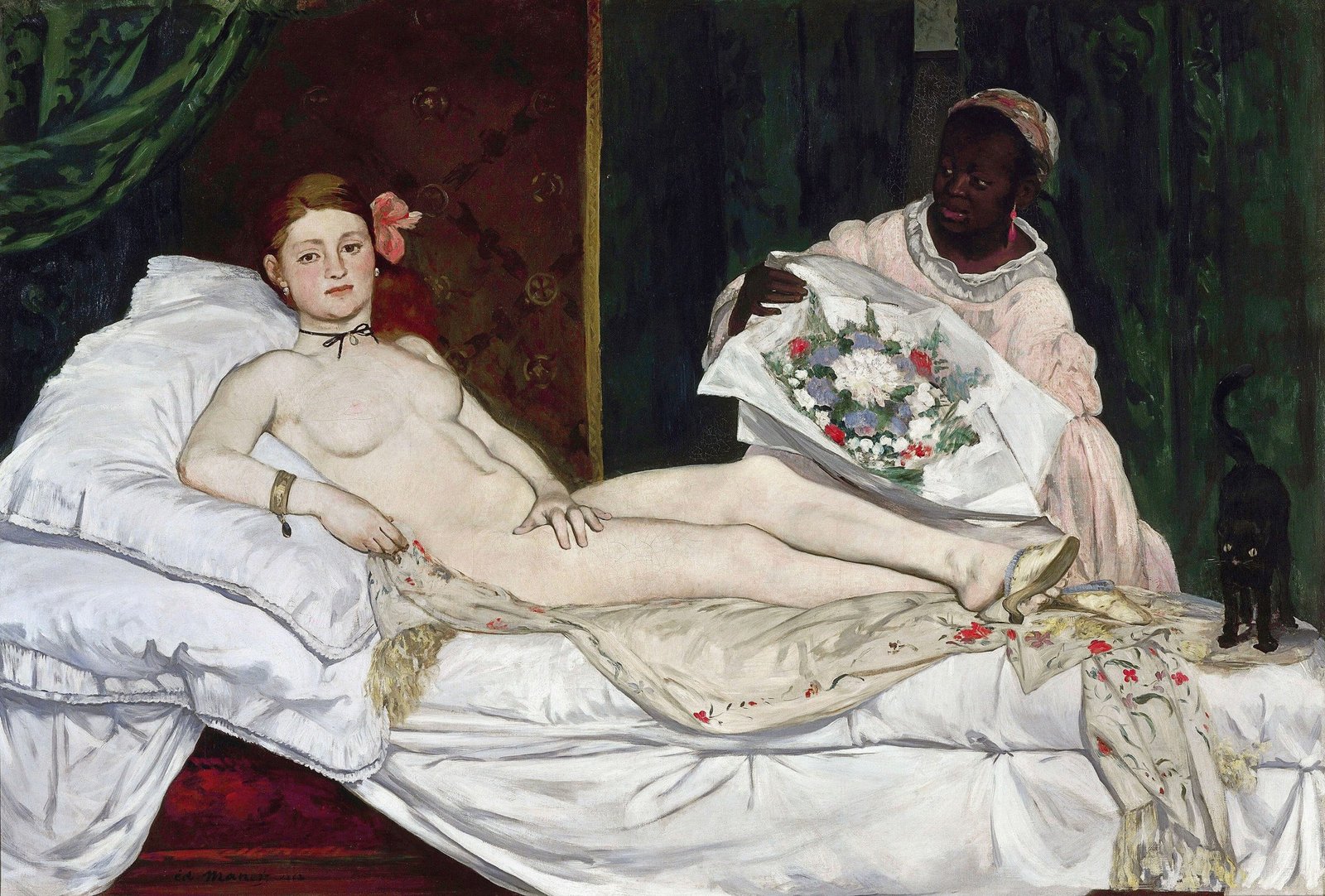
For a century and a half the second woman in this painting had no name. Manet knew it — he wrote it in a notebook: Laure, a model who lived on the rue de Vintimille. He painted her three times. Yet catalogues described her for generations only as “the servant,” and her face was routinely cropped out of reproductions. In 2018 the Musée d’Orsay mounted an exhibition to correct that, and retitled the painting for the occasion: Laure and Olympia.
Quick Facts
- Artist: Édouard Manet (1832–1883)
- Painted: 1863
- Exhibited: Paris Salon, 1865
- Medium: Oil on canvas
- Dimensions: 130.5 × 191 cm
- Movement: Realism, precursor to modernism
- Location: Musée d’Orsay, Paris
What makes it unforgettable?
The nude was the most respectable subject in academic painting — provided it was a goddess. Venus, Diana, a nymph: mythology was the licence.
Manet took the most famous of them all, Titian’s Venus of Urbino of 1534, and replaced the goddess with a Parisian woman who is unmistakably working.
Everything in the composition is quoted and altered. Titian’s sleeping dog — a symbol of fidelity — becomes a black cat with its back arched. The maids rummaging in a chest at the back become a single woman bringing flowers. The soft, inviting gaze becomes a flat stare.
And the body is painted differently. Manet lit her head-on, almost without modelling, so the flesh reads as a pale flat field rather than a rounded form. Critics said she looked like a corpse, like rubber, like something dragged out of the morgue.
Laure
This is the part of the painting that scholarship has caught up with only recently.
The woman holding the flowers is a Black model whom Manet named in his notebook as Laure, with her address. He painted her at least three times: here, in Children in the Tuileries Gardens, and in a portrait study now in Pittsburgh.
Beyond that, almost nothing is documented. She was probably from the French Caribbean; slavery in the French colonies had been abolished in 1848, fifteen years before this painting.
For most of the twentieth century she was omitted. Catalogues listed one figure. Reproductions cropped her. Discussion of the painting treated her as a compositional device — a dark mass to set off pale skin.
The 2018–19 exhibition Le modèle noir at the Musée d’Orsay was built around recovering identities like hers, and during it the painting’s label was changed to Laure and Olympia.
It is worth saying plainly that the recovery is partial. We have a first name, an address and three paintings. That is all.
And Victorine
The woman on the bed was also a real person, and her story is usually told wrong.
Victorine Meurent was Manet’s principal model through the 1860s. She appears in Le Déjeuner sur l’herbe, The Street Singer and The Railway.
The standard account says she ended in poverty and alcoholism. It is false. Research published in the 2000s established that she was a painter in her own right, exhibited at the Salon in 1876 — a year Manet was rejected — and again in 1879, 1885 and 1904. She was admitted to the Société des Artistes Français.
She died in 1927 at Colombes, aged eighty-three, having lived for decades with a woman named Marie Dufour. One of her paintings survives, in the municipal museum at Colombes.
The Salon of 1865
The painting was accepted, which surprised everyone, and hung in the Salon in May 1865.
The reaction was extraordinary. Crowds gathered in front of it. Reviews attacked the drawing, the colour, the subject and the artist personally. Caricatures ran in the press.
The administration moved the painting — first higher, then to a position above a doorway in the last room, where it could barely be seen. Guards were posted.
What offended was not nudity. The same Salon contained several nudes and nobody objected. It was that this one was identifiable as a contemporary woman, with the accessories of her trade: a black ribbon at the throat, a gold bracelet, a slipper half off, an orchid in the hair.
The name did the rest. Olympia was a conventional name for a courtesan in the literature of the period.
Manet left Paris for Spain shortly afterwards.
What to look for
The gaze. Direct, level and entirely unembarrassed. She is not surprised, and she is not inviting.
The left hand. In Titian the hand rests softly. Here it is flat and tense — a refusal rather than a gesture of modesty.
The cat. At the foot of the bed, back arched, barely visible against the dark ground. In early photographs of the painting it disappears entirely.
The bouquet. Wrapped in paper, clearly delivered. It is the one thing in the picture painted with loose, brilliant freedom.
The ribbon. A black band at the throat that divides head from body and makes the nakedness more, not less, conspicuous.
The background. Almost flat, with a curtain and a screen. There is no space to speak of — everything happens on the front plane.
About Édouard Manet
Born in Paris in 1832 to a senior judge and the daughter of a diplomat. He failed the naval examination twice before being allowed to study painting under Thomas Couture.
He wanted official recognition and never stopped submitting to the Salon. He never exhibited with the Impressionists, although Monet, Degas and Morisot treated him as the point of origin.
He married Suzanne Leenhoff, his family’s piano teacher, in 1863 — the year this painting was made. Berthe Morisot, who married his brother, was both model and colleague.
He died in 1883 at fifty-one, of complications of syphilis; his left leg had been amputated eleven days earlier.
How it reached the state
The painting stayed with Manet’s widow after his death.
In 1889 it was shown at the Exposition Universelle, and there was a rumour of an American buyer. Claude Monet organised a public subscription to keep it in France, raising about 20,000 francs from artists and collectors.
The offer to the state was not welcomed. There was resistance to hanging a work of this reputation in a national collection.
It was accepted in 1890 and went to the Musée du Luxembourg, the museum of living artists. It entered the Louvre in 1907, reportedly on Clemenceau’s insistence, and moved to the Musée d’Orsay when that opened in 1986.
Legacy and influence
Cézanne painted A Modern Olympia in 1873–74, a deliberately overheated response. Picasso reworked the composition. Dubuffet, Larry Rivers and Yasumasa Morimura all returned to it.
Kehinde Wiley reversed its terms in 2019, and the painting is now a fixed reference point in arguments about the gaze, race and who is permitted to look.
It is worth noticing what has happened to it. The most scandalous painting of the nineteenth century is now on postcards, tote bags and fridge magnets in the museum shop directly beneath it.
Where to see it today
The painting is at the Musée d’Orsay, Esplanade Valéry Giscard d’Estaing (formerly quai Anatole France), in the former Gare d’Orsay.
- Closed Mondays. Hours and prices change; check before travelling. There is one late evening a week.
- Book online. Queues without a reservation are long.
- Look at Laure. Most visitors take in the nude and move on. Half the painting is on the right-hand side.
- Le Déjeuner sur l’herbe hangs in the same museum — the two 1863 scandals, a few rooms apart.
- Also here: Bal du moulin de la Galette and Whistler’s Mother.
Frequently asked questions
Who is the second woman?
A model named Laure, recorded in Manet’s notebook with an address on the rue de Vintimille. He painted her three times. Almost nothing else about her is documented. The Musée d’Orsay retitled the work Laure and Olympia during its 2019 exhibition on Black models in French painting.
Who was the model for Olympia?
Victorine Meurent, Manet’s principal model in the 1860s. Contrary to the usual story, she did not die destitute: she was a painter who exhibited at the Salon several times and lived to eighty-three.
Why the scandal?
Not the nudity — the Salon was full of nudes. It was that she was recognisably a contemporary Parisian woman, with the accessories of a courtesan, looking straight out at the viewer. The painting had to be rehung out of reach and guarded.
What is the painting based on?
Titian’s Venus of Urbino of 1534. Manet kept the pose and the setting and changed the meaning: the dog of fidelity becomes a black cat, the goddess becomes a working woman.
How did it enter the national collection?
Monet raised a public subscription in 1889 to stop it leaving France. The state accepted it in 1890 and placed it in the Musée du Luxembourg; it reached the Louvre in 1907 and the Musée d’Orsay in 1986.
What does the cat mean?
In Titian there is a sleeping dog, standing for fidelity. Manet replaced it with a black cat, arched and awake — in the slang of the period, an unmistakable innuendo.
If this painting has caught your interest, look next at The Nude Maja by Goya — painted sixty years earlier and causing the same offence for the same reasons, before an inquisitorial tribunal rather than a Salon jury.
Image: Olympia – Édouard Manet (1863). License: Public Domain. Source: Wikimedia Commons.