Melencolia I
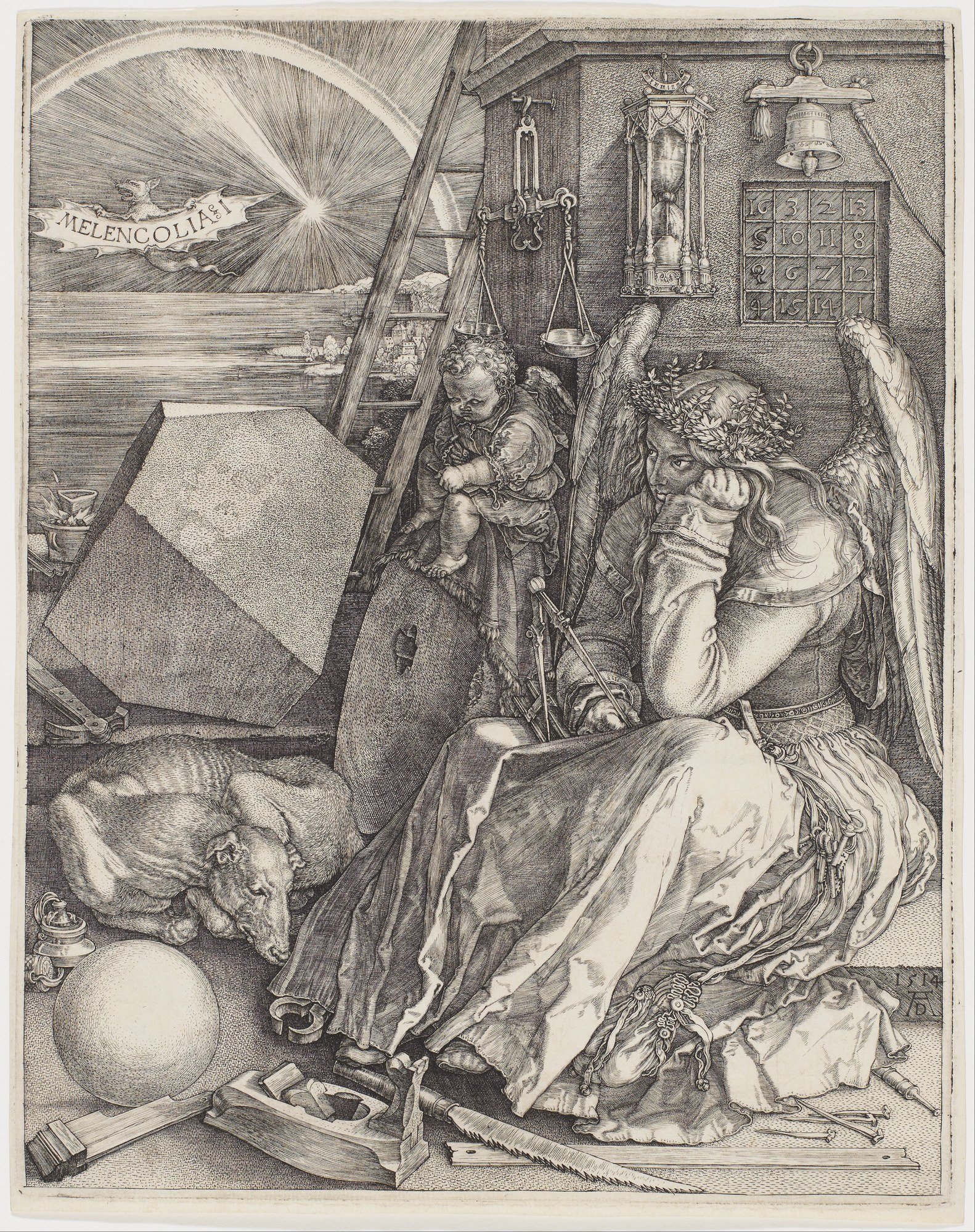
There is a spelling mistake on this print. Dürer engraved MELENCOLIA — with an “e” where an “a” belongs. Nobody knows whether it was an error or a device. Scholars have tried reading it as an anagram and as a cipher; one hypothesis holds that the “I” is not a numeral at all but a Latin imperative, from ire, to go: melencolia, i! — melancholy, be gone.
Quick Facts
- Artist: Albrecht Dürer (1471–1528)
- Year: 1514
- Medium: engraving (copperplate)
- Dimensions: c. 24 × 18.5 cm
- Movement: Northern Renaissance
- Where to find it: impressions at the Metropolitan Museum, the Albertina, the British Museum, Staatliche Kunsthalle Karlsruhe, and elsewhere
This is an impression, not a picture
Worth establishing first, because it changes how you think about the object.
Engraving means cutting lines into a copper plate with a burin. The grooves hold ink; the surface is wiped clean; the image is printed onto damp paper under heavy pressure.
Hundreds of impressions can come from one plate, and they are not equal. The plate wears: lines shallow out, contrast drops. Early impressions are sharp and deep, late ones grey and soft.
So with this work there is no single original. There are impressions of varying quality scattered across the world’s print rooms, and their value depends on how early they were pulled.
Dürer sold prints himself and through agents. Printmaking, not painting, was what supported his household.
What is in the image
There are dozens of objects, and nearly every one has generated its own literature.
The figure. A winged woman sits with her head propped on her fist, in the classical posture of thought. She holds a compass but is not using it. A wreath of plants sits on her head; keys and a purse hang at her belt.
The putto. A small winged child sits on a millstone writing on a tablet. The only figure doing any work.
The polyhedron. A stone solid with eight faces, truncated at two opposite vertices. It corresponds to no figure in classical geometry. It is now called Dürer’s solid, and mathematicians still argue about the exact angles of its faces.
The magic square. Four by four, on the wall. Every row, column and both diagonals sum to 34. The two middle numbers of the bottom row are 15 and 14 — the year. The numbers flanking them, 4 and 1, are sometimes read as the initials AD.
The tools. A saw, a plane, pincers, nails, a ruler, an inkpot, scattered on the ground. All useless, because nobody picks them up.
Hourglass, bell, scales. On the wall of the building. Time, summons, balance.
The dog. Asleep, emaciated, curled at her feet. In humoral iconography the dog was the melancholic’s animal.
The bat. Stretching the banner with the title across the sky.
The sky. A rainbow and a celestial body — a comet, or Saturn, the planet of melancholy.
The ladder. Leaning against the building, running out of the frame with no visible end.
Why it resists explanation
Erwin Panofsky, who wrote the most important analysis of the print, observed that it has attracted more interpretation than any other engraving — and that none of them settles it.
The basic paradox is this: the figure has every tool and does nothing. She holds a compass but measures nothing. She has wings but sits. Around her lies the whole apparatus of practical and geometrical knowledge, unused.
Under humoral theory, inherited from antiquity, melancholy came from an excess of black bile and meant illness, plainly. The Neoplatonists inverted that. Marsilio Ficino argued that melancholy was the affliction of exceptional people — philosophers, astronomers, makers.
Dürer knew these ideas through Nuremberg and through his friend Willibald Pirckheimer.
The commonest reading therefore runs: this is a portrait of a creative mind that has reached the limit of what it can know. Geometry can measure everything except the thing that matters.
Where the “I” comes from
Two main hypotheses, both worth knowing.
First: it is a number. Cornelius Agrippa described three grades of melancholy — of imagination, of reason, of mind. Melencolia I would be the first, belonging to artists and craftsmen, who work through imagination. Dürer never made the other two.
Second: the “I” is the Latin imperative i — “go”. The whole inscription would then read as a formula for driving melancholy away.
Neither can be proved.
Historical context
The print belongs to 1514, together with Saint Jerome in His Study. Knight, Death and the Devil was made the previous year, in 1513. These three are known as the master engravings and are treated as the summit of his printmaking.
They are sometimes set against one another as three conditions: the knight acts, Jerome contemplates in peace, Melancholy sits immobile.
Dürer’s mother died in May 1514. He left a harrowing account of her death and a drawing of her made two months earlier. Some scholars connect the mood of this print to that loss, though there is no evidence for it.
Behind all of it lay the broader moment: three years later Luther published his theses and the old order began to come apart.
About Albrecht Dürer
Born in Nuremberg in 1471, the third of eighteen children of a goldsmith from Hungary.
He travelled to Italy twice — 1494–95 and 1505–07 — where he encountered Bellini’s painting and Italian theories of proportion.
Printmaking brought him a European reputation unmatched by any northern artist before him. His prints were bought from the Netherlands to Italy, and his AD monogram was forged so often that he took legal action to protect it.
He was also a theorist, writing the first German-language treatises on geometry for artists and on human proportion.
He died in 1528, aged fifty-six.
Legacy and influence
The print entered the Western canon as the image of creative paralysis.
The Romantics took it up. In the twentieth century Walter Benjamin made it a starting point for his thinking on allegory and mourning, and Erwin Panofsky, with co-authors, produced the monograph that still underpins scholarship on it.
In literature it is invoked by Thomas Mann and W. G. Sebald. Lars von Trier titled his 2011 film Melancholia and drew explicitly on the tradition.
It now also functions as an image of depression and burnout — contexts Dürer could not have had in mind.
Where to see it
Because these are impressions, they are dispersed. Good ones are held by the Metropolitan Museum in New York, the Albertina in Vienna, the British Museum, the Staatliche Kunsthalle in Karlsruhe and the Germanisches Nationalmuseum in Nuremberg.
- Check whether it is on display before travelling. Works on paper are shown in rotation, briefly and under low light. This is the commonest cause of disappointment.
- The Met makes a very high-resolution scan available free online. For this print that is a genuine alternative — you can enlarge the magic square and read the numbers.
- At the Met, pay-what-you-wish admission applies to New York State residents and students from New Jersey and Connecticut; everyone else pays a fixed rate.
Frequently asked questions
Why does the inscription read MELENCOLIA?
With an “e” rather than an “a”, and it is not known whether this was a slip or deliberate. Attempts have been made to read it as an anagram or cipher; none has been proved.
What does the “I” mean?
Most often taken as the first of the three grades of melancholy described by Cornelius Agrippa. An alternative reading takes it as the Latin imperative “go” — an incantation against melancholy.
How does the magic square work?
Every row, column and both diagonals total 34. The two middle numbers of the bottom row are 15 and 14 — the year of the print.
What is the solid in the left foreground?
A polyhedron with eight faces, truncated at two vertices, corresponding to no classical figure. It is known as Dürer’s solid, and its exact geometry is still debated.
Is it a self-portrait?
Not literally — the figure is female and winged. Dürer regarded himself as melancholic, and many scholars read the print as a portrait of his own creative condition.
Is there only one copy?
No. It is an engraving, printed in many impressions from a single plate. They differ in quality: earlier ones are sharper, later ones flatter.
If this print has caught your interest, look next at Dürer’s Self-Portrait of 1500 — the same mind, with the opposite message: there the artist is certain of his role, here he sits helpless among his own instruments.
Image: Melencolia I – Albrecht Dürer (1514). License: Public Domain. Source: Wikimedia Commons.