Moai
Ahu Tongariki — the row of fifteen moai on every photograph of Easter Island — was lying in pieces thirty years ago, scattered across the slope by the 1960 tsunami. What put them back was a Japanese crane company. Tadano shipped a crane to the other side of the world and did the work at no charge. It took from 1992 to 1996.
Quick Facts
- Makers: Rapa Nui carvers
- Date: c. 1250–1500 CE
- Material: volcanic tuff from the Rano Raraku quarry
- Number: roughly 900
- Dimensions: average 4 m and 12 tonnes; the tallest ever erected, Paro, stands almost 10 m
- Largest unfinished: El Gigante, still in the quarry — about 21 m, estimated at 150–270 tonnes
- Movement: Rapa Nui art
- Location: Rapa Nui (Easter Island), Chile
What makes the moai unforgettable?
Rapa Nui is smaller than most cities and sits more than 3,500 kilometres from the nearest continent. The closest inhabited island is another 2,000 kilometres beyond that.
A population of a few thousand carved nine hundred monumental statues there — without metal, draft animals or the wheel. The tools were basalt picks called toki, thousands of which still lie in the quarry.
The moai are not portraits. They represent ancestors, vessels for mana, the spiritual power that protected the living. That is why they stand with their backs to the ocean: they watch over their villages, not the horizon.
They are not just heads
This is the most persistent misconception about them.
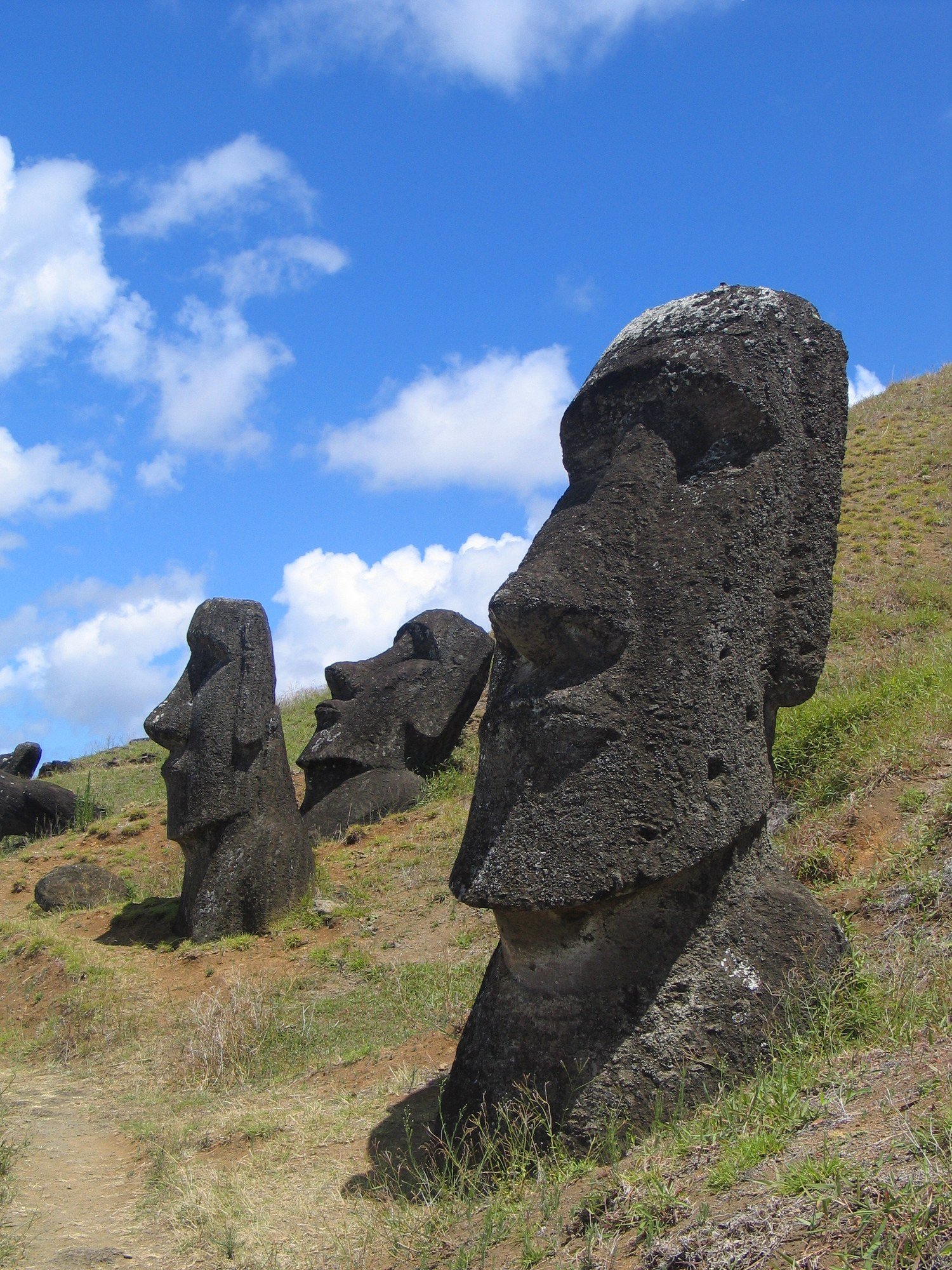
Photographs of Rapa Nui usually show the Rano Raraku quarry, where the statues emerge from the ground at the neck. From that comes the idea that a moai is a bust.
Excavations from 2010 onwards have uncovered full torsos — arms, hands folded across the stomach, carved belts. The statues in the quarry were buried by centuries of slope wash and erosion, not by human action.
The exposed backs revealed something else: petroglyphs, including crescent forms interpreted as the hulls of Polynesian canoes. Traces of red pigment were also found. The statues were painted.
How they were moved
The quarry is in one place; the ahu platforms are scattered across the island, the furthest eighteen kilometres away. The statues weigh over a dozen tonnes.
For decades the assumption was that they were dragged horizontally on wooden rollers. That required enormous quantities of timber, and it became the foundation of the deforestation narrative.
In 2012 Terry Hunt and Carl Lipo tested an alternative. Rapa Nui oral tradition says the statues walked. The team made a five-tonne replica, attached three ropes, and had eighteen people rock it from side to side. It covered a hundred metres in forty minutes, upright — moving much the way one walks a refrigerator across a floor.
The shape supports it. Statues in transport have a forward-leaning posture and a convex belly that makes rocking easier in a standing position. Once installed on a platform, the base was trimmed so the figure stood straight.
The question is not closed — some researchers still argue for horizontal transport — but the walking hypothesis is now taken seriously.
What to look for
Proportions. The head takes up roughly three-eighths of the figure. Deliberate: the head was the seat of mana.
Eyes. The empty sockets were originally filled. A fragment of eye was found in 1978 — white coral with a red scoria iris. Only then did it become clear that the statues had been made to look. The reconstruction is in the museum at Hanga Roa. Eyes were probably fitted only after a statue was erected; that was what activated it.
Pukao. The red cylinders on some heads are not hats. They most likely represent hair worn in a topknot. They were cut from a separate quarry of red scoria and placed after the statue was standing.
Hands. Long fingers meeting across the stomach. Visible only on excavated figures.
Ahu. The platforms are built from fitted stone without mortar. Some contain burials.
El Gigante. Still lying in the quarry, attached to the bedrock. Over twenty metres. It could never have been moved — an ambition that outran capacity.
The collapse was not what the story says
This is the most significant shift in understanding of the island in recent years.
The popular version — widely spread by Jared Diamond — describes ecocide: the islanders cut down every palm to move statues, caused erosion, famine, war and cannibalism, and finally toppled their own moai.
Research over the last fifteen years has undermined much of that.
First, the palms disappeared largely because of Polynesian rats, which arrived with the first settlers and ate the seeds. Deforestation happened, but not because of statue transport.
Second, demographic analysis based on radiocarbon dating and genetics shows no catastrophic population crash before European contact. Genome studies published in 2024 ruled out a drastic collapse.
Third, the islanders adapted. They used manavai — stone enclosures sheltering crops from wind — and lithic mulching, in which crushed rock protects the soil.
The real catastrophe came from outside. In 1862 Peruvian slave raiders abducted close to half the population, including the ruling line and the people who could read the rongorongo script. The few who returned brought smallpox. By 1877 there were 111 people left on the island.
That is when the chain of knowledge about the moai was broken — not centuries earlier.
Statues were indeed toppled, probably during the eighteenth and nineteenth centuries, in the course of conflict and religious change. But that was a consequence, not a cause.
Legacy and influence
The moai are among the most recognisable images in world culture — from emoji to logos to video games.
The island is frequently invoked as an ecological warning. It is worth knowing that this reading rests on a version of events that scholarship has substantially revised. For Rapa Nui people themselves, the story of a society that destroyed its own island is both inaccurate and offensive, and they have said so publicly.
Rapa Nui National Park has been a UNESCO World Heritage Site since 1995. Since 2016 it has been managed by the Rapa Nui themselves rather than by the Chilean state.
Tongariki, Tadano, and Hoa Hakananai’a
Two things worth knowing.
Ahu Tongariki — fifteen statues in a line, the most photographed site on the island — was destroyed by the tsunami that followed the 1960 Chilean earthquake. The wave threw multi-tonne figures hundreds of metres inland.
Restoration was made possible by Tadano, a Japanese crane manufacturer, which donated a crane and funded the operation. The archaeologist Claudio Cristino directed the work, completed in 1996.
Moai abroad. A dozen or so statues are held outside the island. The best known, Hoa Hakananai’a, is in the British Museum, taken in 1868 by the crew of HMS Topaze. It has not been returned. A Rapa Nui delegation travelled to London in 2018 to request it, saying the British had the body but the soul had stayed on the island. Discussions continue; the statue remains in London.
There is also a moai in Japan, at the Sun Messe Nichinan park — the only replica in the world made with the formal permission of the Rapa Nui elders, in acknowledgement of the Tongariki restoration.
Where to see them
Rapa Nui is among the most remote inhabited places on earth. Flights leave from Santiago de Chile, usually once a day, and take about five hours.
- Rano Raraku — the quarry, with nearly four hundred statues in every stage of production. The whole process is visible here.
- Ahu Tongariki — fifteen moai against the ocean. Sunrise here is what people fly in for.
- Ahu Tahai, near Hanga Roa — the only moai with restored eyes.
- The anthropological museum in Hanga Roa holds the original coral eye fragment.
- Park entry is charged, and many sites require a local guide. Rules tightened after a fire in 2022 damaged statues at Rano Raraku.
- Do not touch the moai or walk on the ahu. These are burial sites, and fines are substantial.
Frequently asked questions
Are the moai just heads?
No. They have full bodies with arms and hands folded across the stomach. The statues in the Rano Raraku quarry were buried by centuries of erosion, leaving only the upper portions visible. Excavations since 2010 have exposed complete figures, with petroglyphs carved on their backs.
How were they moved?
It is not settled. A 2012 experiment showed that eighteen people can move a five-tonne replica upright by rocking it with ropes — which matches the Rapa Nui tradition that the statues walked. The alternative hypothesis is horizontal transport on rollers.
Why do they face inland?
Because they watched over the living, not the sea. The moai represent ancestors and were placed facing the villages they protected.
Did the islanders destroy their own environment?
The popular version is heavily disputed. Deforestation was driven largely by rats eating palm seeds, and 2024 genetic research found no evidence of a population collapse before European contact. The real catastrophe came from outside: slave raids in 1862 and subsequent epidemics reduced the population to 111 people by 1877.
Did the moai have eyes?
Yes. The sockets were filled with white coral and red scoria irises. The first fragment was only identified in 1978. Eyes were probably installed after a statue was raised — that was the act that gave it power.
What are the red cylinders?
Pukao — most likely representing hair tied in a topknot rather than headgear. They were carved at a separate quarry and placed on statues already standing.
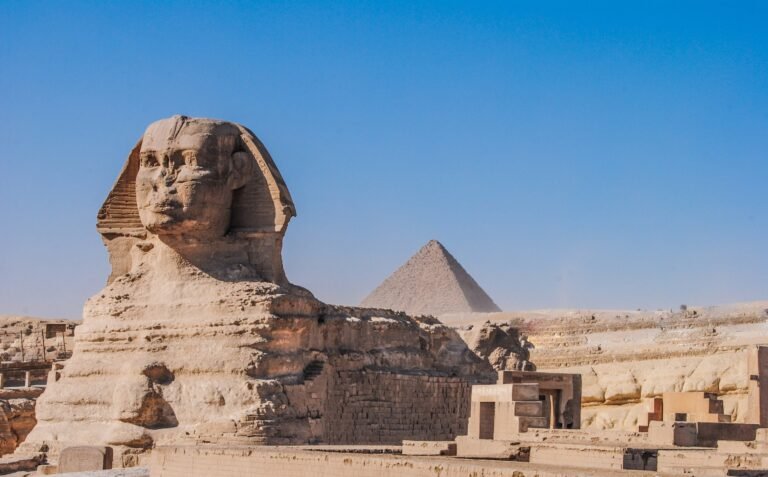
If the moai have caught your interest, look next at the Great Sphinx of Giza — another colossal figure known for centuries only from the shoulders up, and surrounded by an equal quantity of myth.
Image: Moai at Rano Raraku, Rapa Nui (c. 1250–1500). License: Public Domain. Source: Wikimedia Commons.