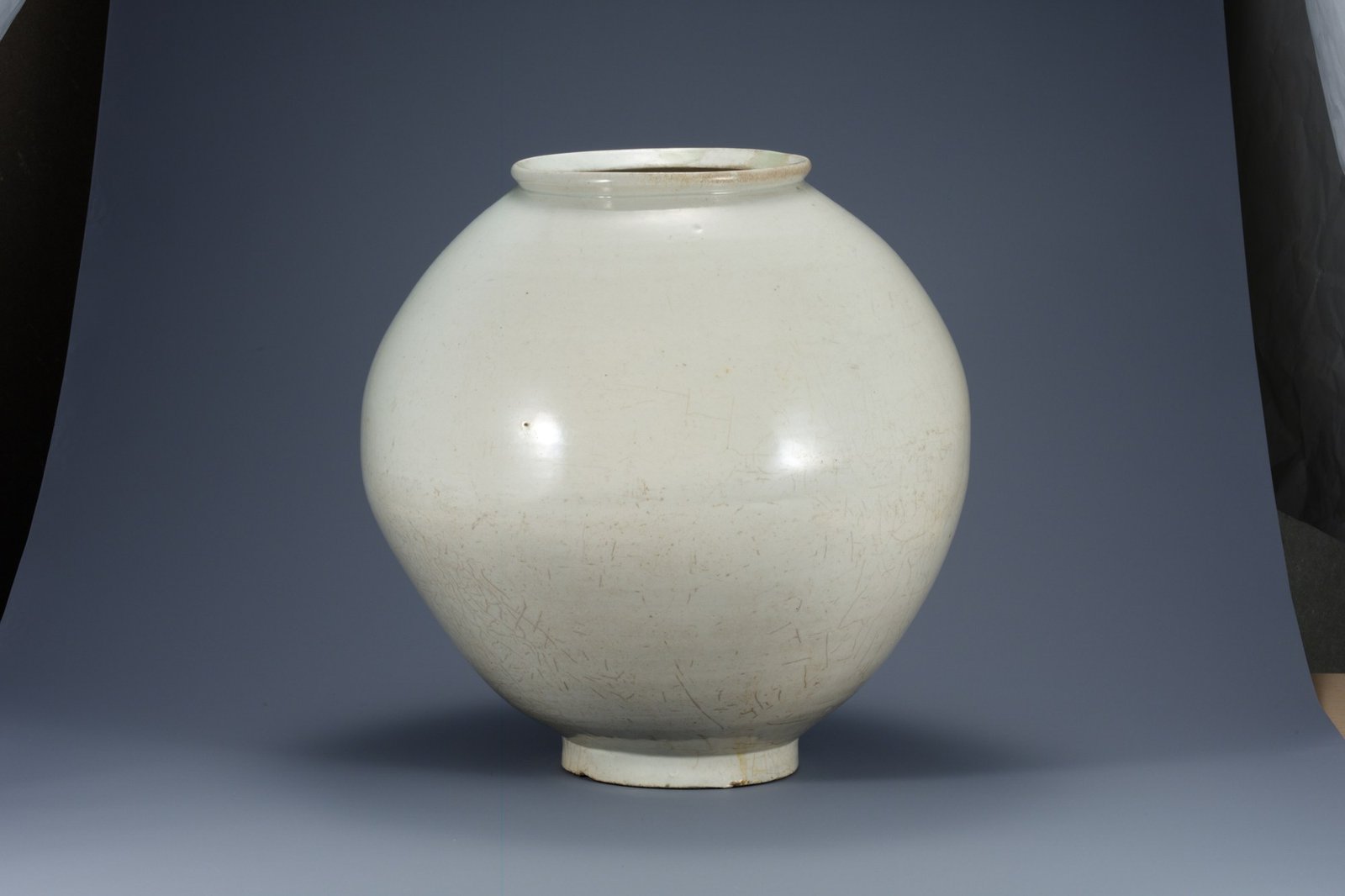
Moon Jar (Joseon White Porcelain)
One of these jars stood in a London studio for forty years. Bernard Leach bought it in Seoul in the 1930s and gave it to the potter Lucie Rie, who kept it on a shelf and looked at it daily. After her death it went to the British Museum. It is probably the single most influential piece of Korean ceramics in the West, and for most of the twentieth century almost nobody saw it.
Quick Facts
- Korean name: 달항아리 (dal hangari) – moon jar
- Maker: unknown, royal kilns at Gwangju
- Date: late 17th to mid-18th century
- Medium: white porcelain, transparent glaze
- Height: typically 40–49 cm
- Period: Joseon dynasty
- Where to find them: National Museum of Korea, Leeum Museum of Art, the British Museum
Why it is not symmetrical
This is the first thing to understand, because it explains the whole object.
A jar of this size could not be thrown in one piece. The clay would collapse under its own weight.
So the potters threw two hemispheres separately, let them stiffen, and joined them at the middle. The seam was smoothed over, but it never disappeared entirely.
Then came the firing, at around 1,250 degrees. At that temperature the whole form sagged slightly under its own weight. Nobody could predict in which direction.
The result is that no moon jar is a true sphere. Each one leans a little differently.
It is worth being careful about how this is described. The asymmetry was not sought. It was a by-product of the technique that Korean collectors and artists came, much later, to prize. The Joseon potter was not trying to be imperfect; he was making as good a jar as he could.
Where the name comes from
Nobody in the Joseon period called these moon jars.
The term appears in the twentieth century, in the circle of Kim Whanki, the painter – the most important Korean modernist and a serious collector of these vessels. He owned several, painted them repeatedly, and wrote about them.
The name caught on and is now used universally, including in scholarship.
The Joseon name was simply baekja daeho – a large white porcelain jar. The usage was practical: storing soy sauce, grain or alcohol, or serving as a container at court ceremonies.
Historical context
The Joseon dynasty adopted Confucianism as a state ideology, and that had consequences for ceramics.
White signified purity, restraint and moral integrity. The exuberant celadons of the preceding Goryeo dynasty, and Chinese polychrome porcelain, were regarded as excessive.
Production was concentrated in the royal kilns at Gwangju, near Seoul, under direct court supervision. The potters were state artisans, and their names were not recorded.
Moon jars belong to a relatively short window – roughly the late seventeenth to the mid-eighteenth century – following the country’s recovery from the Japanese invasions of the 1590s and the Manchu invasions of the 1630s.
Fewer than thirty are thought to survive in good condition worldwide. It is a rare object, not merely a celebrated one.
What to look for
The seam. Look for a faint horizontal line at the widest point. Sometimes it is visible as a change in the glaze, sometimes as a slight ridge.
The lean. Walk around it. Every jar deviates from the sphere in its own way, and from some angles the deviation is obvious.
The colour. Not white. Cream, ivory, a faint blue or grey cast, sometimes a warm tint where the flame touched the surface in the kiln.
The proportions. The mouth is narrow, the foot narrower than the belly. The form is unstable-looking, which is part of its effect.
Marks from firing. There are often small blemishes: specks of iron, a scar where the jar touched a support, a variation in the glaze. These were not faults serious enough to break the piece.
The interior. Where visible through the mouth, the inside is glazed too but finished far less carefully.
Leach, Rie and the jar in London
This chapter explains how a Korean storage vessel became a modern icon.
Bernard Leach, the British potter who did more than anyone to introduce East Asian ceramics to the West, bought a moon jar in Seoul in the 1930s and brought it to England.
He later gave it to Lucie Rie, the Viennese-born potter who had fled to London in 1938. She kept it in her studio for around four decades. Photographs of her workspace show it standing on a shelf among her own work.
After her death in 1995 the jar was sold, and it is now in the British Museum.
Its influence on twentieth-century British studio pottery is hard to overstate. Generations of potters saw it in Rie’s studio or in reproduction, and the idea that a plain, slightly lopsided white vessel could be a major work of art entered Western ceramics largely through this route.
Legacy and influence
In Korea the moon jar functions as a national emblem. It appeared at the opening ceremony of the 2018 Winter Olympics in Pyeongchang, where the cauldron was shaped as one.
Contemporary Korean ceramicists continue to make them, and the form has become a genre in its own right rather than a reproduction.
Kim Whanki’s paintings are the other major channel. He painted moon jars throughout his career, and through him the object entered Korean modernism rather than remaining an antiquarian curiosity.
Prices have followed. Good Joseon examples now reach several million dollars at auction.
One note on terminology: South Korea abolished the numbering of National Treasures in 2021, on the grounds that the numbers were read as a ranking. Several moon jars hold the designation; the numbers formerly attached to them are no longer official.
Where to see them
Because so few survive, it is worth knowing where they are.
- National Museum of Korea, Seoul – several examples in the ceramics galleries. Admission to the permanent collection is free.
- Leeum Museum of Art, Seoul – a private museum with an outstanding holding of Joseon ceramics. Closed Mondays; check booking rules before travelling.
- British Museum, London – the Leach and Rie jar, in the Korea gallery.
- Victoria and Albert Museum, London, and the Metropolitan Museum, New York, also hold examples.
Check before visiting whether the piece you want is on display. Ceramics are less light-sensitive than works on paper, but rotation still happens.
Practical advice once you are there: walk all the way round it. A moon jar photographed from the front looks like a circle. It is only from the side, and from several sides, that you see what it actually is.
Frequently asked questions
Why is it not a perfect sphere?
Because a jar this size could not be thrown in one piece. Two hemispheres were made separately and joined, and in the kiln the whole form sagged slightly under its own weight. The asymmetry is a consequence of the method, not a deliberate effect.
Where does the name come from?
From the twentieth century, associated with the painter Kim Whanki and his circle. In the Joseon period these were simply called large white jars.
What were they used for?
Storage – soy sauce, grain, alcohol – and as containers at court ceremonies. They were functional objects, not display pieces.
How many survive?
Fewer than thirty in good condition, held between Korean, British, American and Japanese collections.
What is the connection with Bernard Leach?
Leach bought a moon jar in Seoul in the 1930s and gave it to the potter Lucie Rie, in whose London studio it stood for around forty years. It is now in the British Museum and is among the most influential pieces of Korean ceramics in the West.
Why white?
Because Joseon Confucianism identified white with purity and restraint. Colourful glazes and elaborate decoration were regarded as excess, and the court adopted white porcelain as its standard ware.
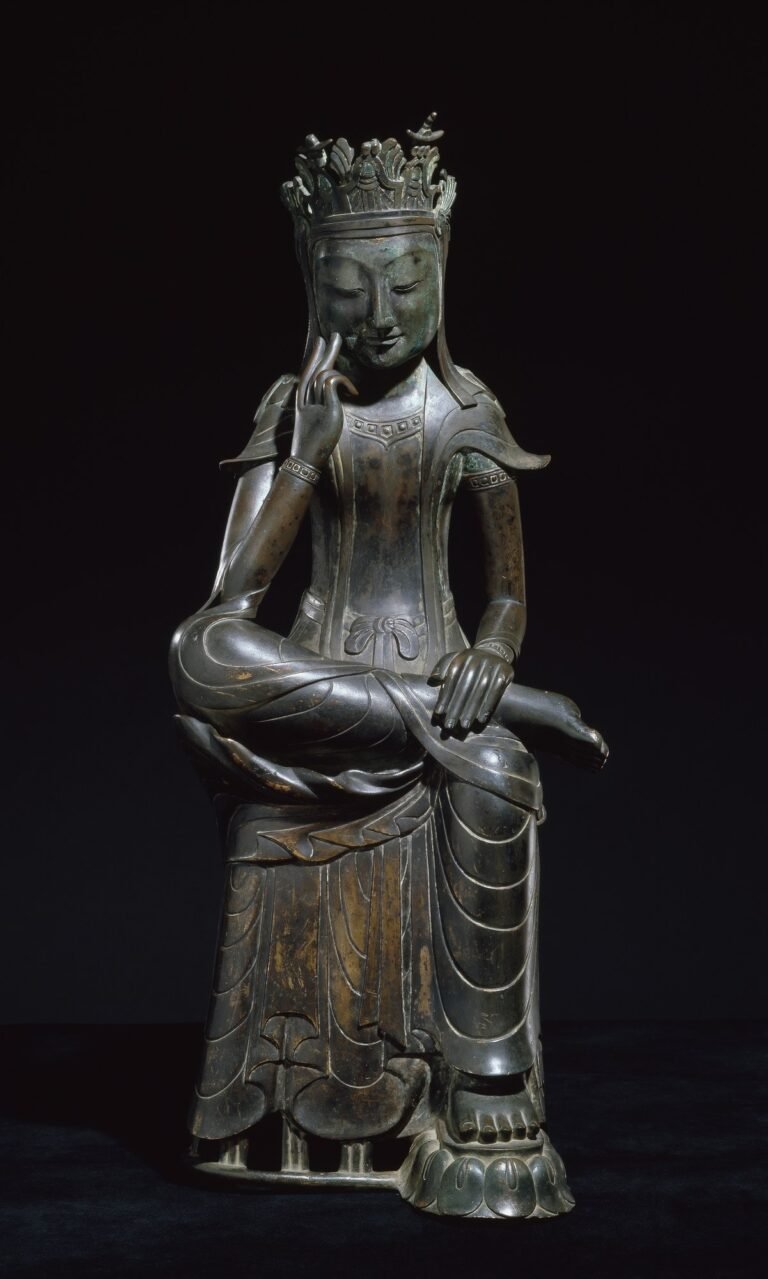
If the moon jar has caught your interest, look next at the Pensive Bodhisattva – a Korean object from a thousand years earlier, working on the same principle: maximum effect from minimum means.
Image: White porcelain moon jar, Joseon dynasty, 18th century. License: Public Domain. Source: Wikimedia Commons.