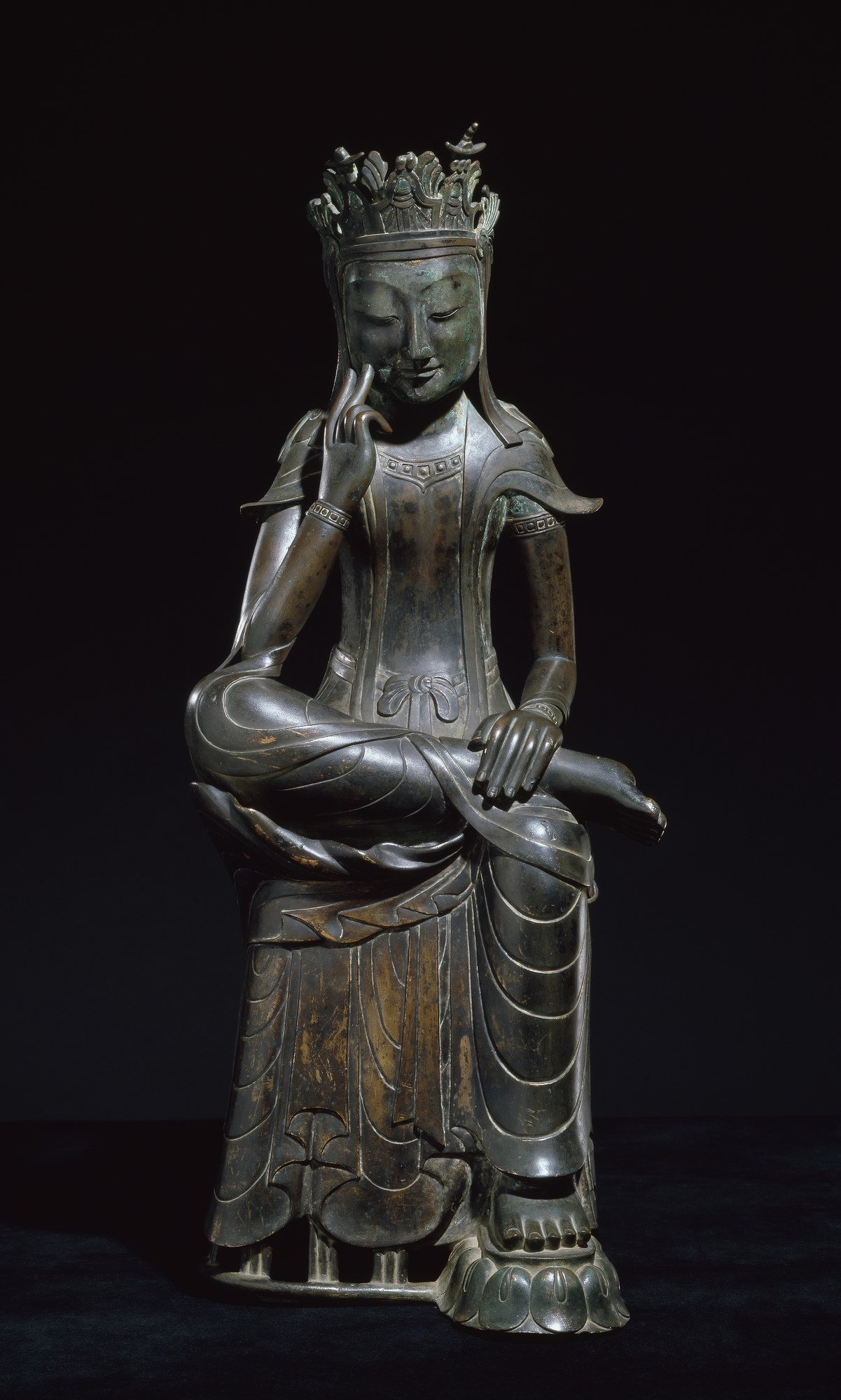
Pensive Bodhisattva (National Treasure No. 78)
Korea’s two most famous sculptures now stand facing each other in a single darkened room. The National Museum of Korea opened it in 2021 and called it the Room of Quiet Contemplation. There are no cases, no labels on the walls, no decoration — two figures on a floor that slopes very slightly, which makes people walk more slowly. For the previous fifty years the two were shown separately, in rotation.
Quick Facts
- Maker: unknown
- Date: second half of the 6th century
- Medium: fire-gilded bronze, lost-wax cast
- Height: 81.5 cm
- Status: National Treasure of South Korea
- Period: Three Kingdoms
- Location: National Museum of Korea, Seoul — Room of Quiet Contemplation
What makes it unforgettable?
The power of this figure is not scale. It is a little over eighty centimetres — about the size of a seated child.
The posture has a name: bangasayusang. The right leg rests on the left knee, the left foot hangs down onto a low stool, and the right hand rises towards the cheek. The fingers do not touch the face. They stop just short of it. That fraction of a centimetre is one of the most technically demanding passages in the entire cast.
The gesture is not sorrow or fatigue. In Buddhist iconography it signifies reflection on the suffering of the world.
What holds people, though, is the face. The smile is so slight that it can be missed entirely at first glance and only emerges after you have looked for a while.
How it was made
This is a detail that only becomes impressive once you understand the problem.
The sculpture is hollow and cast in a single pour, by the lost-wax method. In places the wall is only two to four millimetres thick.
Casting a bronze of this thinness — with an extended arm, an openwork crown and complex drapery — required control of the process that is hard to imagine in the sixth century. Endoscopic examination has confirmed there are no joins: the figure was not assembled from parts.
The gilding was applied by amalgam: gold dissolved in mercury, spread over the surface, and the mercury driven off with heat. Extremely toxic, and extremely durable.
Two sculptures, not one
This figure has a sibling, and comparing them is the most rewarding thing you can do in this museum.
This one — formerly National Treasure No. 78 — is 81.5 cm tall. It wears a tall crown carrying a sun-and-crescent motif, and the robes fall in sharp, symmetrical folds. It reads as more ornate, more regal.
The other — formerly No. 83 — is 93.5 cm and somewhat later. Its crown is plain, with three simple lobes, and the torso is bare. The drapery falls softly. It is austere and more corporeal.
Both are generally identified as Maitreya, the Buddha of the future, waiting for the moment of his descent.
There is a Japanese connection worth knowing. The second of the two is strikingly similar to the wooden Miroku Bosatsu at Kōryū-ji in Kyoto, which is Japan’s National Treasure No. 1. The resemblance is close enough that some scholars regard the Japanese figure as Korean work, or as made by Korean craftsmen in Japan. The argument has run for decades.
Historical context
The sixth century on the peninsula was a period of competition between three kingdoms: Goguryeo in the north, Baekje in the south-west, Silla in the south-east.
Buddhism arrived from China in the fourth century and was adopted as a state religion — in Goguryeo in 372, in Baekje in 384, and in Silla only in 527.
This was not purely a spiritual matter. Buddhism gave rulers an ideology capable of binding a state together, and founding temples and commissioning images was a demonstration of power.
The cult of Maitreya had a particular place in this. In Silla it was associated with the hwarang, an elite corps of young aristocrats who were regarded as embodiments of the future Buddha.
The origin of this particular sculpture is disputed. Baekje, Silla and Goguryeo have all been proposed, and none has been established. Nor do we know where it was found — it entered the collection in 1912, bought from a dealer during the Japanese occupation, with no documented findspot.
What to look for
The gap between the fingers and the cheek. The hand does not touch the face. This is the hardest part of the cast.
The crown. Tall and openwork, with a solar disc and crescent. This type of headdress connects to Sasanian iconography and points to influence transmitted across Central Asia.
The folds. Sharp, geometric, falling in symmetrical cascades. Compare them with the soft drapery of the other figure — the difference shows how the style developed over a few decades.
The toes. The left foot rests on a small lotus stool. The toes are carefully modelled and slightly flexed.
Walk around it. In the Room of Quiet Contemplation the figures stand free, without cases. From behind you can see how carefully the robes and hair were finished — areas nobody would have seen in a temple.
The light. The room is deliberately dim and lit so that the gold shifts as you move. Move slowly.
Who made it
Unknown, and it will remain so.
In the sixth century craftsmen worked anonymously. The work served the Dharma, not a career, and signing an image was not the practice.
The cast itself tells us a good deal, though. The maker knew Chinese models from the Northern Wei dynasty and, indirectly via the Silk Road, the art of Gandhara. The command of thin-wall casting was at a level not reached again on the peninsula for centuries.
Legacy and influence
The pensive bodhisattva became one of the defining types of Korean Buddhist sculpture and travelled from there to Japan.
In Korea both figures function as national images, appearing in textbooks, on stamps and in cultural campaigns.
Something more recent is worth adding. The Room of Quiet Contemplation, opened in 2021, became an unexpected phenomenon. People go there to sit — sometimes for half an hour — and the museum has come to treat it as a space for contemplation rather than display. Miniatures of the two figures are among the best-selling museum products in Korea.
It is also worth knowing that the numbering of National Treasures was abolished in 2021, on the grounds that the numbers implied a hierarchy. Officially these are simply pensive bodhisattvas; 78 and 83 survive as conventional shorthand.
Where to see it today
The sculpture is at the National Museum of Korea in Yongsan-gu, Seoul, near Ichon station.
- The Room of Quiet Contemplation is on the second floor — a separate, darkened space holding both figures. It is the only place where they can be seen together.
- Admission to the permanent galleries is free.
- Come early. The room is small and loses its character when busy.
- Do not hurry. The floor slopes slightly, which slows your pace. That is deliberate.
- The museum is very large; allow at least three hours for the whole thing.
Frequently asked questions
Who does the sculpture represent?
Most probably Maitreya, the Buddha of the future, awaiting the moment of his descent to earth. The pose with the hand at the cheek signifies reflection on the suffering of the world.
How does it differ from the other pensive bodhisattva?
This one is 81.5 cm tall, with a tall openwork crown bearing a sun and crescent, and sharp symmetrical folds. The other, formerly No. 83, is larger at 93.5 cm, with a plain three-lobed crown, bare torso and soft drapery. They now stand facing each other in the same room.
Which kingdom did it come from?
Unresolved. Baekje, Silla and Goguryeo have all been argued. The findspot is unknown too — the piece was acquired in 1912 from a dealer during the Japanese occupation.
How was it cast?
By lost wax, as a single hollow pour with walls only a few millimetres thick. The gilding was applied as a gold-mercury amalgam.
Is it connected to the sculpture in Kyoto?
The wooden Miroku Bosatsu at Kōryū-ji closely resembles the second Korean pensive bodhisattva. Some scholars consider it Korean work or the work of Korean craftsmen. The question has not been settled.
Do National Treasure numbers still apply?
No. South Korea abolished the numbering in 2021 because it was read as a ranking. The numbers 78 and 83 remain in use informally.
If this sculpture has caught your interest, look next at Irworobongdo — a painting from a thousand years later, in which art serves not contemplation but the state.
Image: Pensive Bodhisattva, gilt bronze, second half of the 6th century. License: Public Domain. Source: Wikimedia Commons.