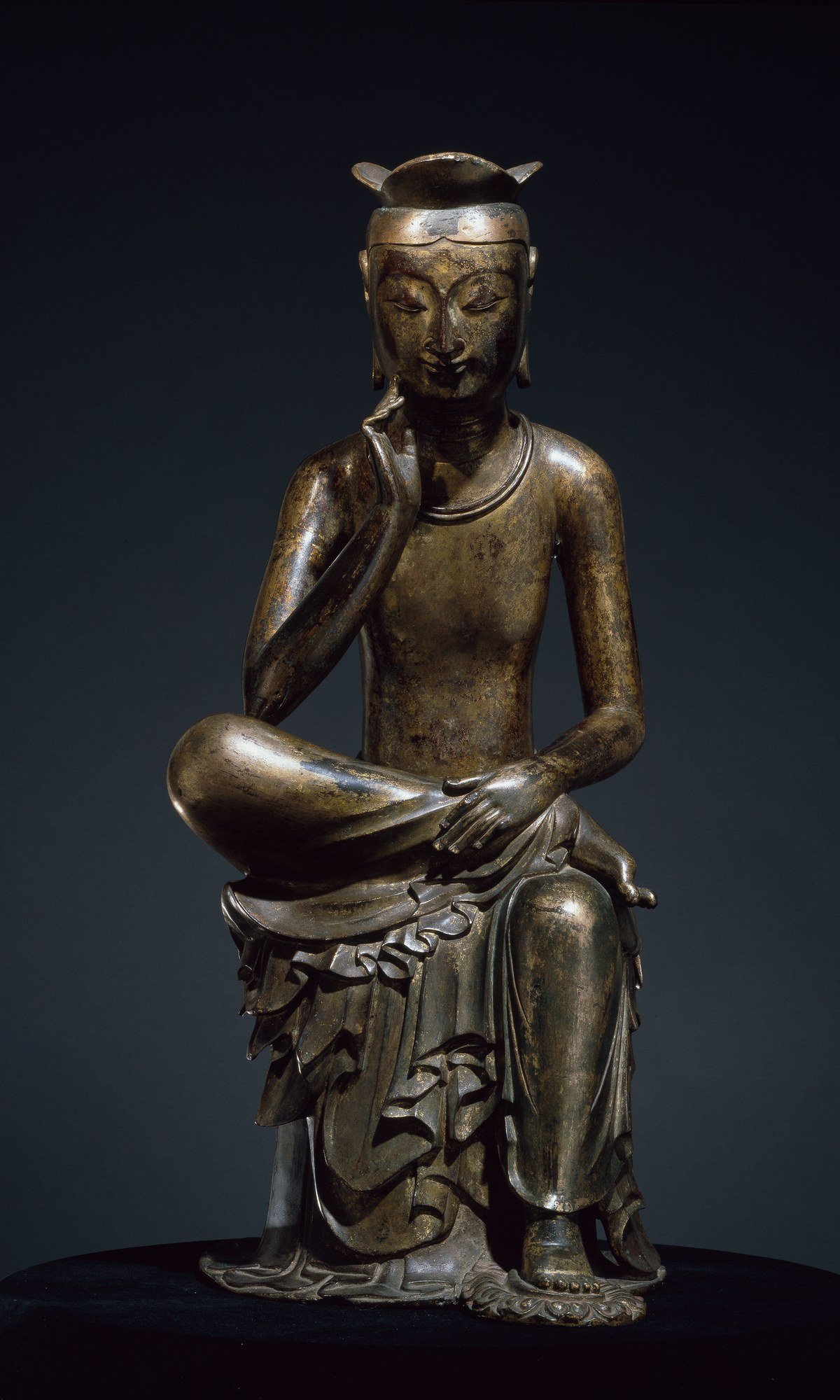
Pensive Bodhisattva (National Treasure No. 83)
A German student once stood before the Pensive Bodhisattva (National Treasure No. 83) in Seoul and reportedly wept — moved so deeply by its expression of quiet contemplation that he could not speak. That reaction speaks to something almost inexplicable: a seventh-century gilded figure, barely larger than a person’s torso, that somehow radiates more emotional presence than sculptures ten times its size.
Quick Facts
- Artist: Unknown
- Year: 7th century
- Medium: Gilt bronze
- Dimensions: Approximately 93.5 cm (height)
- Movement: Three Kingdoms Period
- Current location: National Museum of Korea, Seoul
What Makes Pensive Bodhisattva (National Treasure No. 83) So Unforgettable?
Most sacred sculptures from ancient Asia demand reverence through scale or grandeur. This one demands it through intimacy. The Pensive Bodhisattva (National Treasure No. 83) achieves something rare: it makes you feel like you have interrupted a private moment of thought.
The figure sits in a pose known in Korean as pan’gasayu — one leg crossed, the other pendant, one hand raised delicately to the cheek. It is a posture of thinking, of pausing on the edge of a decision. For a religious object, that is a radical choice. This is not a triumphant deity. This is a being still working something out.
Therefore, viewers across cultures and centuries connect with it instantly. The gesture is universal. We have all sat exactly like this, chin resting on a finger, lost in thought. However, here that gesture carries the weight of cosmic compassion — a future Buddha contemplating how to save all living beings. That collision of the deeply human and the profoundly divine is what sets this sculpture apart from almost everything else in Korean art history.
Historical Context
The seventh century on the Korean peninsula was a period of extraordinary creative and political energy. Three rival kingdoms — Goguryeo, Baekje, and Silla — competed not only militarily but culturally. Buddhism had arrived from China and rapidly became both a spiritual force and a tool of statecraft. Kings commissioned sacred objects to demonstrate piety, legitimacy, and sophistication.
In this charged atmosphere, gilt-bronze sculpture became a prestige medium. Craftsmen developed extraordinary technical skill, casting complex forms and applying gold leaf to surfaces with remarkable precision. The Pensive Bodhisattva (National Treasure No. 83) represents the peak of that tradition. Scholars debate whether it originated in Baekje or Silla, and that debate remains genuinely unresolved — which itself tells us something important. Both kingdoms produced work of this quality.
Buddhism’s concept of Maitreya, the future Buddha who waits in a heavenly realm before descending to enlighten humanity, held particular resonance in this era. For people living through war, displacement, and uncertainty, the idea of a compassionate figure actively thinking about how to help carried deep emotional meaning. In addition, the pensive pose — borrowed from earlier Chinese and Indian artistic traditions — found its most refined expression on the Korean peninsula during precisely this period.
Symbolism and What to Look For
Stand in front of this sculpture and first notice the hand. The right hand rises to meet the cheek with extraordinary lightness — the fingers barely touch the face. There is no tension here, no weight. The gesture suggests thought without effort, wisdom without strain.
Next, look at the face. The sculptor gave this figure a faint smile — not the broad grin of happiness, but the subtle, inward expression of someone who understands something deeply. Art historians sometimes call this the “archaic smile,” seen also in ancient Greek sculpture. Here, however, it feels less like a stylistic convention and more like genuine serenity.
The gilt surface deserves attention too. Even after fourteen centuries, traces of gold catch the light across the bronze. Originally, this figure would have blazed in lamplight inside a temple, its gilded body flickering against darkness. That visual drama was entirely intentional — gold signified the radiance of enlightenment, the light of a being who had transcended ordinary existence.
For example, notice the crown. It sits delicately on the head with two simple lotus-form ornaments. The lotus, rising clean from muddy water, symbolizes purity emerging from the impure world. Finally, observe the pendant leg resting on the lotus pedestal below — grounded in this world while the mind reaches toward another. Every element reinforces the same idea: a being balanced between the human and the transcendent.
About Unknown
We do not know who made the Pensive Bodhisattva (National Treasure No. 83). That anonymity is not unusual for this period — master craftsmen rarely signed their work, and their identities dissolved into the collective religious mission of creation. However, the skill evident in this sculpture tells us a great deal about whoever held the tools.
This was an artist of exceptional technical mastery and deep spiritual understanding. Casting bronze at this scale, achieving this delicacy of surface detail, and capturing this quality of emotional expression required years of training and genuine artistic vision. The unknown maker almost certainly worked within a royal or temple workshop, supported by patronage and part of a living tradition passed between generations of skilled hands.
In a meaningful sense, this sculptor’s greatest achievement was disappearing. The work feels timeless precisely because no individual personality pushes through it — only pure craft and pure intention.
Legacy and Influence
The Pensive Bodhisattva (National Treasure No. 83) did not simply survive history — it shaped it. The pensive bodhisattva type became one of the defining forms of Korean Buddhist art, inspiring countless later sculptures across the peninsula and influencing artistic exchange with Japan. Similar pensive figures appear in early Japanese Buddhist sculpture, reflecting the deep cultural connections of this era.
Today, the sculpture functions as something close to a national symbol. It appears on publications, in museum branding, and in cultural education across Korea. However, its influence reaches well beyond Korea’s borders. It regularly appears in global surveys of world art history as a masterwork of human creative achievement — not merely of Asian art, but of all art.
Furthermore, its emotional directness continues to inspire contemporary artists working across media. The universality of its central gesture — that quiet, thoughtful pause — speaks to anyone grappling with creativity, compassion, or simply the challenge of being alive.
Where to See Pensive Bodhisattva (National Treasure No. 83) Today
The Pensive Bodhisattva (National Treasure No. 83) is housed in the National Museum of Korea in Seoul, located in Yongsan-gu near the Han River. The museum is free to enter for its permanent collection, which makes it one of the world’s great cultural bargains.
Plan to arrive early on weekdays to avoid crowds around this particular piece. The sculpture sits in a dedicated space within the Buddhist art galleries, and the lighting is carefully controlled to show its gilt surface to best effect. Give yourself quiet time in front of it — resist the urge to rush.
While you are there, seek out the companion piece, National Treasure No. 78, another gilt-bronze pensive bodhisattva figure that invites direct comparison. Seeing both together deepens your understanding of how Korean craftsmen approached this form. The museum café and garden are also genuinely pleasant, making a full half-day visit very worthwhile.
Frequently Asked Questions
Where is the Pensive Bodhisattva (National Treasure No. 83) located?
It is permanently displayed at the National Museum of Korea in Seoul, South Korea, within the Buddhist sculpture galleries of the main building.
When was it created?
The sculpture dates to the 7th century, during Korea’s Three Kingdoms Period. The precise date and kingdom of origin remain subjects of scholarly discussion.
What does the Pensive Bodhisattva (National Treasure No. 83) represent?
It most likely depicts Maitreya, the future Buddha, in a moment of deep contemplation — pondering how to bring salvation and relief to all living beings before descending to earth.
Why is the Pensive Bodhisattva (National Treasure No. 83) so famous?
Its fame rests on the extraordinary combination of technical brilliance and emotional depth. The sculpture’s subtle smile and contemplative gesture create a feeling of genuine presence that moves viewers from every cultural background.
Is there more than one pensive bodhisattva sculpture in Korea?
Yes — National Treasure No. 78 is another celebrated gilt-bronze pensive figure, also housed at the National Museum of Korea. Comparing the two reveals fascinating differences in style and craftsmanship despite their shared subject matter.
If the Pensive Bodhisattva (National Treasure No. 83) has sparked your curiosity about the extraordinary world of Buddhist art and ancient Korean sculpture, we invite you to explore more masterworks right here on the site. Each artwork has its own story waiting to pull you in — follow the thread and see where it leads.
Image: Pensive Bodhisattva (National Treasure No. 83) – Unknown (7th century). License: Public Domain. Source: Wikimedia Commons.