The Second of May 1808
Most people know that a single painting can stop a war’s memory from fading — but few realize that The Second of May 1808 was completed six years after the battle it depicts, painted not as a commission but as Goya’s raw, unsolicited act of witness against tyranny.
Quick Facts
- Artist: Francisco Goya
- Year: 1814
- Medium: Oil on canvas
- Dimensions: 268 cm × 347 cm (105.5 in × 136.6 in)
- Movement: Romanticism
- Current location: Prado, Madrid
What Makes The Second of May 1808 So Unforgettable?
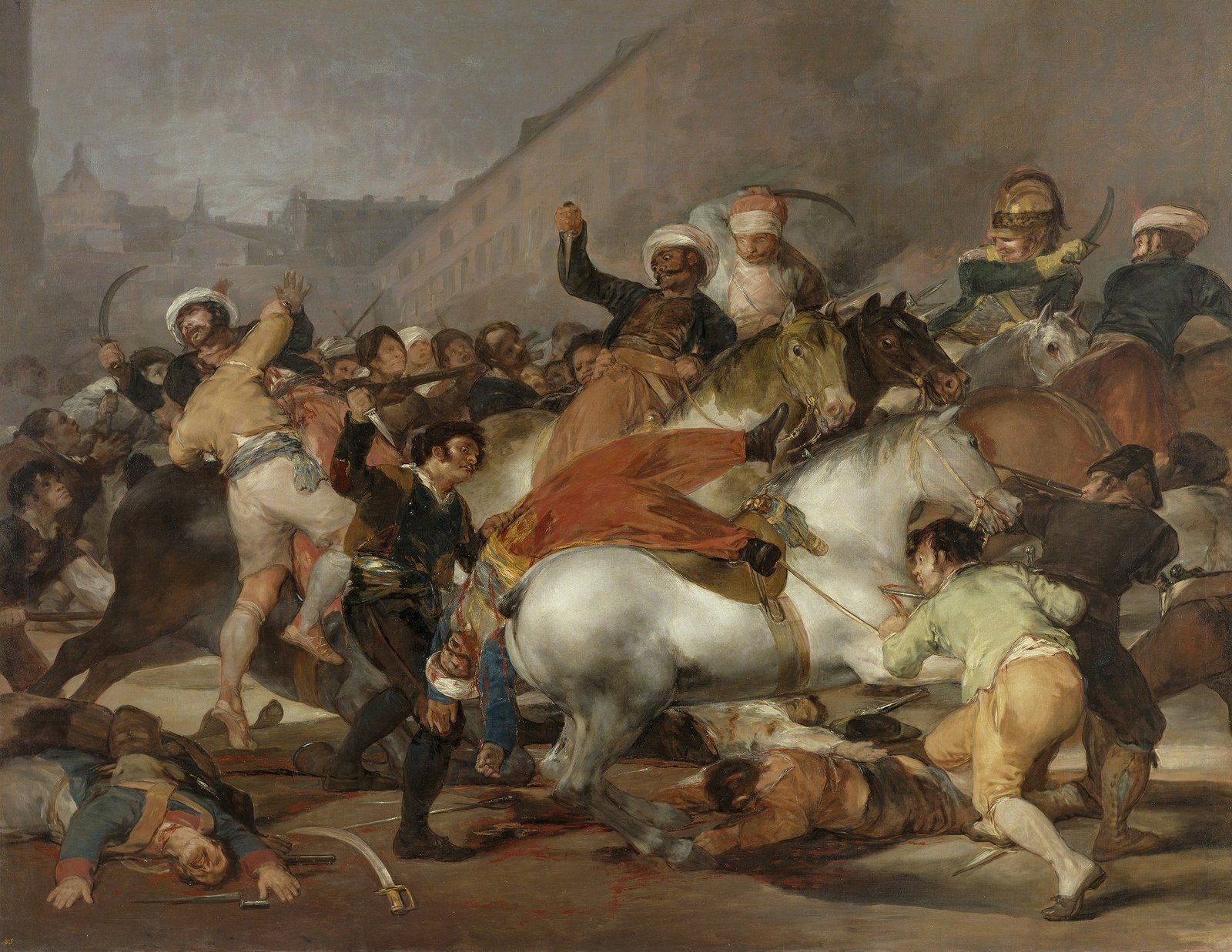
Most battle paintings of the era placed a heroic general at the center — someone on horseback, sword raised, glory guaranteed. Goya refused that formula entirely. In The Second of May 1808, there is no single hero. There is no clean narrative of victory.
Instead, Goya gives us chaos. Ordinary Madrileños — tradespeople, laborers, anonymous citizens — claw and stab at mounted Mameluke soldiers with whatever they have. The fighting is desperate, close, and ugly. This was radical for its time. Goya treated common people as the true protagonists of history, not as background figures.
The painting also refuses to romanticize violence. Every figure strains with real physical effort. The horses rear with genuine terror. The result is one of the earliest examples of modern war art — honest, visceral, and deeply human.
Historical Context
To understand The Second of May 1808, you need to understand the moment that shook Spain to its core. In 1808, Napoleon Bonaparte had maneuvered the Spanish royal family into exile and placed his brother Joseph on the Spanish throne. Madrid was under French occupation.
On May 2nd of that year, the people of Madrid rose up spontaneously against the occupiers. The uprising was fierce but brief. French forces, including their elite Mameluke cavalry — soldiers originally recruited from Egypt — crushed the rebellion within hours. The reprisals that followed on May 3rd were even more brutal.
Goya witnessed this period firsthand. He lived in Madrid throughout the occupation and the six-year Peninsular War that followed. However, he waited until 1814 — after Napoleon’s defeat and the restoration of Ferdinand VII — to paint his response. By then, the events had fermented inside him for years. The result was not a celebratory war panorama. It was something far more complicated and enduring.
In addition, the timing of the painting matters. Goya approached the restored Spanish government in 1814 and asked for funding to commemorate the uprising. He wanted the paintings displayed publicly. Therefore, there was a political dimension too — but the raw emotional power of the work transcended any official purpose.
Symbolism and What to Look For
Stand in front of The Second of May 1808 and let your eyes follow the chaos deliberately. Here is what rewards close attention.
The Mamelukes on horseback dominate the upper half of the canvas. Their horses are enormous, wild-eyed, and unstoppable-looking. Goya uses their size to convey the overwhelming power of the French military machine. For example, the rearing white horse in the center forces every other element to organize around it.
The civilian fighters cluster low in the composition — physically beneath the soldiers, yet fighting upward with extraordinary ferocity. Notice the man in the yellow breeches lunging with a knife. His expression is not heroic. It is desperate. That distinction is everything.
Color tells the story of power. The Mamelukes wear rich, exotic costumes — reds, blues, and golds that mark them as foreign and imperial. By contrast, the Madrileños wear drab working clothes. The color contrast reinforces the asymmetry of the fight.
The background is deliberately compressed. Goya gives no sense of open sky or escape. Buildings press in from behind. The crowd is dense and suffocating. This claustrophobic composition heightens the sense of panic and makes the violence feel inescapable.
Finally, look at the ground. Fallen figures already lie beneath the horses’ hooves. Goya does not let you forget the cost.
About Francisco Goya
Francisco José de Goya y Lucientes was born in Fuendetodos, Spain, in 1746. He rose through the ranks of Spanish court painting to become one of the most celebrated artists in Europe, serving as court painter to the Spanish Crown from 1786 onward.
However, Goya’s real significance lies in how dramatically his work evolved. An illness in 1792 left him profoundly deaf, and something shifted. His art grew darker, stranger, and more honest. He produced the devastating Disasters of War series, the unsettling Black Paintings, and the companion masterpiece to this work — The Third of May 1808.
Goya bridges two worlds. He belongs to the old European tradition of court portraiture and religious painting, yet he also anticipates modern art in his willingness to depict psychological darkness and political horror without flinching. He died in Bordeaux, France, in 1828, in self-imposed exile.
Legacy and Influence
The Second of May 1808 permanently changed what war painting could be. Before Goya, battle scenes typically glorified military commanders and national triumphs. After Goya, artists had permission — and a model — for depicting war as suffering, confusion, and moral ambiguity.
Édouard Manet studied Goya closely, and the influence appears in Manet’s own political works. Pablo Picasso, another Spaniard who felt the weight of war personally, drew deeply from Goya’s fearless approach when creating Guernica in 1937. The lineage is direct and powerful.
In Spain, The Second of May 1808 holds the status of a national icon. May 2nd is still commemorated annually in Madrid as a public holiday. The painting is not merely art history — it is living cultural memory.
Where to See The Second of May 1808 Today
The Second of May 1808 hangs permanently in the Museo Nacional del Prado in Madrid, Spain. It is displayed alongside its companion piece, The Third of May 1808, which makes visiting both on the same trip deeply rewarding.
The Prado is located on the Paseo del Prado, easily reachable by metro (Banco de España or Atocha stations). The museum opens Tuesday through Sunday. Monday closures catch many visitors off guard, so plan accordingly.
Arrive early or book timed tickets online to avoid the longest queues. The Goya rooms tend to draw significant crowds, particularly in summer. However, weekday mornings offer a noticeably quieter experience.
While you are there, explore the full scope of Goya’s work in the Prado’s collection — from his early tapestry cartoons to the haunting Black Paintings relocated from his country house. The contrast across his career is extraordinary.
Frequently Asked Questions
Where is The Second of May 1808 located?
The painting is housed in the Museo Nacional del Prado in Madrid, Spain, where it has been on display since the 19th century alongside its companion work, The Third of May 1808.
When was The Second of May 1808 created?
Goya completed the painting in 1814, approximately six years after the actual uprising took place. He painted it following Napoleon’s defeat and the restoration of the Spanish monarchy.
What does The Second of May 1808 represent?
It depicts the spontaneous uprising of Madrid’s citizens against French Mameluke soldiers on May 2nd, 1808. More broadly, it represents popular resistance against foreign occupation and the human cost of imperial violence.
Why is The Second of May 1808 so famous?
It is famous for its radical honesty. Goya replaced traditional battle-painting heroics with raw, chaotic street fighting. He made ordinary people — not generals — the center of history, creating one of the earliest examples of modern war art.
Who were the Mamelukes depicted in the painting?
The Mamelukes were an elite cavalry unit serving in Napoleon’s army, originally recruited from Egypt and the Ottoman Empire. Their exotic appearance and reputation for ferocity made them a powerful symbol of foreign imperial force in the painting.
If The Second of May 1808 has sparked your curiosity about Goya’s fearless vision, we invite you to explore more masterworks on this site — from his haunting companion piece The Third of May 1808 to the broader world of Romantic painting that forever changed how artists saw power, suffering, and truth.
Image: The Second of May 1808 – Francisco Goya (1814). License: Public Domain. Source: Wikimedia Commons.