The Third of May 1808
For the first forty years, nobody saw this painting. Commissioned in 1814, it went into storage and the first firm record of it hanging in the Prado dates from 1872. The reason was simple: Ferdinand VII, who paid for it, was building his legitimacy on the return of a rightful monarch — not on a popular uprising by people he went on to persecute.
Quick Facts
- Artist: Francisco Goya (1746–1828)
- Spanish title: El tres de mayo de 1808 en Madrid
- Year: 1814
- Medium: Oil on canvas
- Dimensions: 268 × 347 cm
- Movement: Romanticism, anticipating Realism
- Location: Museo del Prado, Madrid
What makes it unforgettable?
Battle painting before Goya showed the victors. Generals on horseback, standards, heroic poses.
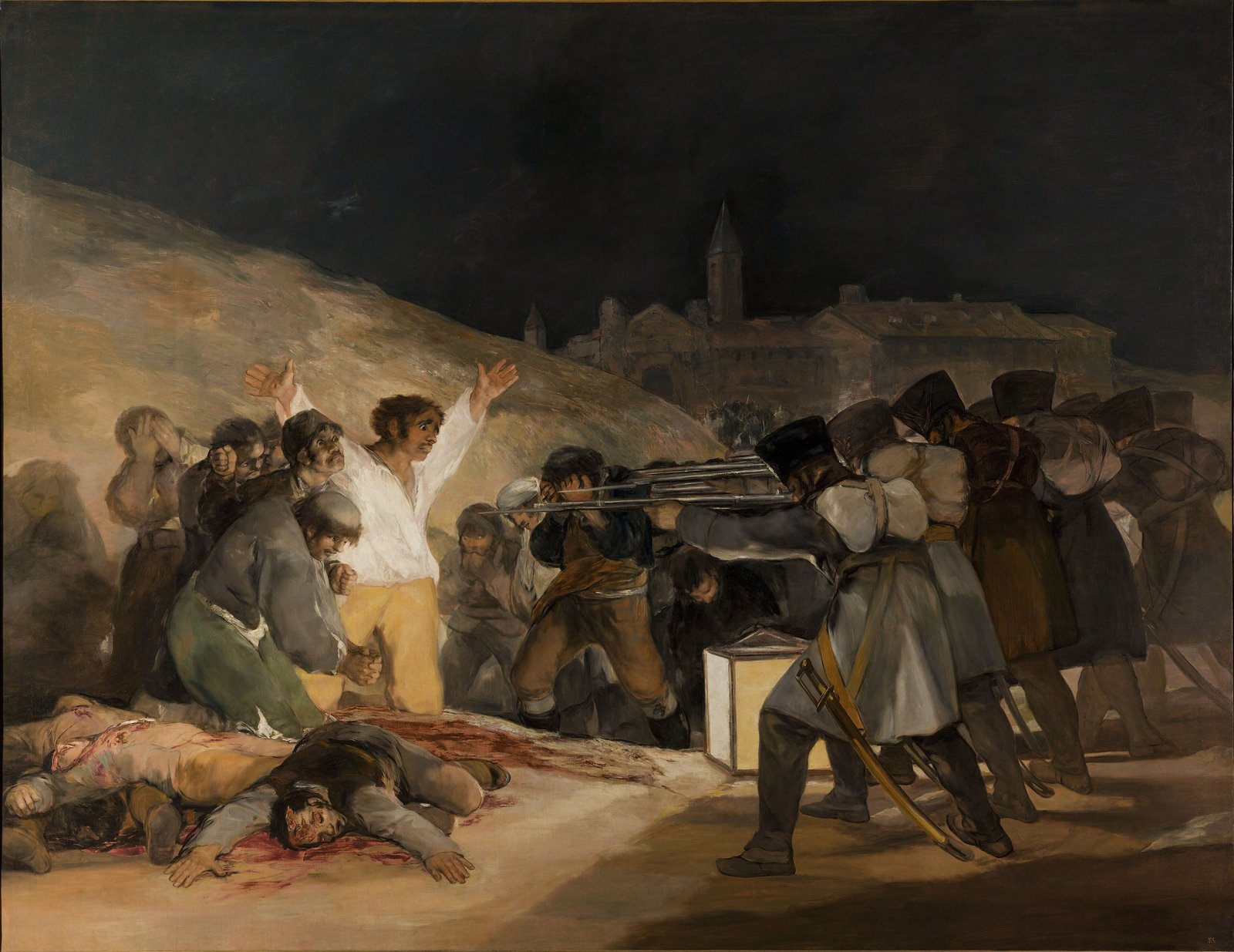
Goya reversed the camera. He painted the moment before death, from the side of the people about to die. There is no victory here, no glory, and no way of telling who will be shot next.
The central figure is anonymous. The man in the white shirt has no name and was never meant to have one.
The soldiers have no faces. We see them from behind, in identical uniforms, with rifles raised in the same line. They are not men; they are a mechanism. That choice is what allows the painting to work regardless of which war you happen to be thinking about — it does not accuse the French so much as the act itself.
Historical context
On 2 May 1808 the people of Madrid rose against Napoleon’s occupying troops. The rising was put down within a day.
The reprisals came that night and the following morning, at several sites including the hill of Príncipe Pío. Insurgents were shot, along with suspects and anyone found carrying a weapon — a knife was enough.
The war that followed lasted six years and was exceptionally brutal on both sides. The word “guerrilla” comes from it.
In February 1814, with the French in retreat, Goya himself approached the provisional government proposing to paint the uprising. He also asked for expenses and a salary while he worked — the document survives.
Two canvases resulted: The Second of May, showing the fighting against the Mamluk cavalry, and The Third of May, showing the consequences.
Why Goya needed to prove himself
This is the context that explains a great deal, and it is usually left out.
Goya had been court painter under Joseph Bonaparte too — Napoleon’s brother, installed on the Spanish throne. He painted French officials and accepted a decoration from the regime.
After Ferdinand VII’s return, such people were called afrancesados — Frenchified — and were subject to investigation.
Goya went through a formal enquiry and was cleared. But the proposal to paint the uprising came at precisely that moment. It is hard to separate the patriotic impulse from the need to demonstrate loyalty.
This does not diminish the painting. It does make it more complicated than the standard account of an artist bearing witness.
One further correction is worth making: there is no evidence Goya saw the executions. The anecdote about him sketching at night by lantern light appeared in the nineteenth century and is not documented.
What to look for
The lantern. A large cubic lamp on the ground, the only light source. It works like a stage light — picking out the victims and leaving the soldiers in shadow.
The hands. Arms flung wide in a posture that reads as crucifixion. On the right palm there is a dark mark that scholars interpret as a reference to the stigmata.
The monk. Among the condemned, a friar kneels with his hands clasped. Easy to miss, and it changes the scene: clergy were shot too.
The body in the foreground. Face down in a pool of blood, in a position nobody could have posed. The most literal passage in the painting.
The queue behind. On the left, another group is being brought forward. One man covers his eyes. The killing does not stop with this row.
The town. A dark silhouette of buildings behind — probably a monastery. Shuttered. Nobody is watching.
The handling. Goya worked fast and broadly, in places almost violently. Up close, the white shirt is a handful of strokes. This is not a finished surface.
What happened to the painting
The history after 1814 is peculiar.
It was not put on public display for decades. The first reliable record of both canvases hanging in the Prado comes from an 1872 catalogue — fifty-eight years after they were painted.
Ferdinand VII had no use for an image of the common people fighting. His legitimacy rested on divine right, not popular resistance.
In 1936, at the outbreak of the Civil War, the Prado’s collection was evacuated. Both Goya canvases were taken by lorry to Valencia, then further east. During transport in 1938 this painting was damaged — losses on the left side have never been fully restored and can still be seen.
The Second of May suffered far worse and required extensive reconstruction.
The paintings returned to Madrid in 1939 after an international rescue operation conducted under the auspices of the League of Nations.
About Francisco Goya
Born in Fuendetodos, Aragon, in 1746. He began with tapestry cartoons for the royal manufactory and rose to First Painter to the Crown in 1799.
A severe illness in 1793 left him permanently deaf. After that his work divided in two: official portraits in public, and privately the Caprichos, the Disasters of War, and eventually the Black Paintings.
He left for France in 1824 and died in Bordeaux four years later, aged eighty-two.
Legacy and influence
The painting set the terms for how art responds to atrocity: show the victim, not the perpetrator.
Manet quoted it almost directly in The Execution of Emperor Maximilian in 1868 — the same arrangement, the same firing squad, the same facelessness.
Picasso studied it before Guernica, and in 1951 painted Massacre in Korea, which is a direct reworking of Goya’s composition.
The influence reaches beyond painting. The principle of showing the victim rather than the aggressor became foundational to war photography, from Capa to Vietnam.
Kenneth Clark called it the first great picture that can be called revolutionary in every sense of the word.
Where to see it today
The painting hangs in the Museo del Prado in Madrid, beside its companion, The Second of May 1808.
- The Prado opens on Mondays as well: Monday to Saturday 10–20, Sundays and holidays 10–19. Hours change from time to time.
- Admission is free for the last two hours of each day. These places cannot be reserved, and a queue forms well beforehand.
- See the two canvases in order — the fighting first, then the executions. They were conceived as a pair and work that way.
- Look at the left side of the painting for traces of the 1938 damage.
- Also in the museum: Saturn Devouring His Son, The Nude Maja, and Velázquez’s Las Meninas.
Frequently asked questions
Did Goya witness the executions?
There is no evidence that he did. The story of him sketching at the scene by lantern light appeared in the nineteenth century and is undocumented. The painting was made six years after the event.
Who is the man in the white shirt?
Nobody in particular. Goya painted a type rather than a person. The anonymity is deliberate, not a gap in the record.
Why was the painting not exhibited for so long?
Because Ferdinand VII, who commissioned it, based his legitimacy on the restoration of a rightful king rather than on a popular rising. The first firm record of it on display at the Prado dates from 1872.
Has the painting been damaged?
Yes. During the evacuation of the Prado’s collection in the Spanish Civil War, the canvas was damaged in transit in 1938. Losses on the left side were never fully restored.
Did Goya work for the French?
He served as court painter under Joseph Bonaparte and accepted a decoration from that regime. After Ferdinand VII’s return he was investigated and cleared — and it was at that point that he proposed painting the uprising.
Which works refer to it?
Manet’s Execution of Emperor Maximilian (1868) and Picasso’s Massacre in Korea (1951), among others. The composition also shaped twentieth-century war photography.
If this painting has affected you, look next at Saturn Devouring His Son — made by the same artist six years later, on the wall of his own house, for no one but himself.
Image: The Third of May 1808 – Francisco Goya (1814). License: Public Domain. Source: Wikimedia Commons.