The Tower of Babel
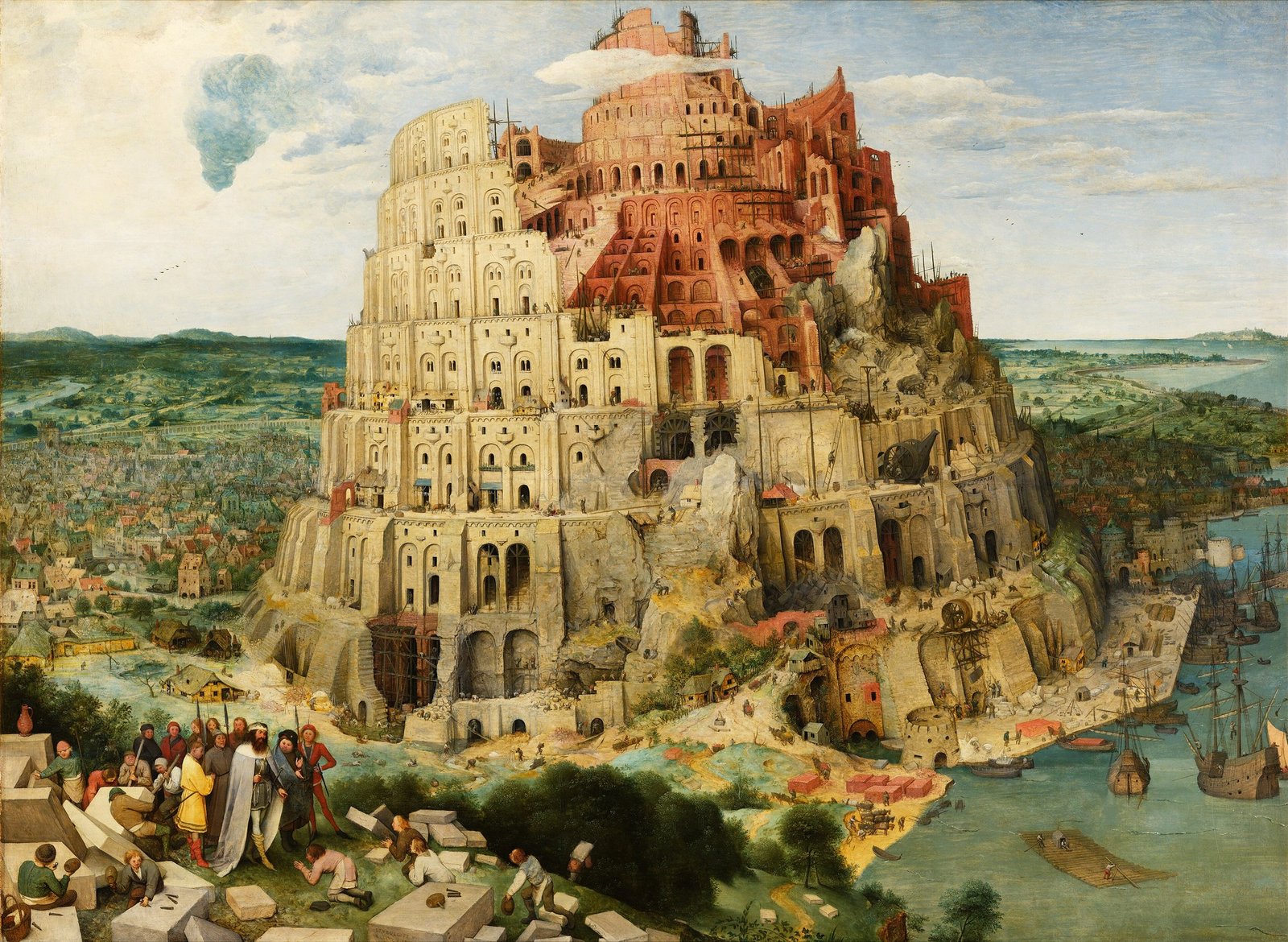
This tower is not falling because God is angry. It is falling because it was built wrong, and you can see the mistake in every arch. Bruegel drew a structure raised on an uneven base: successive storeys are not parallel, one side is settling into the ground, and the arcades on the lower levels are already deformed. It is the most carefully rendered structural failure in the history of painting.
Quick Facts
- Artist: Pieter Bruegel the Elder (c. 1525–1569)
- Dutch title: De toren van Babel
- Year: 1563
- Medium: oil on oak panel
- Dimensions: 114 × 155 cm
- Movement: Northern Renaissance
- Location: Kunsthistorisches Museum, Vienna
What makes it unforgettable?
Painters before Bruegel usually showed the catastrophe: lightning, fire, collapsing walls.
Bruegel painted a building site in full operation. Treadwheel cranes are turning, workers are hauling blocks, men stand on scaffolding. Nothing has gone wrong yet.
And yet everything is already decided — not by divine intervention but by engineering.
Bruegel understood construction. The painting contains dozens of technically accurate details: treadwheel cranes driven by men walking inside the drum, scaffolding, wedges, ramps, vault construction. Engineers have analysed it as a credible record of sixteenth-century building practice.
Which is exactly why it is obvious that this cannot work.
Why the tower is crooked
This is the most interesting thread in the picture and it is rarely spelled out.
The base sits on rock, but unevenly. The right side grows out of a natural outcrop; the left rests on ground. Settlement is already visible.
The storeys are not parallel. Each successive ring is slightly rotated relative to the one below. The builders tried to correct the tilt by laying each new course level — which made it worse.
The arches are deformed. On the lower levels the arcades lose their regularity; some are compressed, others stretched.
The upper storeys are still raw while the lower ones are finished and occupied — in places you can see windows, doors and washing hung out. People are living in a building that is subsiding.
In other words: this is not a painting about punishment but about pride leading to a technical error. God does not need to intervene. Physics will do it.
Historical context
1563. The Low Countries were under Habsburg rule, religious tension was rising, and three years later the iconoclastic revolt broke out.
Bruegel was living in Antwerp — one of the richest cities in Europe, a port, polyglot, full of merchants from across the continent.
That multilingualism matters. Antwerp was a city where dozens of languages were spoken at once. A story about the confusion of tongues had a very concrete resonance there.
The city had just begun building a new town hall — an enormous prestige project — and work was under way on the fortifications.
A word on the politics. Some scholars read the painting as a comment on Habsburg rule or on Roman Catholicism — the tower’s form is modelled on the Colosseum, and Rome was for Protestants the symbol of imperial ecclesiastical pride. There is no proof of such an intention, but the association was available to contemporaries.
What to look for
Nimrod. Lower left, crowned, with a retinue. Stonemasons kneel before him. The Bible does not connect Nimrod with the Tower of Babel — that is a later tradition, taken from Josephus.
The cranes. Huge treadwheels driven by men walking inside them, visible on several levels. Genuine period technology.
The inhabitants. In the finished sections there are open windows, laundry, smoke from chimneys. The tower is already lived in.
Ships in the harbour. Lower right, at the foot. The city with its port is Antwerp — Bruegel set the biblical story in his own town.
The clouds. The summit reaches cloud level and partly disappears into it. The highest point of the painting, and the only place the building touches the sky.
Scale. Count the figures on the scaffolding against the arches. Bruegel kept the proportions consistent throughout, which is why the tower reads as genuinely enormous.
The quarry. Lower left, at the base, workers are still cutting blocks from the living rock. The building is growing out of the hill it is made from.
Three towers
Bruegel painted this subject at least twice, and a third version is lost.
The Vienna version of 1563, described here, is the larger and brighter. It has Nimrod, the harbour and construction visibly under way.
The Rotterdam version, around 1568, in the Museum Boijmans Van Beuningen, is smaller, darker and more disturbing. There is no ruler and no port. The tower is closer to completion and noticeably more tilted.
The third, a miniature on ivory, is known only from an inventory of a Roman collection and has disappeared.
Setting the two surviving paintings side by side shows how Bruegel sharpened the subject: from a spectacular building site to a grim mass with no figures in the foreground.
About Pieter Bruegel the Elder
Born around 1525, probably near Breda. He became a master in the Antwerp Guild of Saint Luke in 1551.
Between 1552 and 1554 he travelled through the Alps to Italy, reaching Rome and Sicily. He saw the Colosseum, which became the model for this tower.
The nickname “Peasant Bruegel” is misleading. His buyers were wealthy burghers, bankers and humanist scholars, and he moved in Antwerp’s intellectual circles.
He died in Brussels in 1569, aged about forty-four. Around forty-five paintings survive.
Both sons became painters: Pieter the Younger copied his father’s works, Jan developed a style of his own.
Legacy and influence
Bruegel’s image of the Tower of Babel dominated the Western imagination. When someone says “Tower of Babel” today, most people see this painting rather than any other.
The motif recurs in literature, film and games as shorthand for an ambitious project heading for collapse.
It has a political life too. It has served as an emblem of the European Union, used by supporters and critics alike. A European Parliament poster in the 1990s drew on this iconography and caused considerable argument.
In painting, Bruegel set the pattern for combining epic scale with minute detail: hundreds of scenes the size of a fingernail in a single composition.
Where to see it today
The painting hangs in the Kunsthistorisches Museum on Maria-Theresien-Platz in Vienna.
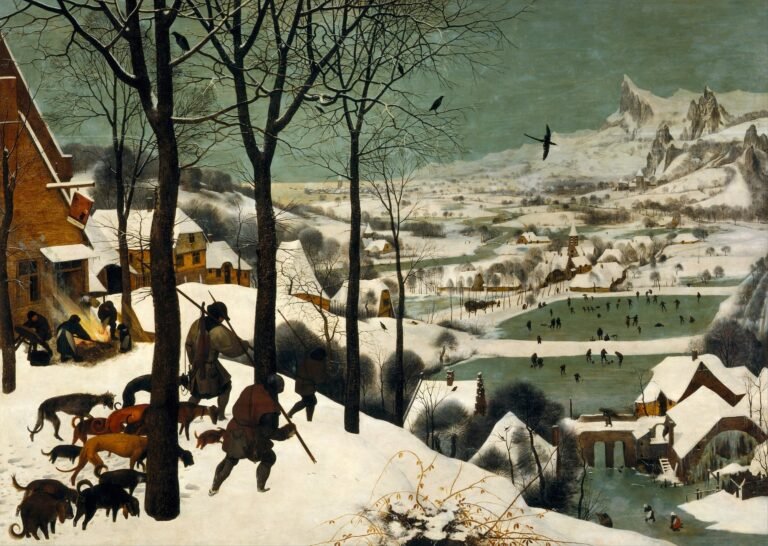
- This museum holds the largest Bruegel collection in the world — roughly a third of all surviving paintings, including Hunters in the Snow, The Return of the Herd, The Fight Between Carnival and Lent and Children’s Games.
- Closed on Mondays outside the summer season. Check hours and prices before travelling.
- Get very close. The whole point of this painting is in the detail: the cranes, the windows, the laundry, the masons. From three metres you see only a mass.
- Then step back and look at the silhouette. The tilt is only visible from a distance.
- The museum’s staircase carries murals by the young Klimt and is worth attention in its own right.
The second version is in the Museum Boijmans Van Beuningen in Rotterdam — check availability, as the museum is undergoing a long renovation and shows parts of the collection elsewhere.
Frequently asked questions
Why is the tower crooked?
Because Bruegel drew a structural failure. The base is settling unevenly, successive storeys are not parallel, and the arches on the lower levels are already deformed. The catastrophe follows from physics, not from divine intervention.
How many versions did Bruegel paint?
Two survive: the larger Vienna panel of 1563 and a smaller, darker one of about 1568 in Rotterdam. A third, a miniature on ivory, is lost.
Who is the crowned figure?
Nimrod, identified by post-biblical tradition as the tower’s instigator. Genesis itself does not link him to it — the connection comes from Josephus and became standard in the Middle Ages.
Why does the tower resemble the Colosseum?
Because it is modelled on it. Bruegel saw the Colosseum in Rome in the 1550s. For contemporaries the association with a fallen empire was legible.
What city is at the foot of the tower?
Antwerp, or a city modelled on it — the port, the shipping and the street pattern correspond to the painter’s own town.
Is anyone living in the tower?
Yes. In the finished lower sections you can see windows, doors, laundry hung out and smoke from chimneys. The lower storeys are occupied while the upper ones are still being built.
If this painting has caught your interest, look next at Hunters in the Snow by the same artist, painted two years later and hanging in the same museum — built on the same principle: hundreds of small scenes that only appear at close range.
Image: The Tower of Babel – Pieter Bruegel the Elder (1563). License: Public Domain. Source: Wikimedia Commons.