The Fighting Temeraire
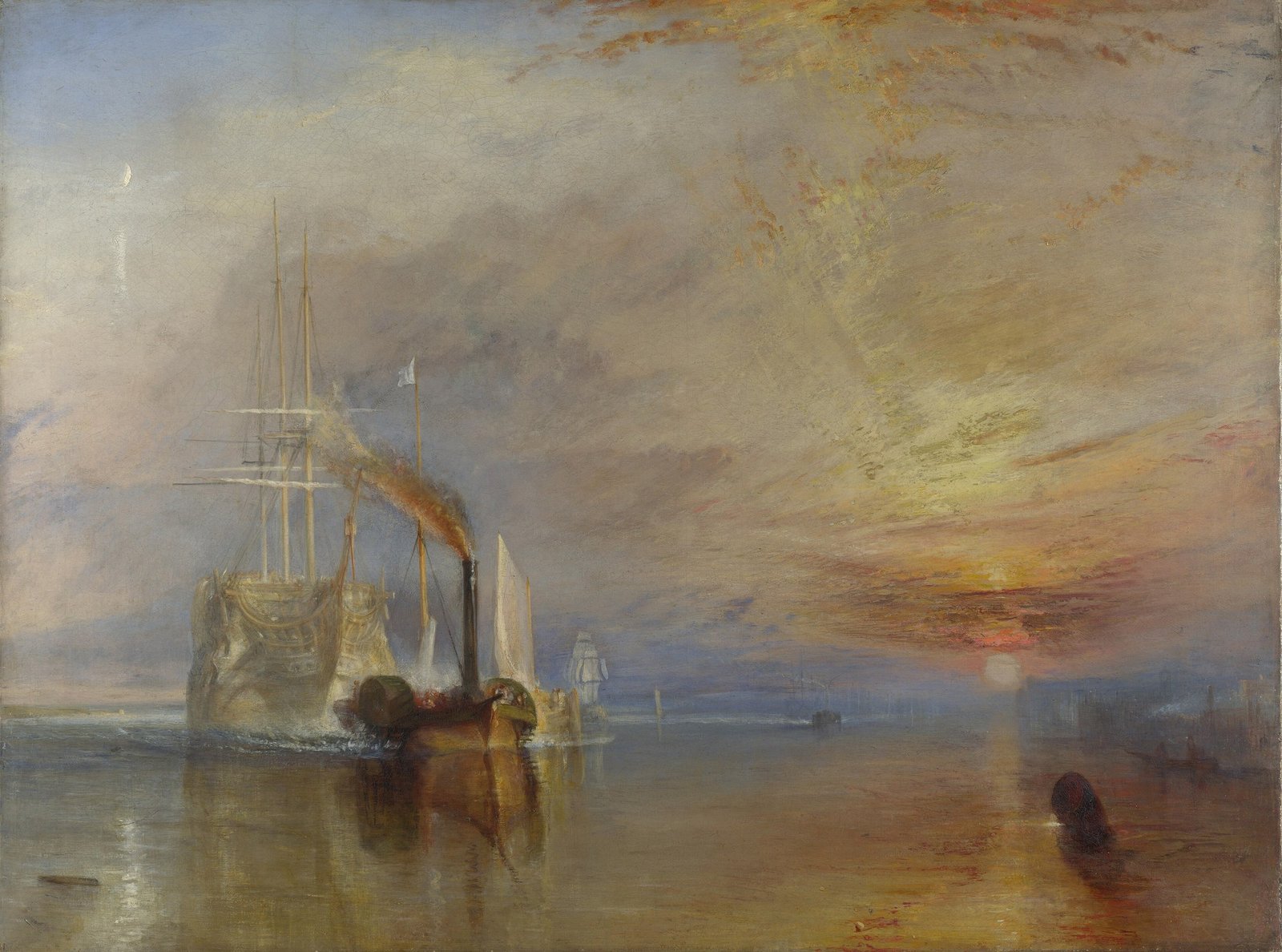
This ship could not have looked like this. Before the Temeraire was sold for breaking, everything had been stripped from her: masts, rigging, guns, even part of the planking. What went up the Thames was a bare hull. Turner gave her masts back — and set her sailing towards the sunset, though in reality she was moving west, up-river, with the sun behind her.
Quick Facts
- Artist: J. M. W. Turner (1775–1851)
- Full title: The Fighting Temeraire tugged to her last berth to be broken up
- Painted: 1838; exhibited 1839
- Medium: oil on canvas
- Dimensions: 90.7 × 121.6 cm
- Movement: Romanticism
- Location: National Gallery, London
What makes it unforgettable?
The scene is banal: two vessels on a river. The effect is among the strongest in British painting.
The tension comes from the pairing. A small black tug, smoking, tows an enormous white sailing ship. The new thing is ugly and efficient. The old thing is beautiful and finished.
Turner supplied no commentary. There is no crowd, no weeping sailors, no inscription. Only two shapes and the light.
Look at how the ship itself is painted. It is pale, almost transparent, laid in thin washes through which the ground shows. The tug is the opposite: dark, dense, with the red of its funnel loaded on thickly.
A ghost and a machine.
What Turner changed
This is the richest layer of the painting, because almost nothing in it matches the record.
The masts. The Temeraire was stripped bare before sale. She travelled as an empty hull, without masts or rigging. Turner gave her slender masts and yards.
The direction. The tow ran from Sheerness up the Thames, westward, to Rotherhithe. In the painting she sails towards the setting sun — which, by the geography of the scene, is the direction she could not have been coming from.
The time of day. The two-day operation began in the morning. The sunset is a choice.
The number of tugs. There were two. Turner painted one.
The colour. The hull was most likely painted in the black-and-yellow bands standard in the Royal Navy. Turner made it white and gold.
The funnel. On the tug it stands forward of the mast — structurally impossible. Turner moved it to improve the rhythm of the verticals.
In other words, this is not reportage. Whether Turner saw the tow at all is disputed — the story that he sketched it from a boat comes from later accounts and is not documented. He built a scene that never happened.
Who the Temeraire was
The reputation has a specific source.
HMS Temeraire was a 98-gun ship of the line, launched in 1798.
At Trafalgar, on 21 October 1805, she sailed immediately astern of Nelson’s flagship. When Victory came under pressure, the Temeraire drew fire onto herself and engaged two French ships at once — Redoutable and Fougueux — capturing both.
British accounts gave her the name Fighting Temeraire.
She later served as a prison ship and a depot. In 1838 the Admiralty sold her for breaking to the shipbreaker John Beatson for £5,530.
Breaking her up took nearly two years. Her timber went into buildings and furniture across London — some of it into the church at Rotherhithe, where it remains.
What to look for
The divided sky. A blazing sunset on the right; on the left a pale moon in a grey sky. Two light sources, two temperatures, two times of day at once.
The buoy. Lower right, a black buoy on the water. Unobtrusive, and it anchors the composition.
The smoke. Black and churning, blown from the tug’s funnel directly towards the warship. The only violent element in a calm scene.
Sails in the distance. To the right, small sailing craft — the world the Temeraire belonged to.
The handling. Come close. The sky is built up thickly, in places worked with a knife. The ship is thin and fluid by contrast.
The water. Reflections blur the boundary between river and sky. The signature of late Turner.
Historical context
1839. The Industrial Revolution was at full pitch: railways spreading at speed, steamers displacing sail, Britain changing faster than at any point in its history.
Turner showed the painting at the Royal Academy in 1839 with a modified couplet from Thomas Campbell’s poem about a ship whose glory had passed.
It was received with enthusiasm. Thackeray wrote that it was the most beautiful painting ever produced by the greatest living painter.
Turner was sixty-four and at the height of his reputation.
He never sold it. He refused every offer, called it his favourite work, and left it to the nation with the rest of his studio.
About J. M. W. Turner
Born in 1775 in Covent Garden, the son of a barber. His mother died in an asylum.
He entered the Royal Academy Schools at fourteen and became a full Academician before he was thirty.
He travelled constantly across Europe, filling hundreds of sketchbooks. The story that he had himself lashed to a mast during a storm to observe the weather comes from Turner himself and is unverified.
His late paintings were unreadable to many critics. Constable said Turner painted with tinted steam — an insult that became a description of method.
He lived secretively. In his last years he lodged in Chelsea under a false name, as “Mr Booth”.
He died in 1851. He left the nation around three hundred oil paintings and nearly thirty thousand works on paper — the core of the Tate’s holdings.
Legacy and influence
Turner fed directly into Impressionism. Monet and Pissarro saw his paintings in London in 1870, having fled the Franco-Prussian War, and Monet later described the encounter as a revelation.
In 2005 the painting won a BBC Radio 4 poll for the nation’s favourite painting in a British collection.
In 2020 it went onto the Bank of England’s twenty-pound note, alongside a self-portrait of Turner.
In Skyfall (2012), Bond and Q meet in front of it at the National Gallery, and Q remarks on the inevitability of time — the scene that sets up the film’s theme.
Where to see it today
The painting is at the National Gallery on Trafalgar Square. Entry to the permanent collection is free.
- Room numbering changed with the rehang completed in 2025 — use the plan on site or the gallery’s app.
- Weekday mornings are quietest.
- Get very close to the sky, then walk away. At half a metre you see thick paint and tool marks; at five metres it becomes a sunset.
- In the same gallery: Rain, Steam and Speed by Turner and The Hay Wain by Constable — setting the two against each other is one of the better things this building offers.
- The main Turner collection is elsewhere — at Tate Britain, twenty minutes’ walk along the river, where the Clore Gallery holds several hundred works.
If you want to see what is left of the ship: furniture made from her timbers is in St Mary’s church, Rotherhithe.
Frequently asked questions
Is the scene historically accurate?
No. The ship was towed without masts, in the opposite direction, at a different time of day, and by two tugs rather than one. Turner added the masts, reversed the orientation and set a sunset behind the destination.
Did Turner witness the tow?
It is not established. The account of him sketching from a boat appears in later sources and is not documented.
What was the Temeraire?
A 98-gun ship of the line which at Trafalgar in 1805 shielded Nelson’s flagship and captured two French vessels, earning the name Fighting Temeraire.
What does the double light mean?
The sun sets on the right while the moon rises on the left. Two times of day in one image — a symbolic device marking the end of one era and the start of another.
Did Turner sell the painting?
No. He refused all offers, kept it to the end of his life, and bequeathed it to the nation along with the contents of his studio.
Where does it appear in public life?
On the Bank of England’s twenty-pound note, issued in 2020, and in the 2012 film Skyfall. It also won a 2005 BBC poll for the nation’s favourite painting.
If this painting has caught your interest, look next at Rain, Steam and Speed — painted five years later and hanging in the same gallery. There Turner has stopped mourning the machine and started admiring it.
Image: The Fighting Temeraire – J. M. W. Turner (1838). License: Public Domain. Source: Wikimedia Commons.