The Kiss
Every year, millions of people stand before a single painting and feel something close to breathless — yet most of them don’t realise that the glittering gold surface they’re admiring isn’t paint at all, but actual gold leaf, applied by an artist who grew up watching his father engrave the same metal for a living.
Quick Facts
- Artist: Gustav Klimt
- Year: 1907–1908
- Medium: Oil on canvas with gold leaf, silver, and platinum
- Dimensions: 180 cm × 180 cm (70.9 in × 70.9 in)
- Movement: Art Nouveau
- Current location: Belvedere, Vienna
What Makes The Kiss So Unforgettable?
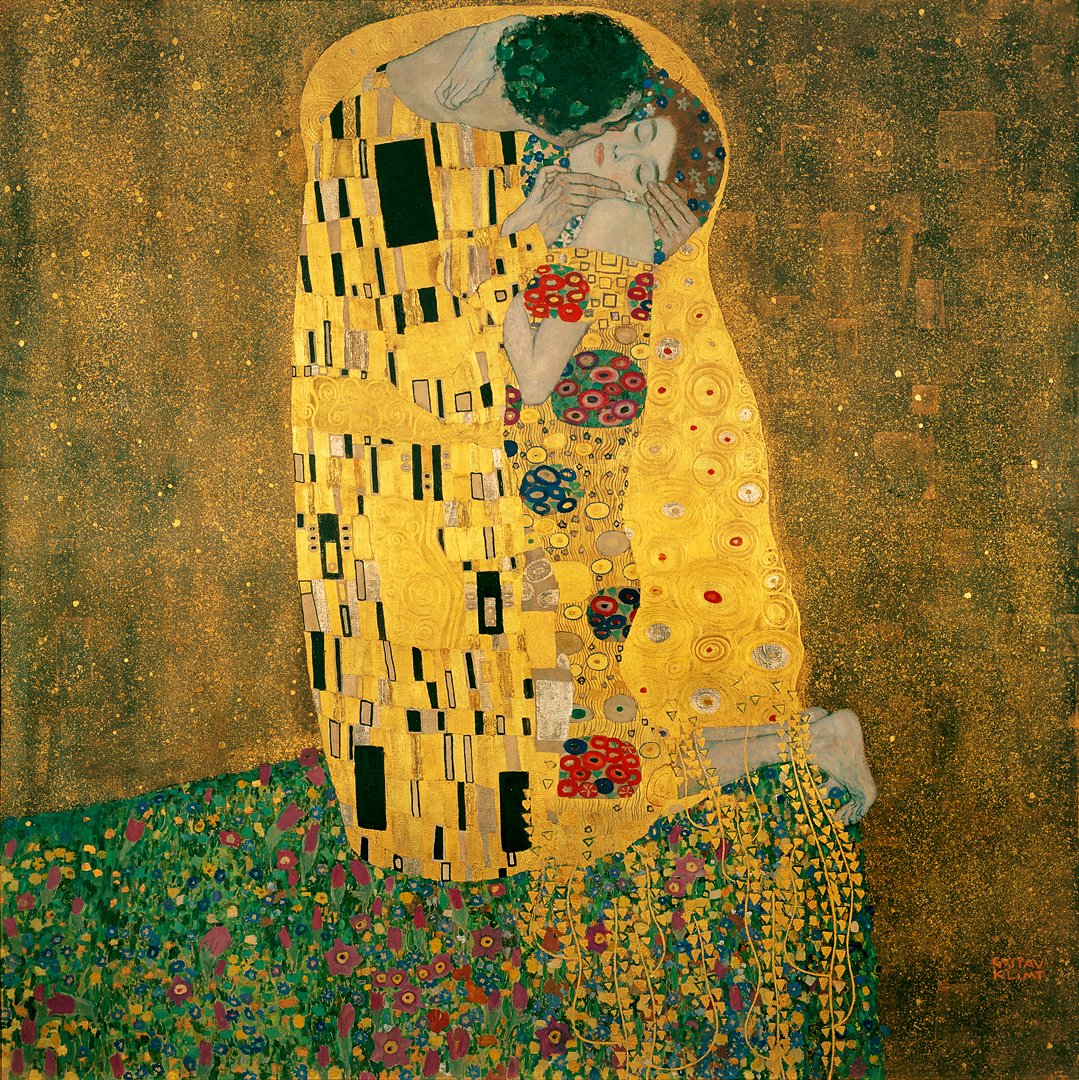
There are thousands of paintings depicting romantic love, but The Kiss does something almost none of them attempt: it dissolves the boundary between two people entirely. The couple doesn’t simply embrace — they merge. Their robes flow together into one continuous, shimmering mass of gold so completely that you can barely tell where one body ends and the other begins.
This is the painting’s radical move. Klimt wasn’t interested in showing two separate individuals sharing a moment. He was painting the feeling of total surrender — the way intense love collapses the self. The golden cocoon they share isn’t decoration. It’s a metaphor made visible.
What also sets The Kiss apart is its almost total rejection of deep space. The background is a flat, luminous gold that pushes the couple forward, pressing them almost uncomfortably close to the viewer. There’s no landscape, no room, no context — just this eternal, hovering moment suspended outside of time.
Historical Context
Klimt completed The Kiss between 1907 and 1908, at the absolute peak of his so-called Golden Period — a phase of his career when he was obsessed with integrating real precious metals into his work. Vienna at this time was one of the most intellectually and culturally charged cities in the world. Sigmund Freud was rewriting how people understood desire and the unconscious. Arthur Schnitzler was scandalising theatre audiences with frank depictions of sexuality. And artists across Europe were tearing down the stuffy conventions of academic painting.
Klimt was right at the centre of this upheaval. He had co-founded the Vienna Secession movement in 1897, a breakaway group of artists who rejected the conservative establishment and embraced radical new aesthetics. By the time he painted The Kiss, he had already caused public scandal with his allegorical ceiling paintings for the University of Vienna, which were considered far too erotic and subversive.
The Kiss was first exhibited publicly in 1908 under the title Liebespaar — meaning “Lovers” — as part of the Kunstschau Vienna exhibition. The response was extraordinary. The Austrian state purchased it almost immediately, a rare honour, and it has remained in Vienna ever since. In a city debating the nature of love, identity, and modernity, this golden vision of human connection struck a profound nerve.
Symbolism and What to Look For
Stand in front of The Kiss and give yourself permission to slow down. Here’s what to hunt for.
The flowers beneath their feet. Look at the very bottom of the canvas. The couple kneels on a blossoming meadow that ends abruptly at a cliff’s edge. That floral carpet feels lush and alive — but the drop below is implied. Even in this golden paradise, there’s a sense of precariousness.
The difference in their robes. His robe is decorated with bold, rectangular black-and-white geometric patterns — assertive, angular, masculine. Hers flows with soft, circular floral motifs — curved and organic. Klimt uses pattern like a visual language to distinguish their identities even as their forms merge.
Her closed eyes and tilted face. She’s not actively kissing — she’s receiving, surrendering, eyes shut. Her expression is peaceful but also slightly ambiguous. Is it bliss? Resignation? Klimt leaves just enough uncertainty to keep you looking.
The halo of gold. The couple’s heads are surrounded by a subtle aureole of warm gold — a deliberate nod to Byzantine religious iconography. Klimt had travelled to Ravenna in 1903 and studied its glittering mosaics closely, and he brought that sacred visual language into an intensely secular, erotic subject. Love, he seems to suggest, is its own kind of religion.
The way the surface behaves. This is the part no reproduction can give you. Gold leaf is not a colour but a mirror: it changes as you move, catching light from one angle and going flat from another. Klimt built the painting for a viewer who walks around it, which means every photograph of The Kiss is a record of one arbitrary moment out of hundreds.
About Gustav Klimt
Gustav Klimt was born in Baumgarten, near Vienna, in 1862, the second of seven children in a family of modest means. His father was a gold engraver — a detail that feels almost too perfectly symbolic given what Klimt would later create. He trained at the Vienna School of Arts and Crafts and spent his early career painting murals and decorative schemes with his brother Ernst and colleague Franz Matsch.
After Ernst’s death in 1892, Klimt went through a profound artistic crisis and emerged with an entirely new vision. He became a founding member of the Vienna Secession and began developing the highly ornamented, symbol-laden style for which he is now famous. His Golden Period, spanning roughly 1899 to 1910, produced his most iconic works — including Portrait of Adele Bloch-Bauer I and, of course, The Kiss.
Klimt never married, but he had numerous relationships and reportedly fathered several children. He died in February 1918, following a stroke, just as the old Austro-Hungarian world he had decorated so brilliantly was collapsing around him.
Legacy and Influence
The Kiss has had an almost unparalleled cultural afterlife. It has been reproduced on everything from museum posters to phone cases, from chocolates to wedding invitations — making it one of the most commercially reproduced artworks in history, rivalling even the Mona Lisa in terms of everyday visibility.
But its influence runs deeper than merchandise. Klimt’s integration of fine art with decorative craft had a lasting impact on design movements throughout the twentieth century. His flat, patterned surfaces and rejection of perspective influenced early modernists, while his lush symbolism gave the Expressionists something to push against.
In recent years, The Kiss has also become a touchstone in conversations about intimacy, gender, and the representation of love — studied by scholars and reclaimed by artists exploring everything from queer romance to digital abstraction.
Klimt built the surface for how it behaves in front of a moving viewer — which raises the obvious question of what happens inside that viewer. Neuroscience has an answer, and it is stranger than you might expect.
Where to See The Kiss Today
The Kiss lives permanently in the Österreichische Galerie Belvedere in Vienna, housed in the magnificent Upper Belvedere palace. It occupies a room almost entirely to itself, and the painting’s true scale — a perfect square measuring 180 by 180 centimetres — is impossible to appreciate in reproduction. Seeing it in person is genuinely transformative.
The Belvedere is open daily, with extended hours on certain evenings. Book tickets online in advance, especially during summer, as queues can be long. The palace itself is surrounded by beautiful baroque gardens worth a leisurely stroll before or after your visit. While you’re there, don’t miss Klimt’s Judith I, also held in the collection, along with works by Egon Schiele and Oskar Kokoschka that show exactly how Klimt’s legacy rippled through the next generation of Viennese artists. (The later Judith II is not in Vienna — it was bought by the city of Venice after the 1910 Biennale and hangs in Ca’ Pesaro.)
Frequently Asked Questions
Where is The Kiss located?
The Kiss is permanently housed at the Österreichische Galerie Belvedere in Vienna, Austria, where it has been since the Austrian state purchased it shortly after its debut in 1908.
When was The Kiss created?
Klimt worked on The Kiss between 1907 and 1908, during the height of his celebrated Golden Period. It was first exhibited publicly in 1908 at the Kunstschau Vienna exhibition.
What does The Kiss represent?
On one level, it depicts two lovers in an intimate embrace. On a deeper level, it represents the idea of total union — the dissolution of individual identity through love. The golden forms, floral meadow, and Byzantine-style halos all suggest that romantic love is something sacred and transcendent.
Why is The Kiss so famous?
Its combination of breathtaking visual beauty, real gold leaf, rich symbolism, and an emotionally universal subject matter gives it an almost magnetic pull. It speaks to something deeply human while looking unlike anything else ever painted.
Is the gold in The Kiss real?
Yes. Klimt applied genuine gold leaf — along with silver and platinum — directly onto the canvas, a technique inspired by the Byzantine mosaics he studied in Ravenna, Italy. This is what gives the surface its extraordinary luminosity and sets the work apart from any ordinary oil painting.
Why does The Kiss look different in person than in photographs?
Because gold leaf reflects rather than absorbs light. The surface shifts as the viewer moves, so the painting has no single fixed appearance — something a photograph, taken from one position under one light source, cannot reproduce.
If The Kiss has sparked your curiosity about the gilded world of Symbolism and Art Nouveau, we’d love to keep the conversation going. Explore our other features on Gustav Klimt, the Vienna Secession, and the artists who transformed the turn of the twentieth century into one of the most dazzling moments in art history — all right here on the site.
Image: The Kiss – Gustav Klimt (1908). License: Public Domain. Source: Wikimedia Commons.