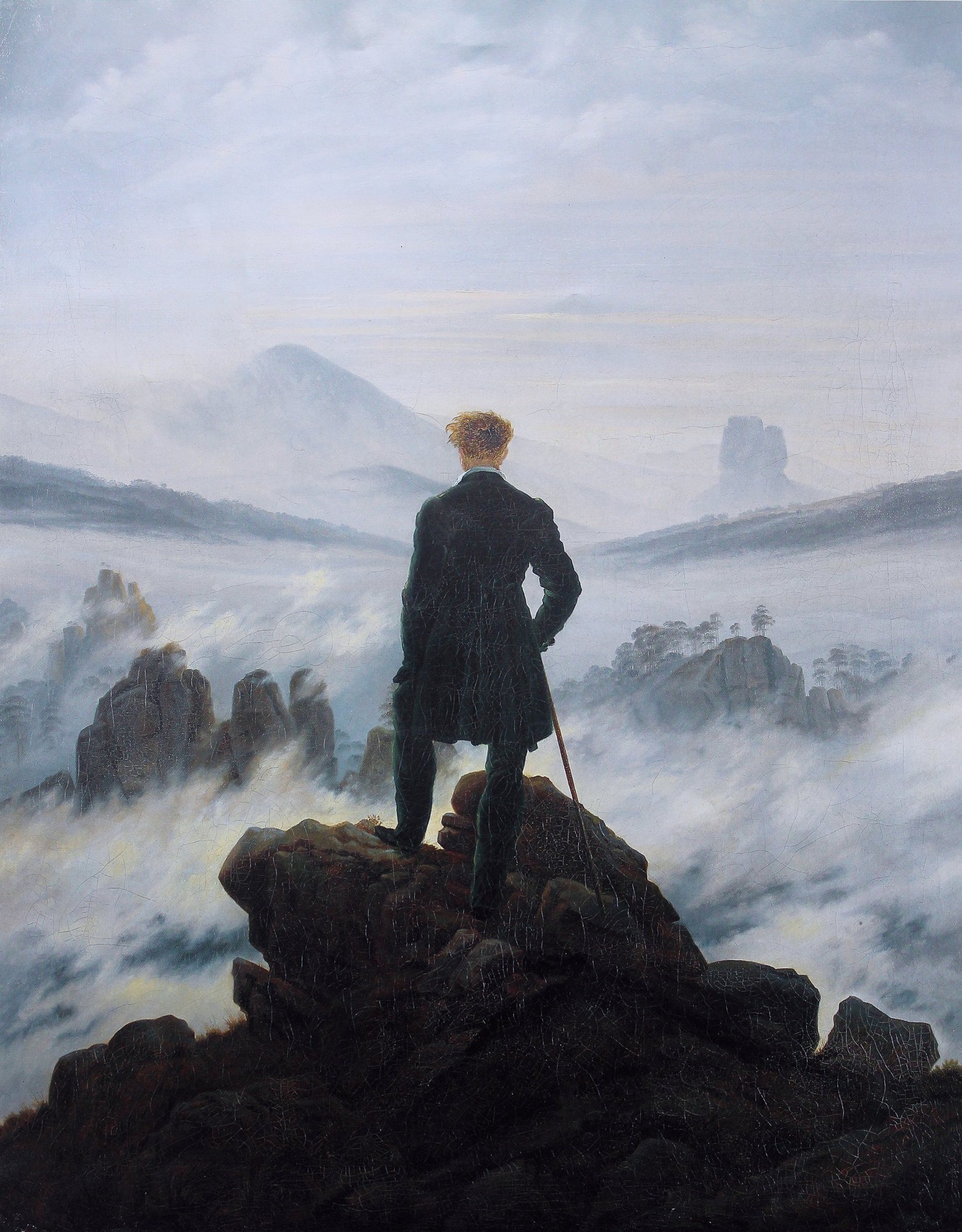
Wanderer above the Sea of Fog
This landscape does not exist. Every peak in it is real and identifiable — Friedrich sketched them across the Elbe Sandstone Mountains over years — but no vantage point in Saxony shows them arranged this way. He assembled the view in his studio from drawings, then painted it in a room he had deliberately stripped bare. Visitors described the space as empty: no pictures, no furniture, nothing but an easel and a palette.
Quick Facts
- Artist: Caspar David Friedrich (1774–1840)
- German title: Der Wanderer über dem Nebelmeer
- Year: c. 1818
- Medium: Oil on canvas
- Dimensions: 94.8 × 74.8 cm
- Movement: Romanticism
- Location: Hamburger Kunsthalle, Hamburg
What makes this painting unforgettable?
Most paintings invite you in. This one turns its back on you.
The device has a name: Rückenfigur, the figure seen from behind. Friedrich did not invent it, but he made it a principle. In his work almost nobody looks at the viewer.
The effect is that you do not observe the wanderer. You stand where he stands and look at what he looks at. The painting is empty enough for anyone to occupy.
It also refuses to resolve. There is no narrative, no incident, no answer — just a man facing weather.
The landscape is real. The view is not
This is worth knowing because it changes how you read the picture.
The rocks are identifiable. They come from the Elbe Sandstone Mountains in Saxony, an area Friedrich walked and sketched repeatedly. The summit the figure stands on is usually identified as the Kaiserkrone or the Zirkelstein. The peaks behind include the Rosenberg and the Zirkelstein.
But they do not sit together like this in nature. Friedrich never painted outdoors. He collected drawings on walking tours, returned to the studio, and built landscapes that cannot be found.
His studio was famously bare. Contemporaries noted there was nothing in it — no decoration, no pictures on the walls. He worked from memory in a room emptied of distraction.
Historical context
1818. The Napoleonic Wars had ended three years earlier at Waterloo, but the aftershocks were still running through the continent. Germany remained a patchwork of states, and the question of national identity was open and urgent.
Friedrich had a personal stake in this. He was an outspoken German patriot and hostile to French occupation. In 1813–14 he painted works in which the forest hides fallen riflemen. After the Congress of Vienna dashed hopes of unification and constitutional reform, his work turned noticeably darker.
Romanticism was in part a revolt against Enlightenment rationalism. Artists began to treat nature as a language through which something larger than man speaks. Friedrich spoke it more clearly than anyone.
There is a private context too. In January 1818, aged forty-three, Friedrich married Caroline Bommer. The painting dates from roughly that year — the calmest stretch of his life.
What to look for
The figure. He holds a walking stick and wears a dark green Altdeutsche Tracht — old German dress, associated at the time with nationalist and anti-French sentiment. His red hair is disordered by wind.
The fog. Not weather. In Friedrich, fog is the limit of knowledge. The ridges breaking through it are points of certainty in a sea of not-knowing.
The light. Diffuse, cool, with no visible source. Everything is lit from within. This is metaphysical light, not physical.
The composition. The figure sits precisely on the vertical axis. He is central and simultaneously small. Nature surrounds and exceeds him.
The other reading. Here is what rarely gets said: he has run out of places to go. He stands on a summit with fog below and nothing ahead. This is not a conquest pose. It is a man stopped at an edge.
About Caspar David Friedrich
Friedrich was born in 1774 in Greifswald on the Baltic coast, in a town then belonging to Sweden. Sea, fog, and open sky surrounded him from childhood.
His childhood was marked by death. His mother died when he was seven; two sisters died of typhus and smallpox. When he was thirteen, his brother Johann Christoph drowned in a frozen pond — most accounts say while rescuing Caspar, who had fallen through the ice. The scene returns in his painting for the rest of his life.
He trained in Copenhagen, then settled in Dresden. He was deeply religious and reserved, and he believed a landscape could function as a prayer.
In 1835 a stroke left him unable to work in oils. He died in 1840, poor and largely forgotten.
A hundred years of absence
The reception history of this painting is nearly as interesting as the painting.
After Friedrich’s death his work was considered outdated. The Wanderer passed into private hands and vanished from view. It was first shown publicly in 1906, at a large exhibition of German art in Berlin — sixty-six years after the artist died.
The rediscovery was late and violent. Symbolists and Expressionists claimed him as a forerunner.
Then, in the 1930s, Nazi propaganda appropriated Friedrich as the painter of German blood and soil.
This had consequences. After 1945 his work carried that association, and many scholars avoided him for two decades. Full rehabilitation came with a major exhibition at the Tate Gallery in 1972.
In 2024, for the 250th anniversary of his birth, Hamburg, Berlin, and Dresden mounted large retrospectives. Attendance broke records.
Legacy and influence
The composition — a solitary figure looking into the distance — has become an archetype. It appears on album covers, film posters, advertising, and memes, usually with no awareness of its origin.
Friedrich’s influence runs through Symbolism, Expressionism, and nineteenth-century American landscape painting. Mark Rothko cited his empty spaces as a reference point for his own work.
Where to see it today
The painting is in the Hamburger Kunsthalle, in central Hamburg, a few minutes’ walk from the main station.
- Check opening hours and prices on the museum’s website before you travel. Weekdays are considerably quieter than weekends.
- It hangs in the nineteenth-century galleries alongside other Friedrich works, including The Sea of Ice and Morning.
- Get close. This is a small canvas — under a metre tall. Up close you can see that the fog is built from very thin, translucent layers of paint.
- Friedrich’s other major holdings are at the Alte Nationalgalerie in Berlin and the Galerie Neue Meister in Dresden — three German cities, three collections.
Frequently asked questions
Who is the man in the painting?
Unknown. One hypothesis names Friedrich Gotthard von Brincken, a Saxon infantry officer; another argues it is a self-portrait. Friedrich never explained, and the figure’s red hair does resemble his own.
Is this a real place?
Partly. The individual peaks come from the Elbe Sandstone Mountains and are identifiable. But Friedrich combined them into an arrangement that does not exist. He painted in the studio, from sketches.
Why does the figure face away?
It is a deliberate device called Rückenfigur. The viewer does not watch the subject but looks with him. Friedrich used it in almost every painting that contains people.
Is the painting optimistic?
That depends on the reading. It can be seen as man triumphing over nature — or the opposite: a figure at an edge, with no way forward and everything below obscured. Friedrich usually painted solitude rather than victory.
Why did it only become famous in the twentieth century?
Friedrich’s work was considered outmoded after his death, and this painting stayed in private collections. Its first public showing was in Berlin in 1906. Recognition followed from the Symbolists and Expressionists.
How large is it?
94.8 × 74.8 cm. Reproductions make it look monumental; it is intimate.
If Wanderer above the Sea of Fog has caught your interest, look next at Liberty Leading the People by Delacroix and The Third of May 1808 by Goya — three Romantic paintings, three entirely different answers to the same question about where the individual stands in history.
Image: Wanderer above the Sea of Fog – Caspar David Friedrich (c. 1818). License: Public Domain. Source: Wikimedia Commons.