The Thinker
One cast of this sculpture has had its legs blown apart, and the museum decided to leave it that way. In March 1970 someone planted explosives beneath the cast outside the Cleveland Museum of Art. After consulting the Musée Rodin, Cleveland concluded that restoring it would be a forgery. It stands by the entrance today, torn open at the base — a sculpture about thinking, mutilated by an act of its absence.
Quick Facts
- Artist: Auguste Rodin (1840–1917)
- Original model: c. 1880–1881, 71.5 cm
- Monumental version: enlarged 1903–1904, c. 180 cm
- Medium: bronze
- Movement: Romanticism, precursor to modern sculpture
- Location: Musée Rodin, Paris, and casts worldwide
What makes it unforgettable?
Most monuments celebrate triumph — a general on horseback, a saint with a halo, a hero mid-gesture. This one shows a man sitting still.
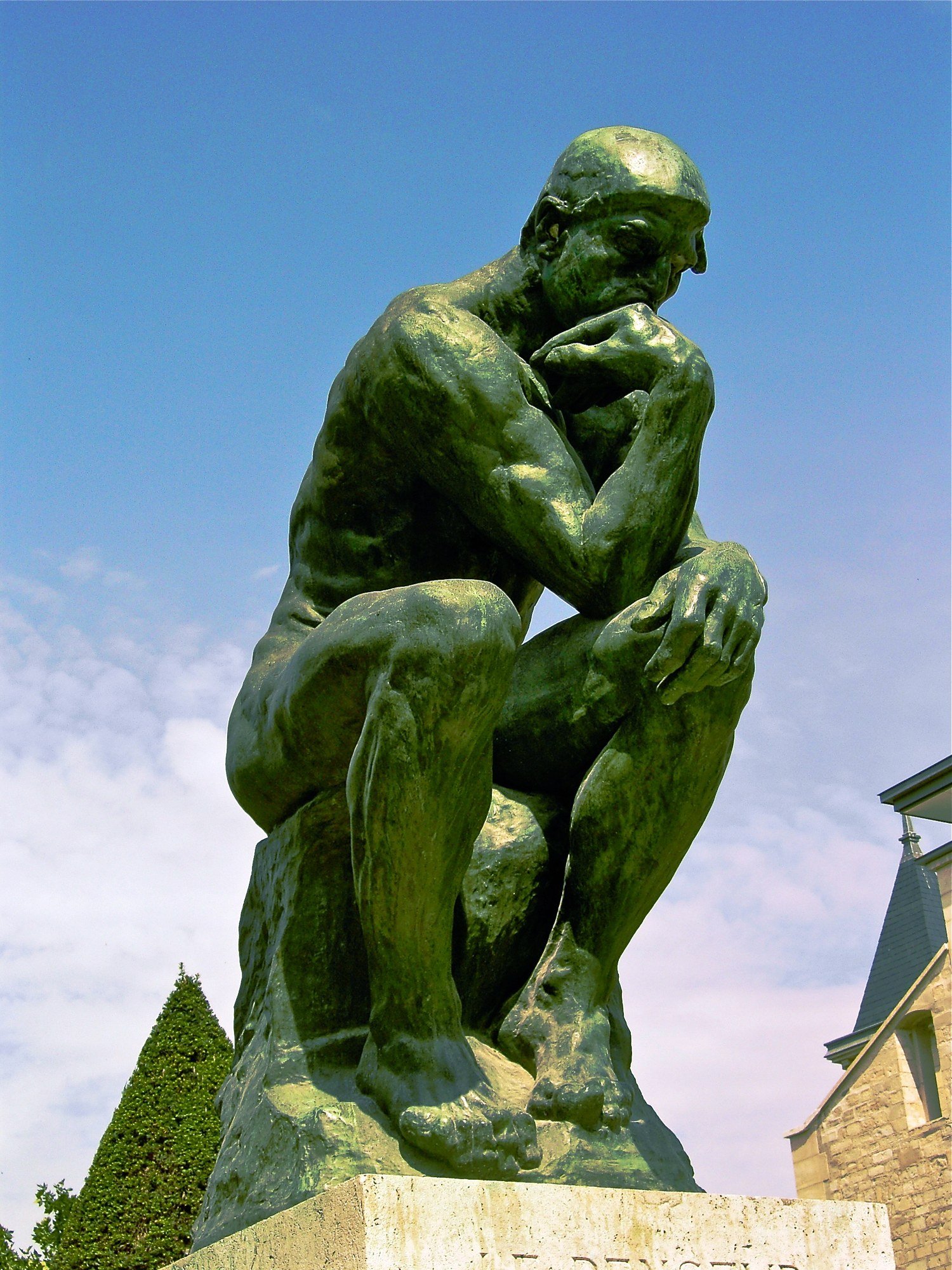
What separates it from every other depiction of contemplation is the body. The figure is built like a wrestler, and every part of that physique is doing one thing: thinking. Rodin does not separate intellect from flesh. He makes thought look like labour.
It helps to compare it with the tradition. In Western art, a pensive figure usually rests the chin on the fingers, in a gesture of elegant melancholy. Here there is no elegance. There is weight.
Where it came from
In 1880 the French government commissioned Rodin to design bronze doors for a planned museum of decorative arts. The subject was to be Dante’s Divine Comedy.
Rodin worked on The Gates of Hell for thirty-seven years, until his death. He never finished them, and the museum they were made for was never built. The composition holds around two hundred figures, many of which he later extracted and turned into independent sculptures — The Kiss among them.
The figure we know as The Thinker sat on the tympanum above the doors, looking down at the damned. Rodin called it Le Poète — the Poet. It was meant to be Dante contemplating his own work.
The name The Thinker came later, and not from the artist. It originated with the foundry workers in his studio.
In 1903 the sculptor Henri Lebossé produced a mechanical enlargement. The monumental version appeared at the Salon in 1904, and it was at that point that the figure stopped being a fragment and became itself.
Historical context
This was a period of upheaval. France was in the Belle Époque, and the art world was fracturing — Impressionism had already broken painting open, but sculpture remained bound to academic convention: smooth surfaces, ideal proportions, mythological subjects.
Rodin broke that. His figure does not look like a classical god. It looks like a tired man.
The placement of the monumental version was political. In 1906 a cast was bought by public subscription — not by the state — and installed in front of the Panthéon in Paris. That was a republican and leftist gesture: a monument to thought, rather than to power, in front of the national shrine. It was moved to the garden of the Hôtel Biron in 1922.
What to look for
The twist. The right elbow rests on the left knee. Try it yourself — it is anatomically awkward and physically uncomfortable. Rodin chose it deliberately, because it makes the body work against itself.
The hand. It is the back of the hand, not the fingers, that touches the mouth. The gesture reads as suppression rather than reverie.
The feet. The toes are curled and gripping the rock. It is easy to miss, and it tells you as much as the face does.
The surface. Rodin left fingerprints and tool marks in the clay, and the bronze reproduces them faithfully. In raking light you can see that this is not a polished form but something still being made.
The face. Partly obscured, legible only from close range or from the side. Rodin did not want the expression to carry the meaning — the posture does that.
Walk around it. In Paris it stands in the open garden, so you can. From behind, the tension across the back is obvious in a way it never is from the front.
About Auguste Rodin
Rodin failed the entrance examination to the École des Beaux-Arts three times. He spent years working as a craftsman, a ceramic decorator, and an assistant to other sculptors. Until he was thirty-five he was essentially nobody.
The breakthrough was The Age of Bronze, shown in 1877 — so lifelike that he was accused of casting it directly from a living model. He had to defend himself publicly and produce witnesses. The scandal made his name.
He died in 1917 at Meudon, outside Paris. A cast of The Thinker stands over his grave, which was his own wish.
Legacy and influence
Rodin’s willingness to leave surfaces rough, to exhibit fragments, and to treat the body as a vehicle for psychological content opened the door that Brâncuși and Giacometti later walked through. Modern sculpture begins here.
Culturally, the image is shorthand for intellectual life. It appears in cartoons, advertising, and film with a frequency few artworks can match.
There are roughly twenty-eight authorised monumental casts worldwide, plus a much larger number of smaller versions. It is worth knowing that French law permits posthumous casting from an artist’s original moulds — up to twelve examples are legally considered originals. This is why some casts of The Thinker were made decades after Rodin’s death and are still regarded as his work rather than reproductions.
The Cleveland cast
This is the strangest chapter in the sculpture’s history.
On 24 March 1970, an explosive device detonated beneath the cast standing outside the Cleveland Museum of Art. The blast destroyed the lower portion — the feet and base. No one was ever charged; suspicion fell on the radical group Weather Underground.
The museum chose not to repair it. After consulting the Musée Rodin, it decided that reconstructing the missing sections would amount to falsification. The cast now stands at the museum entrance exactly as the bomb left it, legs torn open.
There is something in this that Rodin did not plan: a sculpture about thought, damaged by an act of its opposite, and displayed for precisely that reason.
Where to see it today
The best-known monumental cast stands in the garden of the Musée Rodin at 77 rue de Varenne in the 7th arrondissement of Paris, in the grounds of the Hôtel Biron, where Rodin had his studio.
- A garden-only ticket costs considerably less than full admission — and The Thinker, The Gates of Hell and The Burghers of Calais are all in the garden. If those are what you came for, you do not need the full ticket.
- Check opening hours and prices before you travel; the museum is normally closed on Mondays.
- Come early. The garden is empty in the first hour and you can walk around the sculpture without a crowd.
- See The Gates of Hell, a few metres away. The figure appears there in its original place and scale, small, above the doors, looking down.
- The Hôtel des Invalides, with Napoleon’s tomb, is a short walk away.
Other casts stand outside the Rodin Museum in Philadelphia, at the National Museum of Western Art in Tokyo, the Kunsthaus Zürich — and, in its damaged state, outside the Cleveland Museum of Art.
Frequently asked questions
Who does the figure represent?
Originally Dante Alighieri, contemplating the world of the Divine Comedy. Rodin called it The Poet. The title The Thinker came from his foundry workers, and over time the figure detached from its literary source.
How many casts exist?
Around twenty-eight at monumental scale, plus many smaller versions. French law permits up to twelve posthumous casts from an artist’s original moulds to be considered originals, which is why some were produced after Rodin’s death.
Why is the figure nude?
Nudity in sculpture traditionally signified truth and the stripping away of social convention. Rodin used it to insist that thinking is a fundamentally human act, independent of dress, rank, or period.
Was one of the casts destroyed?
Damaged, not destroyed. In March 1970 a bomb blew apart the lower section of the cast outside the Cleveland Museum of Art. The museum deliberately chose not to restore it, and it remains on display in that condition.
Where is the most significant cast?
The one in the garden of the Musée Rodin in Paris. It was purchased by public subscription in 1906 and originally installed in front of the Panthéon, then moved to the museum garden in 1922.
Was Rodin a Romantic or a modernist?
Formally he is classed with Romanticism, but he is widely regarded as the beginning of modern sculpture. He combined Romantic emotional intensity with a refusal of academic finish.
If The Thinker has caught your interest, look next at Michelangelo’s David — another sculpture of a man in the moment before action, carved four centuries earlier, from a different material and with an entirely different intention.
Image: The Thinker – Auguste Rodin (monumental version, 1903–1904). License: Public Domain. Source: Wikimedia Commons.