Along the River During the Qingming Festival
This scroll is five metres long and you cannot take it in at once. It was never meant to be. A Chinese handscroll is viewed in motion — unrolled with the right hand, rolled up with the left, about shoulder-width at a time. It is the only art form in which the viewer controls the pace of the narrative.
Quick Facts
- Artist: Zhang Zeduan (c. 1085–1145)
- Chinese title: Qingming shanghe tu (清明上河圖)
- Date: early 12th century, before 1127
- Medium: Ink and colour on silk, handscroll
- Dimensions: 24.8 × 528.7 cm
- Period: Northern Song dynasty
- Location: Palace Museum, Beijing
How it is meant to be seen
Start here, because the format determines everything else.
A handscroll is not hung. It was kept rolled in a box and brought out for a specific occasion, usually viewed by a small group at a table, one section at a time.
It reads right to left. The scroll opens in the countryside, among willows and donkeys carrying charcoal. Then the river appears, traffic thickens, everything culminates at the bridge. Beyond it the city begins — a gate, streets, shops, crowds.
This is narrative distributed through time, not composition distributed through space. The viewer never sees the whole thing at once and was never supposed to. Reproductions that show the entire scroll in one strip show something no one has ever actually looked at.
What makes it unforgettable?
Zhang Zeduan did not paint a court, a battle or a deity. He painted a city at work.
Counts vary, but researchers generally find around 800 human figures, close to 30 boats, 60 animals and several dozen buildings. Among them: merchants, porters, monks, beggars, children, officials in sedan chairs, a fortune teller, a physician with a signboard, innkeepers.
The centre of the scroll is the Rainbow Bridge. A grain barge is entering the arch at the wrong angle, the crew hauling frantically on ropes, people on the bridge shouting and waving, someone throwing a line down. It is the moment before a possible collision — the only passage in the entire scroll where something is genuinely happening.
The bridge itself is remarkable. A timber arch with no pier in the channel — an engineering solution described in Song sources as a regional speciality. This scroll is now the principal visual source for scholars reconstructing how it was built.
The title problem
This is the most interesting unresolved question about the painting, and it rarely gets mentioned.
Qingming is the spring festival when graves are swept and families walk out into the countryside. The title has been understood that way for centuries.
But the evidence on the scroll is awkward. There are watermelon sellers, people in light summer clothing, and fans in use. None of that belongs to early April.
Several alternative readings have been proposed. Qingming can also mean “peace and order,” suggesting a title along the lines of “going up the river in a time of good government.” Others have argued it refers to a district of the city rather than a season.
The debate has run for decades without resolution. What it tells you is that even the name of the most famous painting in China is not settled.
Historical context
Bianjing — modern Kaifeng — was the Northern Song capital and probably the largest city in the world at the time, with something approaching a million inhabitants.
More importantly, it was a city of a new kind. The Song abolished the older system of walled market wards and night curfews. Shops could open onto the street and business carried on after dark. The scroll shows exactly that arrangement: commerce spilling out of buildings, stalls against walls, taverns open to passers-by.
In 1127 it ended. The Jurchen Jin took Bianjing, carried off the emperor Huizong and his son, and the Song court fled south. The city was sacked.
The scroll survived. It is now one of the few surviving records of what that city looked like.
What to look for
The opening is quiet. The first section is mist, willows and a farmer with donkeys. Zhang builds contrast before the crowd arrives.
The bridge scene. If you look at one passage, look at this one. Count how many people react to the emergency, and in how many different ways.
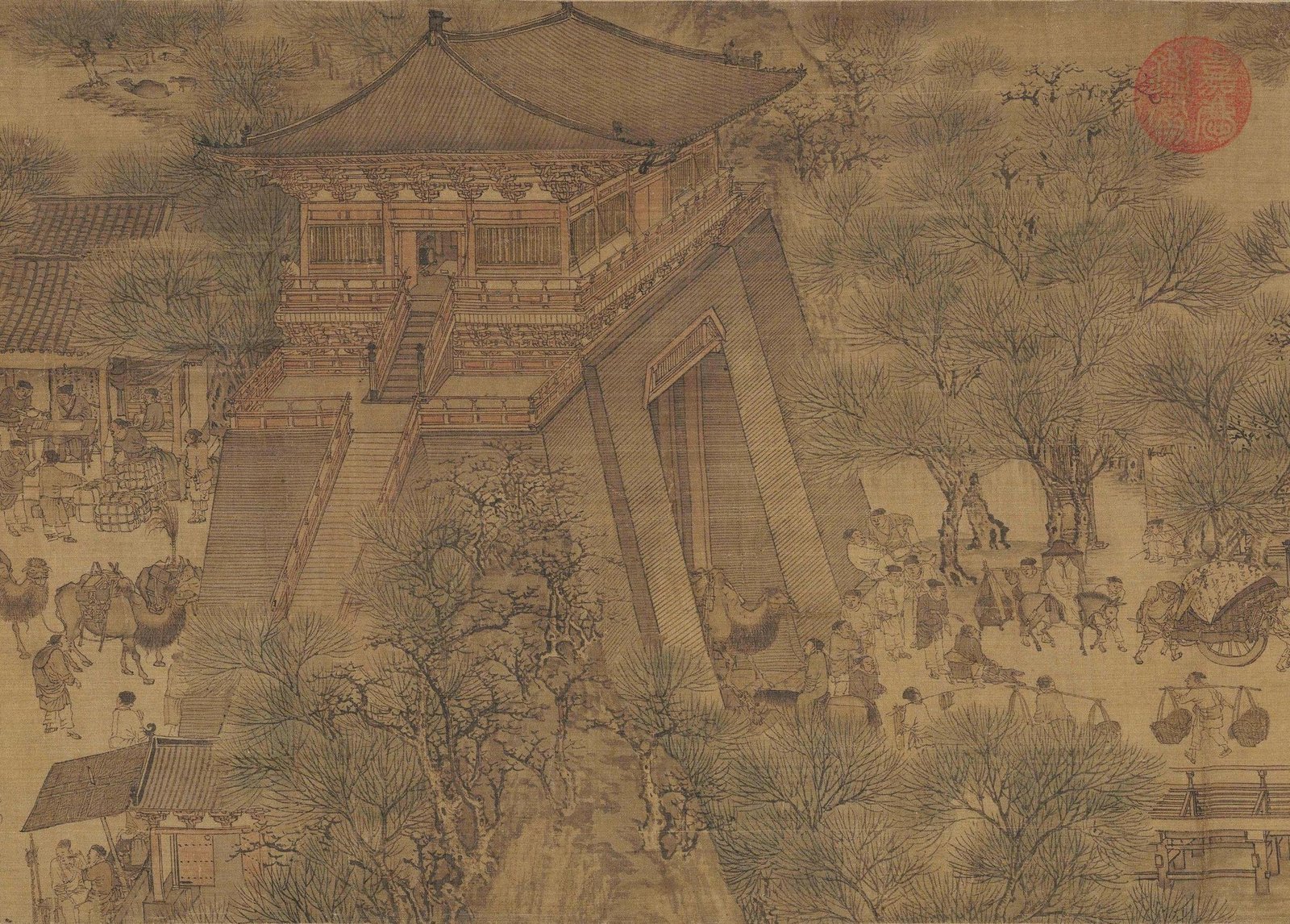
Camels at the gate. A caravan entering through the main city gate — a trace of the Silk Road in the middle of a Chinese capital.
Signboards. Painted shop signs, tavern banners, a physician’s advertisement. These are among the earliest depictions of urban commercial signage anywhere.
People doing nothing. Onlookers at the bridge, men drinking tea, a child pulling at an adult’s sleeve. Zhang painted idleness, which in court painting was unthinkable.
The ending stops abruptly. The scroll breaks off mid-street, without resolution. Some scholars believe a final section was lost; others argue it is deliberate.
About Zhang Zeduan
We know remarkably little, and nearly all of it comes from a single source.
In 1186 a Jin-dynasty official named Zhang Zhu added a colophon to the end of the scroll. It records that Zhang Zeduan came from Shandong, studied in the capital, belonged to the imperial painting academy, and specialised in jiehua — ruled-line architectural painting requiring draughtsman’s precision.
That is essentially everything. No other work is securely attributed to him. One scroll, one note, and a permanent place in the canon.
It is worth adding that jiehua ranked low in the hierarchy of Chinese painting — technical, artisanal, inferior to the scholar’s landscape. Zhang took the despised genre and made a masterpiece out of it.
How many versions exist
Dozens, and the confusion between them is the source of most errors about this work.
The Ming version, attributed to Qiu Ying in the sixteenth century, relocates the scene to contemporary Suzhou. Different clothing, different architecture, different world.
The Qing version was produced in 1736 by five court painters for the Qianlong emperor. It runs to over eleven metres — more than twice the original — and is far more colourful. It is in the National Palace Museum in Taipei.
Figures of nine or eleven metres quoted for “the” scroll almost always come from this version rather than Zhang’s.
The original itself had a turbulent history, entering and leaving imperial collections, being stolen and recovered. In 1945 it was found in the luggage of the last emperor, Puyi, detained in Manchuria.
Legacy and influence
In China the scroll functions as a national image; the comparison to the Mona Lisa is made there routinely.
At Expo 2010 in Shanghai an animated version was shown, six metres high and 120 metres long, in which the figures move and the scene shifts from day to night. It became the main attraction of the China Pavilion and afterwards toured several Asian cities.
For historians it remains a primary source on twelfth-century urban life — everything from bridge construction to boat types to the cut of clothing.
Where to see it today
The scroll is in the Palace Museum in Beijing, inside the Forbidden City.
- It is displayed very rarely. Silk and pigment are extremely light-sensitive; it comes out once every several years, for a short period.
- When it does, queues are extraordinary. During the 2015 showing people waited up to six hours, and the phenomenon acquired a nickname — the “Qingming sprint,” from visitors running through the gates at opening to secure a place.
- Check the museum’s exhibition schedule before travelling. Assuming it will be on view is the commonest mistake.
- The museum offers a high-resolution interactive version online. For this work that is a genuine alternative, because it lets you scroll through as the format intends.
- The permanent collection includes Song ceramics and calligraphy that give the context.
The Qing version can be seen at the National Palace Museum in Taipei — also on rotation.
Frequently asked questions
How long is the scroll?
The original is 528.7 cm long and 24.8 cm high. The Qing court version, often confused with it, exceeds eleven metres.
Does it really show the Qingming festival?
That is disputed. The traditional reading says yes, but the scroll shows watermelon sellers, fans and summer clothing, which do not fit early April. Some scholars argue qingming here means “peace and good order” rather than the festival.
How many figures are there?
Around 800, along with close to 30 boats, 60 animals and several dozen buildings. Exact counts differ depending on method.
Are there other paintings by Zhang Zeduan?
None securely attributed. Almost everything known about him comes from a colophon added to the scroll in 1186.
Can I see it in Beijing?
Only during rare special exhibitions, held every few years. The rest of the time it is in storage because of the fragility of the silk.
Why does it end so abruptly?
Nobody knows. Some scholars think a closing section was lost; others believe Zhang deliberately broke off mid-street, leaving the impression that the city continues without the viewer.
If this scroll has caught your interest, look next at the Japanese woodblock tradition — The Great Wave off Kanagawa and Red Fuji — made seven centuries later, but growing from the same East Asian approach to depicting space without vanishing points.
Image: Qingming shanghe tu (detail) – Zhang Zeduan, early 12th century, Palace Museum, Beijing. License: Public Domain. Source: Wikimedia Commons.