Rain, Steam and Speed – The Great Western Railway
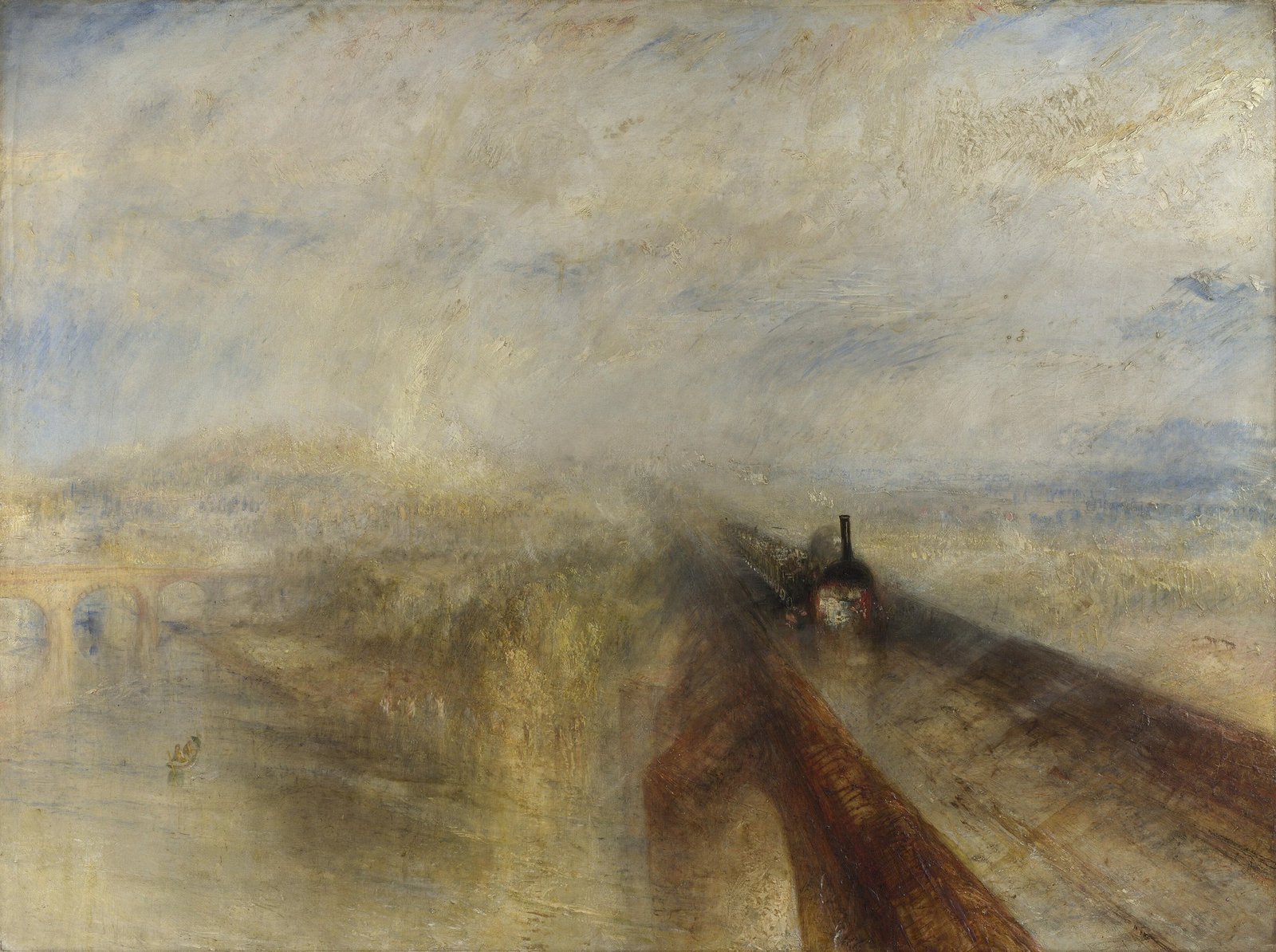
There is a hare in this painting and most people never find it. It runs on the track, ahead of the locomotive, on the right-hand side — a dark streak against dark ground. According to the painter George Dunlop Leslie, who as a child watched Turner finishing the canvas on varnishing day, that animal, and not the engine, was meant to stand for speed.
Quick Facts
- Artist: J. M. W. Turner (1775–1851)
- Full title: Rain, Steam, and Speed – The Great Western Railway
- Exhibited: Royal Academy, 1844
- Medium: oil on canvas
- Dimensions: 91 × 121.8 cm
- Movement: Romanticism
- Location: National Gallery, London
The hare
It is the best detail in the painting and it deserves its own section.
Where to look: on the rails, ahead of the engine, towards the right of the composition. It runs in the same direction as the train, towards the viewer.
It is tiny, dark and laid in with a few strokes. On reproductions it is effectively invisible; in front of the canvas you need to know where to aim your eye. Plenty of visitors stand there and never see it.
Leslie’s account is unambiguous: the hare was there to carry the idea of speed. Not the locomotive.
That changes the reading. If the emblem of speed is a live animal fleeing a machine, the painting is saying something other than the familiar story about the triumph of technology.
It is worth adding that in English tradition the hare stood for both sudden motion and fragility — and it was game.
What makes it unforgettable?
This is among the first paintings in Western art to take the railway as its subject.
And it does so in a way contemporaries found either scandalous or brilliant. Almost nothing is drawn. Rain, steam and motion merge into a single atmospheric mass out of which only the black front of the engine and the line of the bridge emerge.
Turner worked with a knife, with his fingers and with thickly loaded paint. A reviewer in Fraser’s Magazine wrote that the rain had been laid on with a palette knife and dirt, and the light was a smear of yellow — and that the result was nonetheless astonishing.
The firebox is the brightest point on the canvas, and it is built not from red alone but from a set of colours chosen for optical effect rather than description.
Historical context
The Great Western Railway, engineered by Isambard Kingdom Brunel, was a technical marvel. It ran from London to Bristol, and its broad gauge allowed speeds beyond the reach of competitors.
The location is identifiable: the Maidenhead railway bridge over the Thames, completed in 1838. Its brick arches were the flattest and widest in the world at the time, and critics predicted they would fall. They are still standing and still carry trains.
The locomotive belongs to a class designed by Daniel Gooch, who became the GWR’s locomotive superintendent at twenty-one. The individual engine has never been identified.
Turner showed the painting at the Royal Academy in 1844. He was sixty-nine.
A caution about interpretation. Turner travelled by rail regularly and left no word of criticism of it. Readings that treat the painting purely as a lament for a lost natural world go beyond the evidence.
What to look for
The two bridges. On the left the older road bridge, on the right the new railway bridge. In reality they run nearly parallel; Turner pushed them apart and steepened the angle to sharpen the contrast between old and new.
The boat. On the river below, a small rowing boat. A third means of travel, and the oldest of the three.
Figures on the bank. Left side, a group of small figures. Some readings see dancing girls, others farmworkers. Turner left them deliberately illegible.
The track. One line in the painting; two in reality. Another change made for the composition.
The surface. Get very close. You can see knife marks, thick lumps of paint, passages smeared with a finger. Then walk back five metres and it turns into rain.
The direction. The train comes straight at the viewer, on the diagonal. One of the earliest compositions in painting to put the spectator on the track.
About J. M. W. Turner
Born in 1775 in Covent Garden, the son of a barber. His mother died in an asylum.
He entered the Royal Academy Schools at fourteen and exhibited there for half a century. He began with topographical watercolours and ended with paintings so dissolved that many critics took them for unfinished.
Constable said Turner painted with tinted steam. It began as an insult.
In his last years he lived in Chelsea under an assumed name, as “Mr Booth”. He died in 1851.
He left the nation around three hundred oil paintings and close to thirty thousand works on paper. This painting came to the National Gallery by that bequest, in 1856.
Turner and the Impressionists
The link is better documented than usually supposed.
Monet and Pissarro spent the winter of 1870–71 in London, having left France during the Franco-Prussian War. Both saw Turner’s paintings, and both later described the encounter as decisive.
More striking still: an etching by Félix Bracquemond after this painting was shown at the first Impressionist exhibition in 1874. Turner was therefore present, at one remove, at the event that gave the movement its name.
Some proportion is needed, though. Monet later played down Turner’s importance for his own work, and scholars regard his attitude as ambivalent.
What it means
Three readings, all in circulation.
The elements. The title names rain, steam and speed — three forces, not a machine. John Gage argued that Turner was painting an allegory of nature in which the train is one component among others.
Progress. Turner admired technology, used the railway, and showed it at a moment of triumph.
The cost of progress. The hare fleeing the locomotive is nature losing to the machine.
All three appear in the literature. Turner left no guidance.
Where to see it today
The painting hangs in the National Gallery on Trafalgar Square. Entry to the permanent collection is free.
- Room numbering and names changed with the rehang completed in 2025 — use the plan on site or the gallery’s app.
- Check that it is in the building. It travels to exhibitions abroad.
- Look for the hare. The track, ahead of the engine, right-hand side. Give it a minute.
- Approach and retreat. From half a metre it looks like chaos worked with a knife; from five metres it is weather.
- In the same gallery: The Fighting Temeraire by Turner and The Hay Wain by Constable.
- The main Turner collection is at Tate Britain, twenty minutes’ walk along the river — several hundred works in the Clore Gallery.
The bridge is still there, at Maidenhead, about forty kilometres west of London, and still in use.
Frequently asked questions
Where is the hare?
On the track ahead of the locomotive, towards the right, running towards the viewer. It is small and dark and easily missed. According to a witness to the painting’s completion, it was intended to represent speed.
What place is this?
The Maidenhead railway bridge over the Thames, designed by Isambard Kingdom Brunel and completed in 1838. Its brick arches were the flattest in the world when built. The bridge still stands.
Was Turner criticising the railway?
There is no evidence for it. He travelled by train regularly and left no critical remark. Readings that treat the painting solely as a protest against industry are contested.
What did Turner change?
He separated two bridges that in reality run almost parallel, and reduced a double track to a single line. Both changes serve the composition rather than the record.
How did it reach the museum?
Through the Turner Bequest — the terms of the artist’s will, under which around three hundred oil paintings passed to the nation. It entered the National Gallery in 1856.
What is its connection to Impressionism?
Monet and Pissarro saw Turner’s work in London in the winter of 1870–71. An etching after this painting by Félix Bracquemond was shown at the first Impressionist exhibition in 1874.
If this painting has caught your interest, look next at The Fighting Temeraire — painted five years earlier and hanging in the same gallery. There Turner was still mourning the world of sail; here he is watching what replaced it.
Image: Rain, Steam, and Speed – The Great Western Railway – J. M. W. Turner (1844). License: Public Domain. Source: Wikimedia Commons.